




Draw a graph to convert miles to kilometres, given 1 mile = 1.6 km. Use the graph to find
(i) How many kilometres are approximately equal to 4.5 miles?
(ii) How many miles are approximately equal to 8 km?
Answer
 Verified
631.5k+ views
Hint: We know that 1 mile is equal to 1.6 kilometres. Let the distance in kilometres be x and the distance in miles be y, then the relation between miles and kilometres will be $ 1 = 1.6 \times m $ , where m is the slope. Find the value of the slope and substitute it in the line equation when slope and intercept are given, and then using it plot the graph.
Complete step-by-step answer:
We are given to draw a graph to convert miles into kilometres and the value of one mile is equal to 1.6 kilometres.
The line equation when a slope and y-intercept are given is $ y = mx + c $ , where m is the slope and c is the y-intercept.
Let the distance in kilometres be x and the distance in miles be y.
Then we can relate miles and kilometres as $ y = mx \to 1mile = m \times 1.6km $ , where m is the slope.
Slope is $ m = \dfrac{1}{{1.6}} = \dfrac{{10}}{{16}} = \dfrac{5}{8} $
Now, substitute the slope in the line equation where the y-intercept is zero because when the distance is zero miles, the corresponding distance in kilometres is also zero.
$
y = mx + c \\
m = \dfrac{5}{8},c = 0 \\
\Rightarrow y = \dfrac{5}{8}x + 0 \\
\Rightarrow y = \dfrac{5}{8}x \\
$
Now using the line equation $ y = \dfrac{5}{8}x $ , plot the graph.
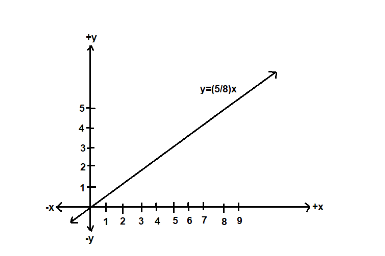
When the value of y is 4.5 miles then the corresponding value of x in kilometers is $ 4.5 = \dfrac{5}{8}x \to x = \dfrac{{4.5 \times 8}}{5} = 7.2km $
When the value x is 8 km then the corresponding value of y in miles is $ y = \dfrac{5}{8} \times 8 \to y = 5 miles $
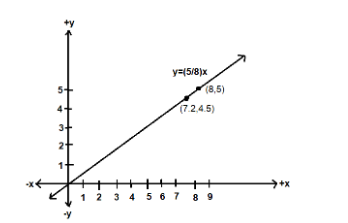
7.2 kilometres is 4.5 miles and 5 miles is 8 kilometres.
So, the correct answer is “Option C”.
Note: The slope of a line can be obtained by the ratio of change in y-coordinates to the change in x-coordinates. Slope is a constant value but it has units. The units of slope will be the ratio of y-units to the x-units. Here, the units of slope are miles per kilometres. So do not assume that the slope will not have units. Do not confuse graphs with charts as a graph is a type of chart, but not vice-versa. All graphs are charts, but all charts need not be graphs.
Complete step-by-step answer:
We are given to draw a graph to convert miles into kilometres and the value of one mile is equal to 1.6 kilometres.
The line equation when a slope and y-intercept are given is $ y = mx + c $ , where m is the slope and c is the y-intercept.
Let the distance in kilometres be x and the distance in miles be y.
Then we can relate miles and kilometres as $ y = mx \to 1mile = m \times 1.6km $ , where m is the slope.
Slope is $ m = \dfrac{1}{{1.6}} = \dfrac{{10}}{{16}} = \dfrac{5}{8} $
Now, substitute the slope in the line equation where the y-intercept is zero because when the distance is zero miles, the corresponding distance in kilometres is also zero.
$
y = mx + c \\
m = \dfrac{5}{8},c = 0 \\
\Rightarrow y = \dfrac{5}{8}x + 0 \\
\Rightarrow y = \dfrac{5}{8}x \\
$
Now using the line equation $ y = \dfrac{5}{8}x $ , plot the graph.
When the value of y is 4.5 miles then the corresponding value of x in kilometers is $ 4.5 = \dfrac{5}{8}x \to x = \dfrac{{4.5 \times 8}}{5} = 7.2km $
When the value x is 8 km then the corresponding value of y in miles is $ y = \dfrac{5}{8} \times 8 \to y = 5 miles $
7.2 kilometres is 4.5 miles and 5 miles is 8 kilometres.
So, the correct answer is “Option C”.
Note: The slope of a line can be obtained by the ratio of change in y-coordinates to the change in x-coordinates. Slope is a constant value but it has units. The units of slope will be the ratio of y-units to the x-units. Here, the units of slope are miles per kilometres. So do not assume that the slope will not have units. Do not confuse graphs with charts as a graph is a type of chart, but not vice-versa. All graphs are charts, but all charts need not be graphs.
Recently Updated Pages
Basicity of sulphurous acid and sulphuric acid are

Master Class 12 Economics: Engaging Questions & Answers for Success
Master Class 12 Biology: Engaging Questions & Answers for Success
Master Class 11 English: Engaging Questions & Answers for Success
Master Class 11 Physics: Engaging Questions & Answers for Success
Master Class 11 Computer Science: Engaging Questions & Answers for Success
Trending doubts
Difference Between Plant Cell and Animal Cell
Fill the blanks with the suitable prepositions 1 The class 9 english CBSE
What is pollution? How many types of pollution? Define it
What is the full form of pH?
What is the Full Form of ICSE, CBSE and SSC
Name 10 Living and Non living things class 9 biology CBSE