




Draw a diagram showing the expansion stroke of a steam engine.
Answer
 Verified
637.2k+ views
Hint: According to thermodynamics, there are two types of cycles, namely the two-stroke cycle and the four-stroke cycle. The four-stroke cycle engine contains four phases, namely, induction/intake stroke, compression stroke, combustion/power/ expansion stroke and the exhaust stroke.
Complete answer:
A steam engine is a heat engine which converts steam energy to mechanical energy, which it turns does work. The pressure produced by the steam is used to move the piston in the cylinder. It follows the principle of external combustion.
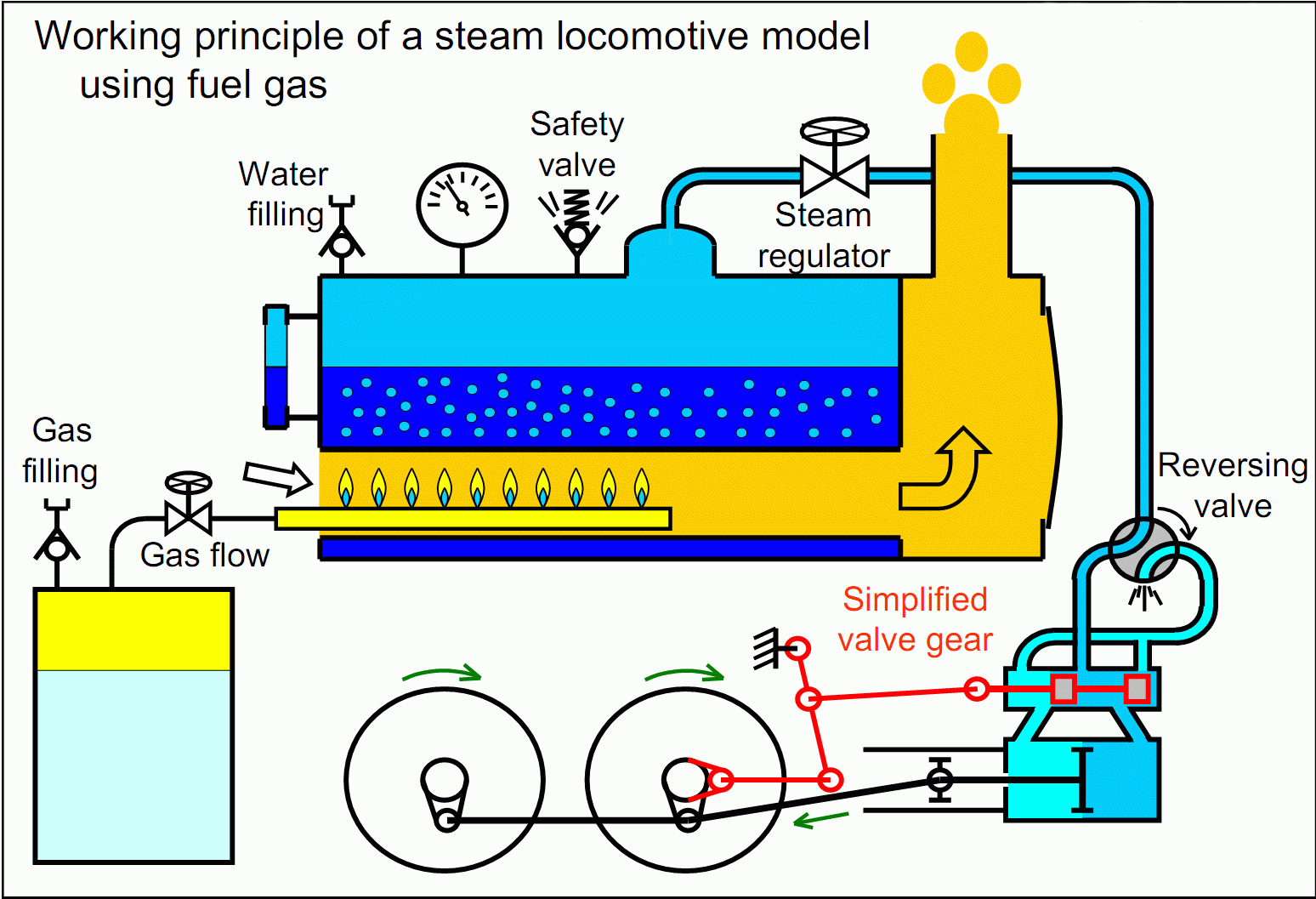
The thermodynamic cycles are described based on the number of strokes to complete a cycle.
Generally the stroke of an engine contains four phases, namely, induction/intake stroke, compression stroke, combustion/power/ expansion stroke and the exhaust stroke.
The induction/intake stroke:
Here the piston moves downward, creating a vacuum that draws the fuel into the combustion chamber.
The compression stroke:
Here the fuel is compressed by a piston. This results in reducing the volume of the fuel. Followed by the ignition of the fuel.
The combustion/power/expansion stroke:
Here the ignited fuel expands, and pushes the piston outward. This creates the necessary force to start the engine power.
The Exhaust stroke:
Here the piston moves inwards, pressing the gas. This pressure makes the gas exist the cylinder through the exhaust valve. When the process ends, the exhaust valve closes, while the intake valve opens, to take in fresh fuel.
Note:
According to thermodynamics, there are two types of cycles, namely the two-stroke cycle and the four-stroke cycle. There are two more cycles, namely the five-stroke and six-stroke cycle, which are less common. Also another important term used in steam engines, is the stroke length, which describes how far the piston travels in the cylinder.
Complete answer:
A steam engine is a heat engine which converts steam energy to mechanical energy, which it turns does work. The pressure produced by the steam is used to move the piston in the cylinder. It follows the principle of external combustion.
The thermodynamic cycles are described based on the number of strokes to complete a cycle.
Generally the stroke of an engine contains four phases, namely, induction/intake stroke, compression stroke, combustion/power/ expansion stroke and the exhaust stroke.
The induction/intake stroke:
Here the piston moves downward, creating a vacuum that draws the fuel into the combustion chamber.
The compression stroke:
Here the fuel is compressed by a piston. This results in reducing the volume of the fuel. Followed by the ignition of the fuel.
The combustion/power/expansion stroke:
Here the ignited fuel expands, and pushes the piston outward. This creates the necessary force to start the engine power.
The Exhaust stroke:
Here the piston moves inwards, pressing the gas. This pressure makes the gas exist the cylinder through the exhaust valve. When the process ends, the exhaust valve closes, while the intake valve opens, to take in fresh fuel.
Note:
According to thermodynamics, there are two types of cycles, namely the two-stroke cycle and the four-stroke cycle. There are two more cycles, namely the five-stroke and six-stroke cycle, which are less common. Also another important term used in steam engines, is the stroke length, which describes how far the piston travels in the cylinder.
Recently Updated Pages
What is BLO What is the full form of BLO class 8 social science CBSE

Explain the Treaty of Vienna of 1815 class 10 social science CBSE
10 examples of friction in our daily life
Draw a diagram of nephron and explain its structur class 11 biology CBSE
Write structures of the following compounds i 2 Chloro3methylpentane class 11 chemistry CBSE
A Paragraph on Pollution in about 100-150 Words
Trending doubts
Draw a labelled sketch of the human eye class 12 physics CBSE
Which are the Top 10 Largest Countries of the World?
Differentiate between homogeneous and heterogeneous class 12 chemistry CBSE
Draw ray diagrams each showing i myopic eye and ii class 12 physics CBSE
Which is the correct genotypic ratio of mendel dihybrid class 12 biology CBSE
What is the Full Form of PVC, PET, HDPE, LDPE, PP and PS ?