




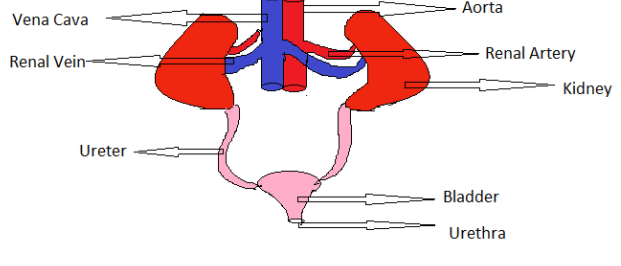
Draw a diagram of the human excretory system and label the various parts.
Answer
 Verified
607.2k+ views
Hint:The principal organ of the human excretory system is the kidneys. Every individual seems to have a pair of kidneys. Ureters are a small muscular tube that takes urine into the bladder from the kidneys. The bladder is a structure resembling a sac. A tube that arises from the urinary bladder is the urethra.
Complete answer:
First we should know about the human excretory system to answer this question. Every organism's survival relies on certain essential processes. One of them is excretion. Different animals adopt varying excretion modes. There is a specialised excretion mechanism in complex organisms, like humans, called the human excretory system. From different sources we all get our nutrients that are digested and metabolised in our body. The body continues to sort out beneficial and toxic compounds in an organism after metabolic reactions. The concentration of toxins can be dangerous, as we all know, and the body eliminates all metabolic waste by the excretion process.
The Human Excretory System comprises a pair of kidneys, a pair of ureters, a urinary bladder, and a urethra.
Kidneys: Kidneys are organs which are present in the form of beans situated on either side of the backbone and are covered by the back ribs and muscles. Through the hilum, which is a notch on the inner concave surface of the kidney, the blood vessels, ureters and nerves enter the kidneys. The renal pelvis is present within the hilum, a large funnel-shaped area.
Ureter: Each kidney extended from the renal pelvis emerges out a pair of thin muscular tubes known as the ureter. It transports water to the urinary bladder from the kidney.
Urinary bladder: It is a sac-like muscular structure which holds urine. The method of micturition, i.e. the process of urination, empties the urinary bladder.
Urethra: This tube originates from the urinary bladder which allows the body to remove urine. It serves as a natural route for sperm and urine in males. The sphincter muscles guard its opening.
Note:The most common excretion process in lower organisms is diffusion. The human body is an exceptional device in which various life processes (breathing, digestion, circulation, etc.) take place simultaneously. As a result, many of the waste products that our body produces come in different forms, including water, carbon dioxide, and nitrogen products such as ammonia, urea, and uric acid.
Complete answer:
First we should know about the human excretory system to answer this question. Every organism's survival relies on certain essential processes. One of them is excretion. Different animals adopt varying excretion modes. There is a specialised excretion mechanism in complex organisms, like humans, called the human excretory system. From different sources we all get our nutrients that are digested and metabolised in our body. The body continues to sort out beneficial and toxic compounds in an organism after metabolic reactions. The concentration of toxins can be dangerous, as we all know, and the body eliminates all metabolic waste by the excretion process.
The Human Excretory System comprises a pair of kidneys, a pair of ureters, a urinary bladder, and a urethra.
Kidneys: Kidneys are organs which are present in the form of beans situated on either side of the backbone and are covered by the back ribs and muscles. Through the hilum, which is a notch on the inner concave surface of the kidney, the blood vessels, ureters and nerves enter the kidneys. The renal pelvis is present within the hilum, a large funnel-shaped area.
Ureter: Each kidney extended from the renal pelvis emerges out a pair of thin muscular tubes known as the ureter. It transports water to the urinary bladder from the kidney.
Urinary bladder: It is a sac-like muscular structure which holds urine. The method of micturition, i.e. the process of urination, empties the urinary bladder.
Urethra: This tube originates from the urinary bladder which allows the body to remove urine. It serves as a natural route for sperm and urine in males. The sphincter muscles guard its opening.
Note:The most common excretion process in lower organisms is diffusion. The human body is an exceptional device in which various life processes (breathing, digestion, circulation, etc.) take place simultaneously. As a result, many of the waste products that our body produces come in different forms, including water, carbon dioxide, and nitrogen products such as ammonia, urea, and uric acid.
Recently Updated Pages
Master Class 12 Business Studies: Engaging Questions & Answers for Success

Master Class 12 Biology: Engaging Questions & Answers for Success
Master Class 12 Chemistry: Engaging Questions & Answers for Success
Class 12 Question and Answer - Your Ultimate Solutions Guide
Master Class 11 English: Engaging Questions & Answers for Success
Master Class 11 Social Science: Engaging Questions & Answers for Success
Trending doubts
Which are the Top 10 Largest Countries of the World?
Draw a labelled sketch of the human eye class 12 physics CBSE
Differentiate between homogeneous and heterogeneous class 12 chemistry CBSE
Why is the cell called the structural and functional class 12 biology CBSE
Draw ray diagrams each showing i myopic eye and ii class 12 physics CBSE
Which is the correct genotypic ratio of mendel dihybrid class 12 biology CBSE