




Draw a curve for showing variation in alternating current with frequency in LCR resonant circuit. Hence obtain an expression of bandwidth.
Answer
 Verified
625.2k+ views
Hint: In a LCR circuit, when the value of capacitive reactance is equal to the inductor reactance and impedance is equal to resistance the value of current increases suddenly. Current takes its root mean squared value at two values of frequency, these values of frequency are known as half power frequency. The bandwidth is the difference between the values of half power frequency.
Complete step-by-step solution:
An LCR circuit is a circuit which contains a resistor, capacitor as well as an inductor. At a certain frequency, the impedance becomes minimum and the current becomes maximum, this condition is called resonance and the frequency is called resonant frequency.
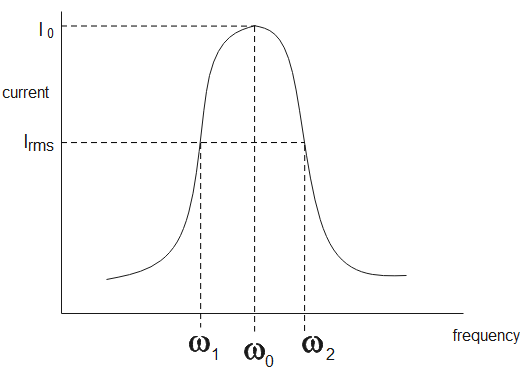
${{\omega }_{0}}$ is the resonant frequency
${{I}_{rms}}$ is the root mean square current
At resonance,
${{X}_{L}}={{X}_{C}}$
We know that,
$\dfrac{{{V}_{0}}}{Z}=I$ - (1)
Here,
${{V}_{0}}$ is the potential difference
$I$ is the current
$Z$ is the impedance
At resonance, $Z=R$ substitute in eq (1), we get,
$\dfrac{{{V}_{0}}}{R}={{I}_{0}}$
$\Rightarrow {{V}_{0}}={{I}_{0}}R$ - (2)
Here,
${{I}_{0}}$ is the maximum current
$R$ is the resistance
When $I=\dfrac{{{I}_{0}}}{\sqrt{2}}$ , the frequency is half power frequency ${{\omega }_{1}},\,{{\omega }_{2}}$ substitute in eq (1), we get,
$\dfrac{{{V}_{0}}}{Z}=\dfrac{{{I}_{0}}}{\sqrt{2}}$
When we substitute eq (2) in the above equation, we get,
$\begin{align}
& \dfrac{{{I}_{0}}R}{Z}=\dfrac{{{I}_{0}}}{\sqrt{2}} \\
& \Rightarrow Z=\sqrt{2}R \\
& \Rightarrow \sqrt{{{R}^{2}}+{{\left( (\omega L)-\dfrac{1}{(\omega C)} \right)}^{2}}}=\sqrt{2}R \\
& \Rightarrow {{R}^{2}}+{{\left( (\omega L)-\dfrac{1}{(\omega C)} \right)}^{2}}=2{{R}^{2}} \\
& \Rightarrow {{\left( (\omega L)-\dfrac{1}{(\omega C)} \right)}^{2}}={{R}^{2}} \\
\end{align}$
Substituting, $\omega ={{\omega }_{0}}+\Delta \omega $ in the above equation, we get,
$\Rightarrow {{\left( {{\omega }_{0}}L\left( 1+\dfrac{\Delta \omega }{{{\omega }_{0}}} \right)-\dfrac{1}{\omega _{0}^{{}}C\left( 1+\dfrac{\Delta \omega }{{{\omega }_{0}}} \right)} \right)}^{2}}={{R}^{2}}$
The condition of resonance is,
$\begin{align}
& {{\omega }_{0}}L=\dfrac{1}{{{\omega }_{0}}C} \\
& \therefore C=\dfrac{1}{\omega _{0}^{2}L} \\
\end{align}$
When we substitute in above equation, we get,
$\begin{align}
& \Rightarrow {{\left( {{\omega }_{0}}L\left( 1+\dfrac{\Delta \omega }{{{\omega }_{0}}} \right)-\dfrac{{{\omega }_{0}}L}{\left( 1+\dfrac{\Delta \omega }{{{\omega }_{0}}} \right)} \right)}^{2}}={{R}^{2}} \\
& \Rightarrow \left( {{\omega }_{0}}L\left( 1+\dfrac{\Delta \omega }{{{\omega }_{0}}} \right)-\dfrac{{{\omega }_{0}}L}{\left( 1+\dfrac{\Delta \omega }{{{\omega }_{0}}} \right)} \right)=R \\
& \Rightarrow \left( {{\omega }_{0}}L\left( 1+\dfrac{\Delta \omega }{{{\omega }_{0}}} \right)-{{\omega }_{0}}L{{\left( 1+\dfrac{\Delta \omega }{{{\omega }_{0}}} \right)}^{-1}} \right)=R \\
\end{align}$
Applying rules of exponents, we get,
$\begin{align}
& \Rightarrow \left( {{\omega }_{0}}L\left( 1+\dfrac{\Delta \omega }{{{\omega }_{0}}} \right)-{{\omega }_{0}}L{{\left( 1+\dfrac{\Delta \omega }{{{\omega }_{0}}} \right)}^{-1}} \right)=R \\
& \Rightarrow \left( {{\omega }_{0}}L\left( 1+\dfrac{\Delta \omega }{{{\omega }_{0}}} \right)-{{\omega }_{0}}L\left( 1-\dfrac{\Delta \omega }{{{\omega }_{0}}} \right) \right)=R \\
& \Rightarrow 2{{\omega }_{0}}L\dfrac{\Delta \omega }{{{\omega }_{0}}}=R \\
& \therefore \Delta \omega =\dfrac{R}{2L} \\
\end{align}$
For bandwidth,
$\begin{align}
& {{\omega }_{2}}-{{\omega }_{1}}=({{\omega }_{0}}+\Delta \omega )-({{\omega }_{0}}-\Delta \omega ) \\
& \therefore {{\omega }_{2}}-{{\omega }_{1}}=2\Delta \omega \\
\end{align}$
Here, ${{\omega }_{2}}-{{\omega }_{1}}$ is the bandwidth.
Therefore,
$\begin{align}
& {{\omega }_{2}}-{{\omega }_{1}}=2\Delta \omega \\
& \Rightarrow {{\omega }_{2}}-{{\omega }_{1}}=2\times \dfrac{R}{2L} \\
& \therefore {{\omega }_{2}}-{{\omega }_{1}}=\dfrac{R}{L} \\
\end{align}$
Therefore, the bandwidth is $\dfrac{R}{L}$.
Note:
At resonance, the current increases infinitely as the impedance becomes minimum. Half power frequencies are those frequencies at which the current attains its root mean squared value. Root mean squared current is defined as the maximum current divided by root two. It is also calculated by taking the average square of all currents.
Complete step-by-step solution:
An LCR circuit is a circuit which contains a resistor, capacitor as well as an inductor. At a certain frequency, the impedance becomes minimum and the current becomes maximum, this condition is called resonance and the frequency is called resonant frequency.
${{\omega }_{0}}$ is the resonant frequency
${{I}_{rms}}$ is the root mean square current
At resonance,
${{X}_{L}}={{X}_{C}}$
We know that,
$\dfrac{{{V}_{0}}}{Z}=I$ - (1)
Here,
${{V}_{0}}$ is the potential difference
$I$ is the current
$Z$ is the impedance
At resonance, $Z=R$ substitute in eq (1), we get,
$\dfrac{{{V}_{0}}}{R}={{I}_{0}}$
$\Rightarrow {{V}_{0}}={{I}_{0}}R$ - (2)
Here,
${{I}_{0}}$ is the maximum current
$R$ is the resistance
When $I=\dfrac{{{I}_{0}}}{\sqrt{2}}$ , the frequency is half power frequency ${{\omega }_{1}},\,{{\omega }_{2}}$ substitute in eq (1), we get,
$\dfrac{{{V}_{0}}}{Z}=\dfrac{{{I}_{0}}}{\sqrt{2}}$
When we substitute eq (2) in the above equation, we get,
$\begin{align}
& \dfrac{{{I}_{0}}R}{Z}=\dfrac{{{I}_{0}}}{\sqrt{2}} \\
& \Rightarrow Z=\sqrt{2}R \\
& \Rightarrow \sqrt{{{R}^{2}}+{{\left( (\omega L)-\dfrac{1}{(\omega C)} \right)}^{2}}}=\sqrt{2}R \\
& \Rightarrow {{R}^{2}}+{{\left( (\omega L)-\dfrac{1}{(\omega C)} \right)}^{2}}=2{{R}^{2}} \\
& \Rightarrow {{\left( (\omega L)-\dfrac{1}{(\omega C)} \right)}^{2}}={{R}^{2}} \\
\end{align}$
Substituting, $\omega ={{\omega }_{0}}+\Delta \omega $ in the above equation, we get,
$\Rightarrow {{\left( {{\omega }_{0}}L\left( 1+\dfrac{\Delta \omega }{{{\omega }_{0}}} \right)-\dfrac{1}{\omega _{0}^{{}}C\left( 1+\dfrac{\Delta \omega }{{{\omega }_{0}}} \right)} \right)}^{2}}={{R}^{2}}$
The condition of resonance is,
$\begin{align}
& {{\omega }_{0}}L=\dfrac{1}{{{\omega }_{0}}C} \\
& \therefore C=\dfrac{1}{\omega _{0}^{2}L} \\
\end{align}$
When we substitute in above equation, we get,
$\begin{align}
& \Rightarrow {{\left( {{\omega }_{0}}L\left( 1+\dfrac{\Delta \omega }{{{\omega }_{0}}} \right)-\dfrac{{{\omega }_{0}}L}{\left( 1+\dfrac{\Delta \omega }{{{\omega }_{0}}} \right)} \right)}^{2}}={{R}^{2}} \\
& \Rightarrow \left( {{\omega }_{0}}L\left( 1+\dfrac{\Delta \omega }{{{\omega }_{0}}} \right)-\dfrac{{{\omega }_{0}}L}{\left( 1+\dfrac{\Delta \omega }{{{\omega }_{0}}} \right)} \right)=R \\
& \Rightarrow \left( {{\omega }_{0}}L\left( 1+\dfrac{\Delta \omega }{{{\omega }_{0}}} \right)-{{\omega }_{0}}L{{\left( 1+\dfrac{\Delta \omega }{{{\omega }_{0}}} \right)}^{-1}} \right)=R \\
\end{align}$
Applying rules of exponents, we get,
$\begin{align}
& \Rightarrow \left( {{\omega }_{0}}L\left( 1+\dfrac{\Delta \omega }{{{\omega }_{0}}} \right)-{{\omega }_{0}}L{{\left( 1+\dfrac{\Delta \omega }{{{\omega }_{0}}} \right)}^{-1}} \right)=R \\
& \Rightarrow \left( {{\omega }_{0}}L\left( 1+\dfrac{\Delta \omega }{{{\omega }_{0}}} \right)-{{\omega }_{0}}L\left( 1-\dfrac{\Delta \omega }{{{\omega }_{0}}} \right) \right)=R \\
& \Rightarrow 2{{\omega }_{0}}L\dfrac{\Delta \omega }{{{\omega }_{0}}}=R \\
& \therefore \Delta \omega =\dfrac{R}{2L} \\
\end{align}$
For bandwidth,
$\begin{align}
& {{\omega }_{2}}-{{\omega }_{1}}=({{\omega }_{0}}+\Delta \omega )-({{\omega }_{0}}-\Delta \omega ) \\
& \therefore {{\omega }_{2}}-{{\omega }_{1}}=2\Delta \omega \\
\end{align}$
Here, ${{\omega }_{2}}-{{\omega }_{1}}$ is the bandwidth.
Therefore,
$\begin{align}
& {{\omega }_{2}}-{{\omega }_{1}}=2\Delta \omega \\
& \Rightarrow {{\omega }_{2}}-{{\omega }_{1}}=2\times \dfrac{R}{2L} \\
& \therefore {{\omega }_{2}}-{{\omega }_{1}}=\dfrac{R}{L} \\
\end{align}$
Therefore, the bandwidth is $\dfrac{R}{L}$.
Note:
At resonance, the current increases infinitely as the impedance becomes minimum. Half power frequencies are those frequencies at which the current attains its root mean squared value. Root mean squared current is defined as the maximum current divided by root two. It is also calculated by taking the average square of all currents.
Recently Updated Pages
Master Class 12 Economics: Engaging Questions & Answers for Success

Master Class 12 Social Science: Engaging Questions & Answers for Success
Master Class 12 English: Engaging Questions & Answers for Success
Master Class 12 Maths: Engaging Questions & Answers for Success
Master Class 12 Physics: Engaging Questions & Answers for Success
Master Class 12 Biology: Engaging Questions & Answers for Success
Trending doubts
Draw a labelled sketch of the human eye class 12 physics CBSE
Which are the Top 10 Largest Countries of the World?
Draw ray diagrams each showing i myopic eye and ii class 12 physics CBSE
Which is the correct genotypic ratio of mendel dihybrid class 12 biology CBSE
Differentiate between homogeneous and heterogeneous class 12 chemistry CBSE
Which animal never drinks water in its entire life class 12 biology CBSE