



Draw 3 equipotential surfaces corresponding to a field that uniformly increased in magnitude but remains constant along positive Z-direction. How are these surfaces different from that of a constant electric field along Z-direction?
Answer
 Verified
635.7k+ views
Hint : The three equipotential surfaces at the location placed should all be in the same potential. For a given potential, the electric field is inversely proportional to the distance of the point of interest to a reference point.
Formula used: In this solution we will be using the following formula;
$ E = \dfrac{V}{d} $ where $ E $ is the electric field at a point, $ V $ is the electric potential at a point with reference to another point, and $ d $ is the distance between the reference point, and the point of interest.
Complete step by step answer:
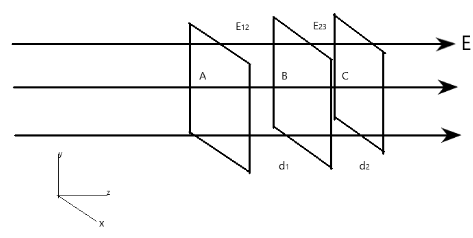
To draw equipotential surfaces, we note that equipotential surfaces are surfaces with equal potential, i.e. there are no potential differences between them.
Now imagine three surfaces on the x-y plane perpendicular to the electric field in the z axis, as shown in figure. In average form, the electric field can be given as
$ E = \dfrac{V}{d} $ where $ V $ is the electric potential at a point with reference to another point, and $ d $ is the distance between the reference point, and the point of interest.
Now, say the surface A is at a potential V, then surface B will be at a potential
$ {V_B} = {E_{12}}{d_{12}} $ with respect to A, and surface C will be at
$ {V_C} = {E_{23}}{d_{23}} $ with respect to B.
Now, since they are equipotential surfaces, then
$ V = {V_B} = {V_C} $
Then by equating the expression,
$ {E_{12}}{d_{12}} = {E_{23}}{d_{23}} $
$ \Rightarrow {d_{23}} = \dfrac{{{E_{12}}{d_{12}}}}{{{E_{23}}}} $
Hence, since $ {E_{23}} > {E_{12}} $ (because the electric field increases along the z axis), then
$ {d_{23}} < {d_{12}} $
This means that the distance between the surfaces decreases. Hence BC should be drawn closer together than AB.
If the electric field was constant, then $ {d_{23}} = {d_{12}} $ hence, they would be equally spaced apart.
Note:
Note that the equation $ E = \dfrac{V}{d} $ is just the constant form which shows the relation between the quantities and thus enough to solve our problem. However, in actuality, since the electric field changes the equation should be given as
$ {V_B} = \int_0^{{d_1}} {Edz} $ . The electric field $ {E_{12}} $ and $ {E_{23}} $ are more or less averages.
Formula used: In this solution we will be using the following formula;
$ E = \dfrac{V}{d} $ where $ E $ is the electric field at a point, $ V $ is the electric potential at a point with reference to another point, and $ d $ is the distance between the reference point, and the point of interest.
Complete step by step answer:
To draw equipotential surfaces, we note that equipotential surfaces are surfaces with equal potential, i.e. there are no potential differences between them.
Now imagine three surfaces on the x-y plane perpendicular to the electric field in the z axis, as shown in figure. In average form, the electric field can be given as
$ E = \dfrac{V}{d} $ where $ V $ is the electric potential at a point with reference to another point, and $ d $ is the distance between the reference point, and the point of interest.
Now, say the surface A is at a potential V, then surface B will be at a potential
$ {V_B} = {E_{12}}{d_{12}} $ with respect to A, and surface C will be at
$ {V_C} = {E_{23}}{d_{23}} $ with respect to B.
Now, since they are equipotential surfaces, then
$ V = {V_B} = {V_C} $
Then by equating the expression,
$ {E_{12}}{d_{12}} = {E_{23}}{d_{23}} $
$ \Rightarrow {d_{23}} = \dfrac{{{E_{12}}{d_{12}}}}{{{E_{23}}}} $
Hence, since $ {E_{23}} > {E_{12}} $ (because the electric field increases along the z axis), then
$ {d_{23}} < {d_{12}} $
This means that the distance between the surfaces decreases. Hence BC should be drawn closer together than AB.
If the electric field was constant, then $ {d_{23}} = {d_{12}} $ hence, they would be equally spaced apart.
Note:
Note that the equation $ E = \dfrac{V}{d} $ is just the constant form which shows the relation between the quantities and thus enough to solve our problem. However, in actuality, since the electric field changes the equation should be given as
$ {V_B} = \int_0^{{d_1}} {Edz} $ . The electric field $ {E_{12}} $ and $ {E_{23}} $ are more or less averages.
Recently Updated Pages
Which of the following graphs shows the variation of class 12 physics CBSE

Draw a labelled diagram of the human male reproductive class 12 biology CBSE
Describe the experiment to compare the emf of two cells class 12 physics CBSE
What is standard hydrogen electrode
What is conventional current and electric current class 12 physics CBSE
2Bromopentane is treated with an alcoholic KOH solution class 12 chemistry CBSE
Trending doubts
Draw a labelled sketch of the human eye class 12 physics CBSE
Which are the Top 10 Largest Countries of the World?
A member of Simon commission later became Prime Minister class 12 social science CBSE
Differentiate between homogeneous and heterogeneous class 12 chemistry CBSE
Draw ray diagrams each showing i myopic eye and ii class 12 physics CBSE
Which is the correct genotypic ratio of mendel dihybrid class 12 biology CBSE