




How does the embryo get nourishment inside the mother’s body?
Answer
 Verified
640.2k+ views
Hint: The embryonic membranes, allantois, and chorion of the fetus develop a connection between the umbilical cord and the mother's uterine cavity. It helps in the exchange of all nutrients, gases, and waste products.
Complete answer:
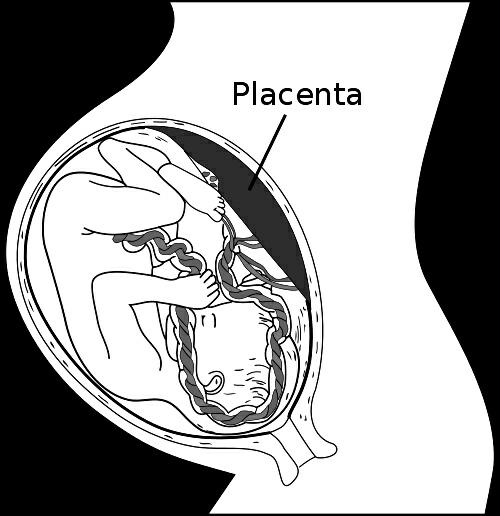
The embryo grows inside the mother’s womb and gets nourishment from the mother’s blood through the tissue called the placenta. The placenta is a temporary organ that connects the developing fetus to the uterine cavity of the mother via the umbilical. It facilitates the uptake of nutrients and the exchange of gases and waste products from the fetus to the mother. It also helps in regulating the body temperature of the fetus.
Additional Information:
Humans have a chorioallantoic placenta that forms from the chorion and allantois. In humans, the placenta is approximately 22 cm in length and weighs approximately 500 grams. It has a dark reddish-blue or crimson color. It connects to the fetus by an umbilical cord of approximately 55–60 cm in length, which contains two umbilical arteries and one umbilical vein.
Note: Numerous pathologies can affect the placenta like-
1. Placenta accreta- It is caused by the deep plantation of the placenta into the wall of the uterus.
2. Placenta praevia- It is caused by the placement of the placenta in such a way that either it is too close to the cervix or blocks the cervix.
3. Placental abruption- The premature detachment of the placenta is known as placental abruption.
Complete answer:
The embryo grows inside the mother’s womb and gets nourishment from the mother’s blood through the tissue called the placenta. The placenta is a temporary organ that connects the developing fetus to the uterine cavity of the mother via the umbilical. It facilitates the uptake of nutrients and the exchange of gases and waste products from the fetus to the mother. It also helps in regulating the body temperature of the fetus.
Additional Information:
Humans have a chorioallantoic placenta that forms from the chorion and allantois. In humans, the placenta is approximately 22 cm in length and weighs approximately 500 grams. It has a dark reddish-blue or crimson color. It connects to the fetus by an umbilical cord of approximately 55–60 cm in length, which contains two umbilical arteries and one umbilical vein.
Note: Numerous pathologies can affect the placenta like-
1. Placenta accreta- It is caused by the deep plantation of the placenta into the wall of the uterus.
2. Placenta praevia- It is caused by the placement of the placenta in such a way that either it is too close to the cervix or blocks the cervix.
3. Placental abruption- The premature detachment of the placenta is known as placental abruption.
Recently Updated Pages
Master Class 12 Business Studies: Engaging Questions & Answers for Success

Master Class 12 Chemistry: Engaging Questions & Answers for Success
Master Class 12 Biology: Engaging Questions & Answers for Success
Class 12 Question and Answer - Your Ultimate Solutions Guide
Master Class 11 English: Engaging Questions & Answers for Success
Master Class 11 Social Science: Engaging Questions & Answers for Success
Trending doubts
Which are the Top 10 Largest Countries of the World?
The total number of vertebrae in man is a30 b31 c32 class 12 biology CBSE
Draw a labelled sketch of the human eye class 12 physics CBSE
The number of cranial nerves in a frog is A 10 pairs class 12 biology CBSE
Differentiate between homogeneous and heterogeneous class 12 chemistry CBSE
Differentiate between Pyramid of energy and pyramid class 12 biology CBSE