




Why does the electrostatic field at the surface of a charged conductor have to be perpendicular to every point on it?
Answer
 Verified
626.1k+ views
Hint: If the electrostatic field is parallel to the conductor surface, there will be an acceleration motion of charges to achieve the equilibrium. But in the real case, the parallel components of the electrostatic field cancel each other. So only perpendicular components will remain. You can use Newton’s law to understand this concept. The non-uniform force will provide acceleration to the body in the direction of the force.
Complete step by step answer:
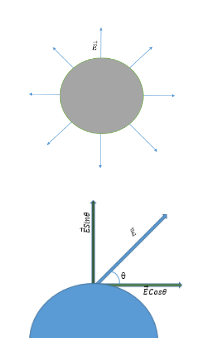
Consider a uniformly charged conductor with electrostatic field E at each point charge. Let the field \[E\] be aligned at an angle \[\theta \] from the surface. This field can be resolved into horizontal and vertical components. \[E\cos \theta \] will be the horizontal component and \[E\sin \theta \] will be the vertical component of the field E. Since the conductor is uniformly charged, each point at the surface contain some charges produces electric field directing at a certain angle outward the surface.
The horizontal component of each field which is parallel to the tangent of the surface of the conductor will cancel each other and thus only vertical components from each point will be present around the surface. In this scenario, only the vertical components can avoid the repulsion between the charges. Thus, the electrostatic field at the surface of a charged conductor will be always perpendicular to the surface.
Additional information:
Electric field lines are also known as electric lines of force. These lines are imaginary as well they won’t intersect each other. The electric field lines start from positive charge and end at a negative charge. These lines of forces exert pressure on other lines. So they will repel each other. When there is no current on the conductor, according to the static situation the charges will orient in a manner. So that the electrostatic field inside the conductor is zero. In the static situation, no excess charges will be present inside the conductor.
Note: If the electrostatic field lines are not perpendicular to the surface of the conductor, then the tangential components will create a potential difference and lead to the acceleration of the free electrons and result in a current. To get equipotential or constant potential throughout the surface, electrostatic field lines have to be perpendicular to the segments of the conductor.
Complete step by step answer:
Consider a uniformly charged conductor with electrostatic field E at each point charge. Let the field \[E\] be aligned at an angle \[\theta \] from the surface. This field can be resolved into horizontal and vertical components. \[E\cos \theta \] will be the horizontal component and \[E\sin \theta \] will be the vertical component of the field E. Since the conductor is uniformly charged, each point at the surface contain some charges produces electric field directing at a certain angle outward the surface.
The horizontal component of each field which is parallel to the tangent of the surface of the conductor will cancel each other and thus only vertical components from each point will be present around the surface. In this scenario, only the vertical components can avoid the repulsion between the charges. Thus, the electrostatic field at the surface of a charged conductor will be always perpendicular to the surface.
Additional information:
Electric field lines are also known as electric lines of force. These lines are imaginary as well they won’t intersect each other. The electric field lines start from positive charge and end at a negative charge. These lines of forces exert pressure on other lines. So they will repel each other. When there is no current on the conductor, according to the static situation the charges will orient in a manner. So that the electrostatic field inside the conductor is zero. In the static situation, no excess charges will be present inside the conductor.
Note: If the electrostatic field lines are not perpendicular to the surface of the conductor, then the tangential components will create a potential difference and lead to the acceleration of the free electrons and result in a current. To get equipotential or constant potential throughout the surface, electrostatic field lines have to be perpendicular to the segments of the conductor.
Recently Updated Pages
Master Class 9 General Knowledge: Engaging Questions & Answers for Success

Master Class 9 Maths: Engaging Questions & Answers for Success
Master Class 9 Science: Engaging Questions & Answers for Success
Master Class 9 English: Engaging Questions & Answers for Success
Master Class 9 Social Science: Engaging Questions & Answers for Success
Class 9 Question and Answer - Your Ultimate Solutions Guide
Trending doubts
Which are the Top 10 Largest Countries of the World?
Draw a labelled sketch of the human eye class 12 physics CBSE
Differentiate between homogeneous and heterogeneous class 12 chemistry CBSE
Sulphuric acid is known as the king of acids State class 12 chemistry CBSE
Why is the cell called the structural and functional class 12 biology CBSE
A dentist uses a small mirror that gives a magnification class 12 physics CBSE