




Why does obtaining the image of the sun on a paper with the help of a concave mirror burn the paper?
Answer
 Verified
572.1k+ views
Hint: When the light reflects back from a mirror, none of it is absorbed, its energy is completely reflected back. A concave mirror is a type of spherical mirror in which the concave part is the reflecting part.
Complete answer:
Light is a form of energy which enables us to see.
Mirrors are silvered surfaces which have the ability to reflect maximum light energy when it strikes the mirror.
Mirrors can be classified into two types. First, the plane mirror, in which the surface which is silvered is a plane surface. Second, the spherical mirror, in which the surface which is silvered is a spherical surface.
Spherical mirrors can further be classified into concave and convex mirrors. In concave mirrors the concave part is silver whereas in convex mirrors, the convex part is silvered.
The centre of the sphere from which the concave mirror is made is known as the centre of curvature $\left( C \right)$ and the radius is known as the radius of curvature $R$. The point at which a light ray coming from infinity would cross the axis of mirror after reflection is known as the focus of the mirror $\left( F \right)$.
Since the distance of the sun from the mirror is very large therefore, the light rays coming from the sun can be considered as coming from infinity. All the rays coming from infinity meet at the focus $\left( F \right)$ after getting reflected. That is all the energy of rays that strike the mirror is concentrated at the focus because of the mirror. If a paper is kept at the focus and the alignment of the whole setup is not changed for an adequate amount of time, because of the concentrated energy of the sun, by the virtue of the concave mirror, the paper starts to burn.
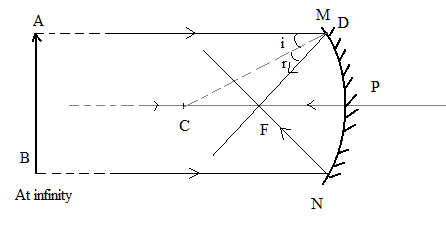
Note: The point at which two or more reflected rays meet is known as an image. When the rays actually meet after getting reflected, the image is known as a real image. Whereas when the rays do not actually meet after getting reflected but appear to meet virtually behind the mirror, the image formed is known as a virtual image.
Complete answer:
Light is a form of energy which enables us to see.
Mirrors are silvered surfaces which have the ability to reflect maximum light energy when it strikes the mirror.
Mirrors can be classified into two types. First, the plane mirror, in which the surface which is silvered is a plane surface. Second, the spherical mirror, in which the surface which is silvered is a spherical surface.
Spherical mirrors can further be classified into concave and convex mirrors. In concave mirrors the concave part is silver whereas in convex mirrors, the convex part is silvered.
The centre of the sphere from which the concave mirror is made is known as the centre of curvature $\left( C \right)$ and the radius is known as the radius of curvature $R$. The point at which a light ray coming from infinity would cross the axis of mirror after reflection is known as the focus of the mirror $\left( F \right)$.
Since the distance of the sun from the mirror is very large therefore, the light rays coming from the sun can be considered as coming from infinity. All the rays coming from infinity meet at the focus $\left( F \right)$ after getting reflected. That is all the energy of rays that strike the mirror is concentrated at the focus because of the mirror. If a paper is kept at the focus and the alignment of the whole setup is not changed for an adequate amount of time, because of the concentrated energy of the sun, by the virtue of the concave mirror, the paper starts to burn.
Note: The point at which two or more reflected rays meet is known as an image. When the rays actually meet after getting reflected, the image is known as a real image. Whereas when the rays do not actually meet after getting reflected but appear to meet virtually behind the mirror, the image formed is known as a virtual image.
Recently Updated Pages
Basicity of sulphurous acid and sulphuric acid are

Master Class 12 English: Engaging Questions & Answers for Success
Master Class 12 Social Science: Engaging Questions & Answers for Success
Master Class 12 Maths: Engaging Questions & Answers for Success
Master Class 12 Economics: Engaging Questions & Answers for Success
Master Class 12 Physics: Engaging Questions & Answers for Success
Trending doubts
Which are the Top 10 Largest Countries of the World?
Draw a labelled sketch of the human eye class 12 physics CBSE
Which country did Danny Casey play for class 12 english CBSE
Give 10 examples of unisexual and bisexual flowers
Coming together federation is practiced in A India class 12 social science CBSE
Write the formula to find the shortest distance between class 12 maths CBSE