




What does H in "d" and "III" refers to in the enzyme Hind III?
Answer
 Verified
536.1k+ views
Hint: Hind III is a restriction endonuclease. Its function is to cleave the DNA at the palindromic site AAGCTT. It is isolated from the organism Haemophilus influenzae.
Complete answer:
The restriction enzymes are the enzymes which cleaves the particular sequence of the DNA. These enzymes are used as a defence and protect the genome of the host from the foreign invaders like bacteriophage. These enzymes are isolated from the prokaryotes which serve as an important tool in genetic engineering. Several examples of restriction enzymes are EcoR1, BamH1, Hind III etc.
Let us discuss Hind III in detail. It is a restriction enzyme which is obtained from the prokaryotic organism. The “H” and “in” in the name of the enzyme refers to the organism from which it is obtained, that is Haemophilus influenzae. The “d” in the enzyme refers to the strain from which it has been extracted, that is strain Rd. “III” refers to the sequence from which it is isolated. It cleaves the DNA sequence at the palindromic site AAGCTT. This enzyme is active in the presence of magnesium ion as cofactor.
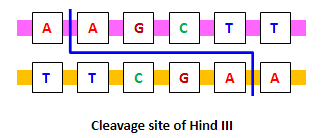
Additional Information: Hind III is a homodimer. The Hind III comprises four beta pleated sheets and single alpha helix. Each subunit is made up of 300 amino acids and has a molecular weight of around 35000 Dalton.
Note: Hind III is a type II restriction enzyme. They cut/cleave the DNA at a very specific sequence. It is used in genome mapping and DNA sequencing. The restriction enzymes are also involved in genetic recombination and transpositions.
Complete answer:
The restriction enzymes are the enzymes which cleaves the particular sequence of the DNA. These enzymes are used as a defence and protect the genome of the host from the foreign invaders like bacteriophage. These enzymes are isolated from the prokaryotes which serve as an important tool in genetic engineering. Several examples of restriction enzymes are EcoR1, BamH1, Hind III etc.
Let us discuss Hind III in detail. It is a restriction enzyme which is obtained from the prokaryotic organism. The “H” and “in” in the name of the enzyme refers to the organism from which it is obtained, that is Haemophilus influenzae. The “d” in the enzyme refers to the strain from which it has been extracted, that is strain Rd. “III” refers to the sequence from which it is isolated. It cleaves the DNA sequence at the palindromic site AAGCTT. This enzyme is active in the presence of magnesium ion as cofactor.
Additional Information: Hind III is a homodimer. The Hind III comprises four beta pleated sheets and single alpha helix. Each subunit is made up of 300 amino acids and has a molecular weight of around 35000 Dalton.
Note: Hind III is a type II restriction enzyme. They cut/cleave the DNA at a very specific sequence. It is used in genome mapping and DNA sequencing. The restriction enzymes are also involved in genetic recombination and transpositions.
Recently Updated Pages
Basicity of sulphurous acid and sulphuric acid are

Master Class 11 English: Engaging Questions & Answers for Success
Master Class 11 Physics: Engaging Questions & Answers for Success
Master Class 11 Computer Science: Engaging Questions & Answers for Success
Master Class 11 Chemistry: Engaging Questions & Answers for Success
Master Class 11 Social Science: Engaging Questions & Answers for Success
Trending doubts
Difference Between Prokaryotic Cells and Eukaryotic Cells
Two of the body parts which do not appear in MRI are class 11 biology CBSE
One Metric ton is equal to kg A 10000 B 1000 C 100 class 11 physics CBSE
10 examples of friction in our daily life
Draw a diagram of nephron and explain its structur class 11 biology CBSE
What will happen if the mucus is not secreted by the class 11 biology CBSE