




How does current affect magnetic force?
Answer
 Verified
560.7k+ views
Hint: In this question, we will use the basic relation between the force applied and the current. Further, from this expression we will be able to get the answer to our question easily. Also, we will study the two different rules to find the magnetic field, current or the force in a given object.
Formula used:
$F = BIL\sin \theta $
Complete solution:
As we know the relation between force, and current is given by:
$F = BIL\sin \theta $
This expression shows the magnetic force acting on a straight current carrying conductor in a uniform magnetic field.
From above expression, we also know that:
$F \propto I$
So, we can say that the force is directly proportional to the current flowing.
Now, from this we get to observe that:
If the current I is doubled the force on the conductor will also get double.
If the current is reduced to one third of the initial value then the force will also get reduced to one third of its initial value.
The last one, if the current is increased five times then the force will also get increased by five times.
Therefore we get the required answer.
Additional information:
We know that Fleming's left-hand rule gives the direction of magnetic force acting on a conductor whereas; Fleming’s right-hand rule gives us the direction of induced current.
Fleming’s right-hand rule can be understood as: from this rule, if we Stretch the thumb, forefinger and middle finger of our right hand such that they are mutually perpendicular to each other.
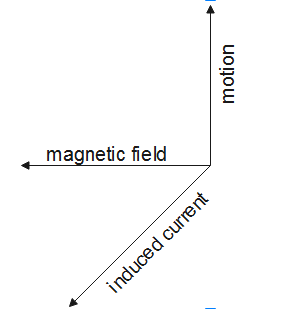
Here, if the forefinger point indicates the direction of the magnetic field and the thumb indicates the direction of motion of the conductor, then the middle finger will indicate the direction of induced current in the conductor.
Fleming’s left-hand rule: from this rule if we Stretch our thumb, forefinger and middle finger of the left hand such that all these fingers are mutually perpendicular to each other.

So, if the forefinger points in the direction of the magnetic field and the middle finger indicates the direction of the current, then the thumb will indicate the direction of motion or the force on the conductor.
Note:
We should remember that a magnetic field B can be defined as a vector field that tells the magnetic influence on moving electric charges, electric currents, and magnetized materials. Also, we should know that a charge that is moving in a magnetic field experiences a force that is perpendicular to its town velocity and to the magnetic field.
Formula used:
$F = BIL\sin \theta $
Complete solution:
As we know the relation between force, and current is given by:
$F = BIL\sin \theta $
This expression shows the magnetic force acting on a straight current carrying conductor in a uniform magnetic field.
From above expression, we also know that:
$F \propto I$
So, we can say that the force is directly proportional to the current flowing.
Now, from this we get to observe that:
If the current I is doubled the force on the conductor will also get double.
If the current is reduced to one third of the initial value then the force will also get reduced to one third of its initial value.
The last one, if the current is increased five times then the force will also get increased by five times.
Therefore we get the required answer.
Additional information:
We know that Fleming's left-hand rule gives the direction of magnetic force acting on a conductor whereas; Fleming’s right-hand rule gives us the direction of induced current.
Fleming’s right-hand rule can be understood as: from this rule, if we Stretch the thumb, forefinger and middle finger of our right hand such that they are mutually perpendicular to each other.
Here, if the forefinger point indicates the direction of the magnetic field and the thumb indicates the direction of motion of the conductor, then the middle finger will indicate the direction of induced current in the conductor.
Fleming’s left-hand rule: from this rule if we Stretch our thumb, forefinger and middle finger of the left hand such that all these fingers are mutually perpendicular to each other.
So, if the forefinger points in the direction of the magnetic field and the middle finger indicates the direction of the current, then the thumb will indicate the direction of motion or the force on the conductor.
Note:
We should remember that a magnetic field B can be defined as a vector field that tells the magnetic influence on moving electric charges, electric currents, and magnetized materials. Also, we should know that a charge that is moving in a magnetic field experiences a force that is perpendicular to its town velocity and to the magnetic field.
Recently Updated Pages
Master Class 12 Economics: Engaging Questions & Answers for Success

Master Class 12 Physics: Engaging Questions & Answers for Success
Master Class 12 English: Engaging Questions & Answers for Success
Master Class 12 Social Science: Engaging Questions & Answers for Success
Master Class 12 Maths: Engaging Questions & Answers for Success
Master Class 12 Business Studies: Engaging Questions & Answers for Success
Trending doubts
Which are the Top 10 Largest Countries of the World?
What are the major means of transport Explain each class 12 social science CBSE
Draw a labelled sketch of the human eye class 12 physics CBSE
Why cannot DNA pass through cell membranes class 12 biology CBSE
Differentiate between insitu conservation and exsitu class 12 biology CBSE
Draw a neat and well labeled diagram of TS of ovary class 12 biology CBSE