




Why does benzene undergo electrophilic substitution reactions easily and nucleophilic substitutions difficulty?
Answer
 Verified
588.1k+ views
Hint:
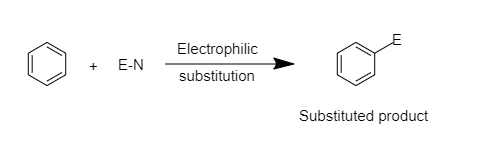
Electrophilic substitution reactions are chemical reactions in which an electrophile displaces a group in a compound, typically but not always hydrogen.
Nucleophilic substitution reactions are those reactions in which substitution is brought about by a nucleophile. These reactions are denoted by { S }_{ N } (S stands for substitution and N for nucleophile). One of the most common examples of this type of reaction is the hydrolysis of an alkyl halide by aqueous to give alcohols.
Complete step-by-step answer:
Benzene is a planar molecule having delocalized electrons above and below the plane of the ring. Hence, it is electron-rich. As a result, it is highly attractive to electron-deficient species i.e., electrophiles. Therefore, it undergoes electrophilic substitution reactions very easily.
Nucleophiles are electron-rich. Due to the presence of an electron cloud of delocalized electrons on the benzene ring nucleophilic attack is difficult. Hence, they are repelled by benzene. Hence, benzene undergoes nucleophilic substitutions with difficulty.
Additional Information:
Electrophilic substitution reactions are chemical reactions in which an electrophile displaces a functional group in a compound, which is typically, but not always, a hydrogen atom.
Electrophilic aromatic substitution reactions are characteristic of aromatic compounds and are important ways of introducing functional groups onto benzene rings.
Note:
The possibility to make a mistake is that nucleophilic reactions also occur in benzene when a Lewis acid like { AlCl }_{ 3 } binds the halogen which creates a positive charge in the alkyl group. But the fact is Electrophilic substitutions are preferred over nucleophilic substitution reactions.
Electrophilic substitution reactions are chemical reactions in which an electrophile displaces a group in a compound, typically but not always hydrogen.
Nucleophilic substitution reactions are those reactions in which substitution is brought about by a nucleophile. These reactions are denoted by { S }_{ N } (S stands for substitution and N for nucleophile). One of the most common examples of this type of reaction is the hydrolysis of an alkyl halide by aqueous to give alcohols.
Complete step-by-step answer:
Benzene is a planar molecule having delocalized electrons above and below the plane of the ring. Hence, it is electron-rich. As a result, it is highly attractive to electron-deficient species i.e., electrophiles. Therefore, it undergoes electrophilic substitution reactions very easily.
Nucleophiles are electron-rich. Due to the presence of an electron cloud of delocalized electrons on the benzene ring nucleophilic attack is difficult. Hence, they are repelled by benzene. Hence, benzene undergoes nucleophilic substitutions with difficulty.
Additional Information:
Electrophilic substitution reactions are chemical reactions in which an electrophile displaces a functional group in a compound, which is typically, but not always, a hydrogen atom.
Electrophilic aromatic substitution reactions are characteristic of aromatic compounds and are important ways of introducing functional groups onto benzene rings.
Note:
The possibility to make a mistake is that nucleophilic reactions also occur in benzene when a Lewis acid like { AlCl }_{ 3 } binds the halogen which creates a positive charge in the alkyl group. But the fact is Electrophilic substitutions are preferred over nucleophilic substitution reactions.
Recently Updated Pages
What is BLO What is the full form of BLO class 8 social science CBSE

Explain the Treaty of Vienna of 1815 class 10 social science CBSE
10 examples of friction in our daily life
Draw a diagram of nephron and explain its structur class 11 biology CBSE
Write structures of the following compounds i 2 Chloro3methylpentane class 11 chemistry CBSE
A Paragraph on Pollution in about 100-150 Words
Trending doubts
Draw a labelled sketch of the human eye class 12 physics CBSE
Which are the Top 10 Largest Countries of the World?
Differentiate between homogeneous and heterogeneous class 12 chemistry CBSE
Draw ray diagrams each showing i myopic eye and ii class 12 physics CBSE
Which is the correct genotypic ratio of mendel dihybrid class 12 biology CBSE
What is the Full Form of PVC, PET, HDPE, LDPE, PP and PS ?