



How does a trawler man catch fish in deep water?
Answer
 Verified
515.1k+ views
Hint:Some sonar systems are developed specifically to find fish. These systems work on the same premise as other sonar systems in that they send out sound pulses, measure the time it takes for echoes to return, and then determine the distance to the objects.
Complete answer:
Sonars transmit sound waves or messages into the water, which bounce back when they hit something. Some of the signal is reflected back to the boat by the fish, while the rest is carried to the seafloor and then bounced back to the boat.
Explanation: Many times per second, fish-finding sonar systems broadcast and receive signals. They focus sound into a beam, which is then transmitted via a transducer.The echoes are printed on visual displays in these units. The display's bottom appears like a continuous line drawn across it. Furthermore, any items in the water between the surface and the bottom may be represented.
Fish finders generally detect the presence of fish by detecting the air in their swim bladders. The air saved in the swim bladder alters the sound path and reflects energy back to the listener. This reflected energy is detected by the fish finder and converted into fish.High-frequency sound, around \[20 - 200{\text{ }}kHz\] , is used by fish finders ( \[20 - 200,000\] cycles per second).
This aids in the identification of targets and can even show two fish as separate echoes or arches. Lower frequencies (such as \[50{\text{ }}kHz\] ) can penetrate deeper seas, but they may not be able to distinguish individual targets. Increasing the energy in the transducer's pulse enhances the chances of receiving a signal to return in deeper water.
Sound is condensed into a beam when it is transferred from the transducer. The beam stretches out and covers a larger area as the sound travels deeper into the water. The transmitted sound would resemble a traffic cone with a pointed tip and a broad base if plotted.
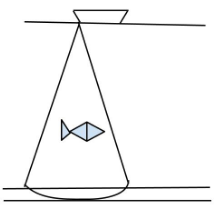
Some of the sound may be reflected back to the transducer by fish swimming within this cone. The sonar's chart display shows the reflected sound, or echo.
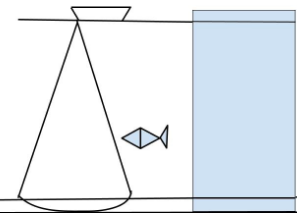
As the fish swims through the sonar beam, it forms a fish arch. When the fish reaches the cone's outside border, a mark appears on the chart display (on the right). The distance between the transducer and the fish reduces as the fish swims within the cone, and the mark begins to curve up. The fish is directly beneath the transducer when it is in the centre of the beam. As the fish gets closer to the transducer, the mark starts to flatten out. The distance between the fish and the opposite end of the cone grows as it moves through the beam.
Note: Unfortunately, the use of underwater sonar (short for sound navigation and range) can cause injury and even death to many whales, dolphins, and other marine animals. These sound waves may travel hundreds of kilometres underwater and maintain a 140 decibel intensity up to 300 miles away from their source.
Complete answer:
Sonars transmit sound waves or messages into the water, which bounce back when they hit something. Some of the signal is reflected back to the boat by the fish, while the rest is carried to the seafloor and then bounced back to the boat.
Explanation: Many times per second, fish-finding sonar systems broadcast and receive signals. They focus sound into a beam, which is then transmitted via a transducer.The echoes are printed on visual displays in these units. The display's bottom appears like a continuous line drawn across it. Furthermore, any items in the water between the surface and the bottom may be represented.
Fish finders generally detect the presence of fish by detecting the air in their swim bladders. The air saved in the swim bladder alters the sound path and reflects energy back to the listener. This reflected energy is detected by the fish finder and converted into fish.High-frequency sound, around \[20 - 200{\text{ }}kHz\] , is used by fish finders ( \[20 - 200,000\] cycles per second).
This aids in the identification of targets and can even show two fish as separate echoes or arches. Lower frequencies (such as \[50{\text{ }}kHz\] ) can penetrate deeper seas, but they may not be able to distinguish individual targets. Increasing the energy in the transducer's pulse enhances the chances of receiving a signal to return in deeper water.
Sound is condensed into a beam when it is transferred from the transducer. The beam stretches out and covers a larger area as the sound travels deeper into the water. The transmitted sound would resemble a traffic cone with a pointed tip and a broad base if plotted.
Some of the sound may be reflected back to the transducer by fish swimming within this cone. The sonar's chart display shows the reflected sound, or echo.
As the fish swims through the sonar beam, it forms a fish arch. When the fish reaches the cone's outside border, a mark appears on the chart display (on the right). The distance between the transducer and the fish reduces as the fish swims within the cone, and the mark begins to curve up. The fish is directly beneath the transducer when it is in the centre of the beam. As the fish gets closer to the transducer, the mark starts to flatten out. The distance between the fish and the opposite end of the cone grows as it moves through the beam.
Note: Unfortunately, the use of underwater sonar (short for sound navigation and range) can cause injury and even death to many whales, dolphins, and other marine animals. These sound waves may travel hundreds of kilometres underwater and maintain a 140 decibel intensity up to 300 miles away from their source.
Recently Updated Pages
In a plane electromagnetic wave the electric field class 12 physics CBSE

A plane electromagnetic wave travels in vacuum along class 12 physics CBSE
The magnetic field in a plane electromagnetic wave class 11 physics CBSE
Basicity of sulphurous acid and sulphuric acid are
Master Class 11 Business Studies: Engaging Questions & Answers for Success
Master Class 11 Computer Science: Engaging Questions & Answers for Success
Trending doubts
Fill the blanks with the suitable prepositions 1 The class 9 english CBSE
Difference Between Plant Cell and Animal Cell
Find the sum of series 1 + 2 + 3 + 4 + 5 + + 100 class 9 maths CBSE
What is tincture of iodine? Identify the solute and solvent in it
What is the Full Form of ICSE / ISC ?
What is pollution? How many types of pollution? Define it