




How does a pitch ball electroscope work ?
Answer
 Verified
590.1k+ views
Hint:In early scientific research, an electroscope was widely used to detect the presence of an electric charge on a body. It’s an instrument which tells us about whether a body has a charge on it or not. An electroscope works on the principle of electrostatic Force which was formulated by coulomb’s such that” two bodies having charges ${q_1}$ and ${q_2}$ separated by a distance of $r$ will experience a force which mathematically written as $F = \dfrac{{{q_1}{q_2}}}{{4\pi { \in _0}}}{r^2}$, where ${ \in _0}$ is called the permittivity of free space.
Complete answer:
A pith ball electroscope consists of two very small sized non-conductor lightweight balls, initially in place of nonconductive balls a spongy plant material was used which was called pith; these lightweight balls are suspended by either a silk or linen thread.
When we have to examine a substance whether it has a charge on it or not, we bring the tested substance near the uncharged pith ball and according to coulomb’s law if this tested substance have a charge then it will tends to move towards the pith ball due to electrostatic force of attraction between two bodies of having charges opposite in sign.
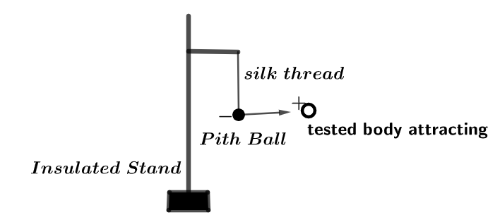
This attraction between pith ball and tested substance is mainly due to polarisation. Let us suppose the tested substance had a positive charge on it and when it bring closer to the uncharged pith ball then electrons of the pith ball atoms in outermost orbits tends to oppose the electrons of the positive charged tested substance with a magnitude of coulomb’s force but there’s also an attraction force between pith ball atom’s electrons and the extra positive charge atom of tested substance with a force, and this attraction force is greater than the repelling force between the atom electrons of two bodies and hence this cause attractive force between pith ball and tested substance.
Note:In the year $1754$ , physicist John canton invented the pith ball electroscope. It should be remember that if a tested substance had a negative charge on it then due to larger repulsion force between electrons of pith ball atoms and tested substance atoms, the pith ball will tends to move away from the tested substance, but in both case that main purpose of pith ball telescope was to detect the presence of charge on a body.
Complete answer:
A pith ball electroscope consists of two very small sized non-conductor lightweight balls, initially in place of nonconductive balls a spongy plant material was used which was called pith; these lightweight balls are suspended by either a silk or linen thread.
When we have to examine a substance whether it has a charge on it or not, we bring the tested substance near the uncharged pith ball and according to coulomb’s law if this tested substance have a charge then it will tends to move towards the pith ball due to electrostatic force of attraction between two bodies of having charges opposite in sign.
This attraction between pith ball and tested substance is mainly due to polarisation. Let us suppose the tested substance had a positive charge on it and when it bring closer to the uncharged pith ball then electrons of the pith ball atoms in outermost orbits tends to oppose the electrons of the positive charged tested substance with a magnitude of coulomb’s force but there’s also an attraction force between pith ball atom’s electrons and the extra positive charge atom of tested substance with a force, and this attraction force is greater than the repelling force between the atom electrons of two bodies and hence this cause attractive force between pith ball and tested substance.
Note:In the year $1754$ , physicist John canton invented the pith ball electroscope. It should be remember that if a tested substance had a negative charge on it then due to larger repulsion force between electrons of pith ball atoms and tested substance atoms, the pith ball will tends to move away from the tested substance, but in both case that main purpose of pith ball telescope was to detect the presence of charge on a body.
Recently Updated Pages
Which of the following graphs shows the variation of class 12 physics CBSE

Draw a labelled diagram of the human male reproductive class 12 biology CBSE
Describe the experiment to compare the emf of two cells class 12 physics CBSE
What is standard hydrogen electrode
What is conventional current and electric current class 12 physics CBSE
2Bromopentane is treated with an alcoholic KOH solution class 12 chemistry CBSE
Trending doubts
Draw a labelled sketch of the human eye class 12 physics CBSE
Which are the Top 10 Largest Countries of the World?
Draw ray diagrams each showing i myopic eye and ii class 12 physics CBSE
Which is the correct genotypic ratio of mendel dihybrid class 12 biology CBSE
Which is the strongest oxidising agent out of the following class 12 chemistry CBSE
Differentiate between homogeneous and heterogeneous class 12 chemistry CBSE