




When does a fuse cut off current? How does it do it?
Answer
 Verified
650.1k+ views
Hint: A fuse is a safety device in an electric plug or a circuit. It contains a piece of wire that melts when there is a fault in the circuit so that the flow of electricity stops. A fuse is basically an automatic means of removing power from a faulty system.
Complete step by step answer:
A fuse is an essential electrical safety device that operates to provide overcurrent protection of an electrical circuit. Its essential component or element is a metal wire or strip that melts when high current flows through it, thereby interrupting or stopping the current in the circuit. It is a sacrificial device, meaning that, once a fuse has operated it becomes an open circuit and it must be replaced or rewired.
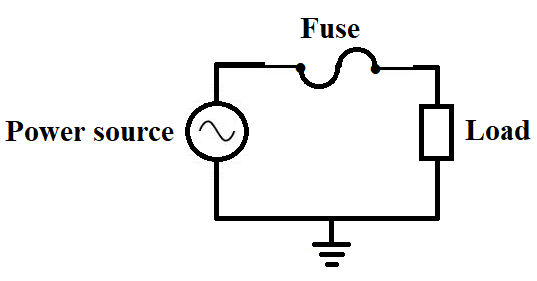
A fuse consists of a metal strip or wire fuse element, of small cross-sectional area compared to the circuit elements or conductors, mounted between a pair of electrical terminals, and enclosed by a non-combustible housing. The fuse is arranged in series in a circuit to carry all the current passing through the protected circuit. The resistance of the element generates heat due to the electric current flow. The size and construction of the fuse element is determined so that the heat produced for a normal current in the circuit does not cause the element to attain a high temperature. If too high an electric current flows, the element rises to a higher temperature and either directly melts, or else melts a soldered joint within the fuse, ultimately opening the circuit.
The fuse is essentially a piece of wire composed of pure tin or alloy of tin and copper. The wire has low melting point and high resistance. When high current flows in the circuit, whatever may be the reason such as short circuit, the fuse wire melts and the circuit is broken and the appliance is saved from the damage.
Note: The fuse wire is always connected in the live wire of the electric circuit because if the fuse is somehow put in the neutral wire in the circuit, then due to excessive flow of electric current when the fuse burns, current will stop flowing in the circuit, but the appliance will still remain connected to the high potential point of the power supply through the live wire. Now if a person touches the appliance, he has the chances of getting an electric shock as the person will come in contact with the live wire through that appliance.
Complete step by step answer:
A fuse is an essential electrical safety device that operates to provide overcurrent protection of an electrical circuit. Its essential component or element is a metal wire or strip that melts when high current flows through it, thereby interrupting or stopping the current in the circuit. It is a sacrificial device, meaning that, once a fuse has operated it becomes an open circuit and it must be replaced or rewired.
A fuse consists of a metal strip or wire fuse element, of small cross-sectional area compared to the circuit elements or conductors, mounted between a pair of electrical terminals, and enclosed by a non-combustible housing. The fuse is arranged in series in a circuit to carry all the current passing through the protected circuit. The resistance of the element generates heat due to the electric current flow. The size and construction of the fuse element is determined so that the heat produced for a normal current in the circuit does not cause the element to attain a high temperature. If too high an electric current flows, the element rises to a higher temperature and either directly melts, or else melts a soldered joint within the fuse, ultimately opening the circuit.
The fuse is essentially a piece of wire composed of pure tin or alloy of tin and copper. The wire has low melting point and high resistance. When high current flows in the circuit, whatever may be the reason such as short circuit, the fuse wire melts and the circuit is broken and the appliance is saved from the damage.
Note: The fuse wire is always connected in the live wire of the electric circuit because if the fuse is somehow put in the neutral wire in the circuit, then due to excessive flow of electric current when the fuse burns, current will stop flowing in the circuit, but the appliance will still remain connected to the high potential point of the power supply through the live wire. Now if a person touches the appliance, he has the chances of getting an electric shock as the person will come in contact with the live wire through that appliance.
Recently Updated Pages
Master Class 12 Economics: Engaging Questions & Answers for Success

Master Class 12 Social Science: Engaging Questions & Answers for Success
Master Class 12 English: Engaging Questions & Answers for Success
Master Class 12 Maths: Engaging Questions & Answers for Success
Master Class 12 Physics: Engaging Questions & Answers for Success
Master Class 12 Biology: Engaging Questions & Answers for Success
Trending doubts
Draw a labelled sketch of the human eye class 12 physics CBSE
Which are the Top 10 Largest Countries of the World?
Draw ray diagrams each showing i myopic eye and ii class 12 physics CBSE
Which is the correct genotypic ratio of mendel dihybrid class 12 biology CBSE
Differentiate between homogeneous and heterogeneous class 12 chemistry CBSE
Which animal never drinks water in its entire life class 12 biology CBSE