




Why does a current carrying conductor kept in the magnetic field experience force? On what factors does the direction of this force depend? Name and state the rule used for the determination of direction of this force.
Answer
 Verified
640.2k+ views
Hint: A current carrying conductor produces a magnetic field around it. Two magnets interact with each other and force is exerted on the current carrying conductor. It depends on the direction and strength of field and current.
Complete step by step answer:
A stationary charge produces an electric field around it while flow of charge or current produces a magnetic field around it. (The direction of magnetic field around a current carrying wire is given by Right hand thumb rule.) Experimentally, it is observed that when a current carrying conductor is placed in an external magnetic field then the conductor experiences a force.
The direction of this magnetic force is directly dependent on:
(1). Direction of current flowing through the conductor
(2). Direction of external magnetic field
In order to determine the force acting on the conductor we use Fleming’s left hand rule. According to this rule, if we stretch the thumb, the forefinger and the middle finger of our left hand in such a way that the three fingers are mutually perpendicular to each other as shown in the figure below:
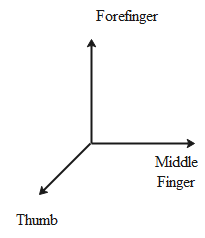
Then the middle points in the direction of flow of current. Forefinger points in the direction of the external magnetic field and the thumb points in the direction of the force acting on the conductor in presence of external magnetic field.
Note: This rule must not be confused with Fleming’s right hand rule which has the same nomenclature as left hand rule but it is used for determining the direction of the current produced when a conductor is moved in an external magnetic field.
Complete step by step answer:
A stationary charge produces an electric field around it while flow of charge or current produces a magnetic field around it. (The direction of magnetic field around a current carrying wire is given by Right hand thumb rule.) Experimentally, it is observed that when a current carrying conductor is placed in an external magnetic field then the conductor experiences a force.
The direction of this magnetic force is directly dependent on:
(1). Direction of current flowing through the conductor
(2). Direction of external magnetic field
In order to determine the force acting on the conductor we use Fleming’s left hand rule. According to this rule, if we stretch the thumb, the forefinger and the middle finger of our left hand in such a way that the three fingers are mutually perpendicular to each other as shown in the figure below:
Then the middle points in the direction of flow of current. Forefinger points in the direction of the external magnetic field and the thumb points in the direction of the force acting on the conductor in presence of external magnetic field.
Note: This rule must not be confused with Fleming’s right hand rule which has the same nomenclature as left hand rule but it is used for determining the direction of the current produced when a conductor is moved in an external magnetic field.
Recently Updated Pages
Master Class 12 Business Studies: Engaging Questions & Answers for Success

Master Class 12 Chemistry: Engaging Questions & Answers for Success
Master Class 12 Biology: Engaging Questions & Answers for Success
Class 12 Question and Answer - Your Ultimate Solutions Guide
Master Class 11 English: Engaging Questions & Answers for Success
Master Class 11 Social Science: Engaging Questions & Answers for Success
Trending doubts
Which are the Top 10 Largest Countries of the World?
Draw a labelled sketch of the human eye class 12 physics CBSE
Differentiate between homogeneous and heterogeneous class 12 chemistry CBSE
Differentiate between Pyramid of energy and pyramid class 12 biology CBSE
Why is the cell called the structural and functional class 12 biology CBSE
Draw the diagram of the pyramid of energy Explain In class 12 biology CBSE