




Do plants have mitochondria?
Answer
 Verified
574.2k+ views
Hint: Mitochondria is famous for being the ‘powerhouse’ of a cell. Unlike the members of the animal kingdom, plants don’t consume physical food. So, they make sugar from sunlight instead. This happens via the process of photosynthesis. Here, two cell organelles play an important role in maintaining energy in the plants.
Complete answer:
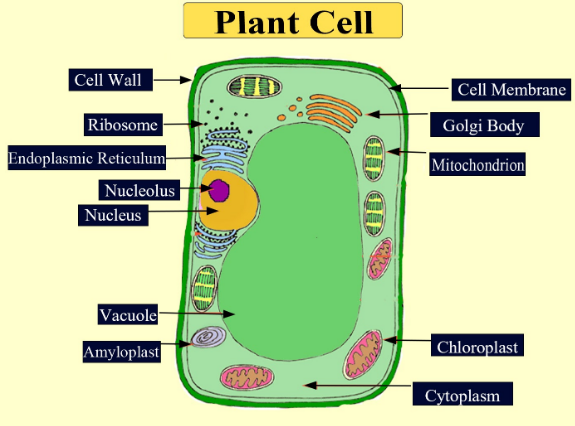
Yes, plants do have mitochondria. It is affirmative that plant and animal cells both have mitochondria. The only difference between plant and animal cells is that the former additionally have chloroplasts as well. Mitochondria play a pivotal role in disintegrating the sugar synthesized by the process of photosynthesis, in order to produce energy for the cells. Since animals derive the energy needed by them from the various things that they consume, so they don’t need chloroplast, unlike plants. However, since plants are autotrophs, they are the primary producers. So, they acquire their share of ‘food’ through photosynthesis, which happens during the daytime. During the night, plants still continue to produce energy through cellular respiration, where again mitochondria play an important role by acting as the site for the process and also capturing energy. The main role of mitochondria is to ensure a steady supply of adenosine triphosphate (ATP), which is every cell’s main energy-carrying molecule.
-Chloroplasts are also found in some algae.
-Mitochondria and chloroplasts have likely begun to exist when bacteria were engulfed by larger cells. This has been stated by the Endosymbiont Theory.
-Mitochondria are suspended in a jelly-like structure, called cytosol in a cell. They are oval in shape and have an outer and an inner membrane. The outer membrane surrounds the whole organelle, while the inner one contains many inward protrusions which are called cristae. These help in increasing surface area.
Note:
-The singular for mitochondria is the mitochondrion.
-Cristae were once imagined to be broad, wavy folds. However, they are now understood to be like long caverns.
-The space enclosed by the inner membrane in the mitochondria is known as Mitochondrial Matrix. This matrix contains mitochondrial DNA and ribosomes.
Complete answer:
Yes, plants do have mitochondria. It is affirmative that plant and animal cells both have mitochondria. The only difference between plant and animal cells is that the former additionally have chloroplasts as well. Mitochondria play a pivotal role in disintegrating the sugar synthesized by the process of photosynthesis, in order to produce energy for the cells. Since animals derive the energy needed by them from the various things that they consume, so they don’t need chloroplast, unlike plants. However, since plants are autotrophs, they are the primary producers. So, they acquire their share of ‘food’ through photosynthesis, which happens during the daytime. During the night, plants still continue to produce energy through cellular respiration, where again mitochondria play an important role by acting as the site for the process and also capturing energy. The main role of mitochondria is to ensure a steady supply of adenosine triphosphate (ATP), which is every cell’s main energy-carrying molecule.
-Chloroplasts are also found in some algae.
-Mitochondria and chloroplasts have likely begun to exist when bacteria were engulfed by larger cells. This has been stated by the Endosymbiont Theory.
-Mitochondria are suspended in a jelly-like structure, called cytosol in a cell. They are oval in shape and have an outer and an inner membrane. The outer membrane surrounds the whole organelle, while the inner one contains many inward protrusions which are called cristae. These help in increasing surface area.
Note:
-The singular for mitochondria is the mitochondrion.
-Cristae were once imagined to be broad, wavy folds. However, they are now understood to be like long caverns.
-The space enclosed by the inner membrane in the mitochondria is known as Mitochondrial Matrix. This matrix contains mitochondrial DNA and ribosomes.
Recently Updated Pages
Master Class 11 English: Engaging Questions & Answers for Success

Master Class 11 Social Science: Engaging Questions & Answers for Success
Master Class 11 Maths: Engaging Questions & Answers for Success
Master Class 11 Biology: Engaging Questions & Answers for Success
Master Class 11 Physics: Engaging Questions & Answers for Success
Master Class 11 Chemistry: Engaging Questions & Answers for Success
Trending doubts
One Metric ton is equal to kg A 10000 B 1000 C 100 class 11 physics CBSE
Difference Between Prokaryotic Cells and Eukaryotic Cells
Find the value of the expression given below sin 30circ class 11 maths CBSE
Difference between physical and chemical change class 11 chemistry CBSE
Two of the body parts which do not appear in MRI are class 11 biology CBSE
Draw a diagram of a plant cell and label at least eight class 11 biology CBSE