




DNA is acidic in nature due to
A. Sugar
B. Purine
C. Phosphoric acid
D. Pyrimidine
Answer
 Verified
621.6k+ views
Hint: DNA is composed of various molecules. It is the genetic information of a being. It is a double-stranded, right-handed helix. It was studied by Watson and Crick. It has an acidic molecule present in it.
Complete answer:
DNA is the genetic material in our body. It is present in the nucleus of our cell. It’s a huge data which is organized in the nucleolus. The genes present in the DNA are transferred to the child from the parents, that is why the DNA of a child is similar to the parents.
DNA is a polymer made up of sugar, nitrogenous bases and phosphate groups. DNA can have four bases – two purines and two pyrimidines. The two adenine are guanine and adenine. The two pyrimidines are cytosine and thymine.
The structure of DNA has a 2’ deoxy-D-ribose sugar which makes it different from the RNA.
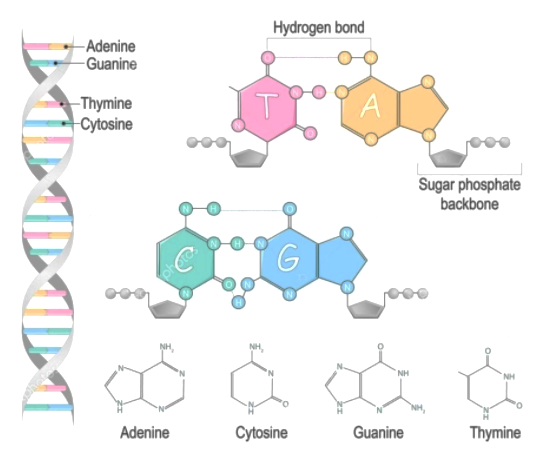
Let us study the function of the options in the DNA.
> Option A- Sugar: It is primarily used as an anchor between the phosphate group and the base. The sugar in the DNA is the ribose sugar, it is a pentose sugar with five carbons. A base + sugar = nucleoside.
> Option B- Purine: It is an aromatic heterocyclic polymer with carbons and nitrogen. Adenine and Guanine are the two purines. Their major work is to uphold the DNA with the help of hydrogen bonds. They are the building blocks of the DNA.
> Option C- Phosphoric acid: A phosphate group is a phosphorus atom with four oxygen atoms. It is the energy carrier responsible for providing energy to our muscles. Nucleoside + phosphate = nucleotide. The phosphate group is present in the form of phosphoric acid i.e. H3PO4. They react with sugars to form the ester bond. This is an acidic group which renders acidity to the DNA
> Option D- Pyrimidines: They are the heterocyclic nitrogenous bases in the nucleic acids. Cytosine and Thymine are the two pyrimidines in the DNA. They serve in human metabolism. They are linked by phosphodiester bonds to purines.
So the answer is option C: Phosphoric acid
Note: RNA is a nucleic acid which is now known to be the genetic material of organisms. It has ribose sugar, it is essential in coding, decoding, regulation, expression of genes. It is the right side, single-stranded molecule. It has Uracil as its pyrimidine base.
Complete answer:
DNA is the genetic material in our body. It is present in the nucleus of our cell. It’s a huge data which is organized in the nucleolus. The genes present in the DNA are transferred to the child from the parents, that is why the DNA of a child is similar to the parents.
DNA is a polymer made up of sugar, nitrogenous bases and phosphate groups. DNA can have four bases – two purines and two pyrimidines. The two adenine are guanine and adenine. The two pyrimidines are cytosine and thymine.
The structure of DNA has a 2’ deoxy-D-ribose sugar which makes it different from the RNA.
Let us study the function of the options in the DNA.
> Option A- Sugar: It is primarily used as an anchor between the phosphate group and the base. The sugar in the DNA is the ribose sugar, it is a pentose sugar with five carbons. A base + sugar = nucleoside.
> Option B- Purine: It is an aromatic heterocyclic polymer with carbons and nitrogen. Adenine and Guanine are the two purines. Their major work is to uphold the DNA with the help of hydrogen bonds. They are the building blocks of the DNA.
> Option C- Phosphoric acid: A phosphate group is a phosphorus atom with four oxygen atoms. It is the energy carrier responsible for providing energy to our muscles. Nucleoside + phosphate = nucleotide. The phosphate group is present in the form of phosphoric acid i.e. H3PO4. They react with sugars to form the ester bond. This is an acidic group which renders acidity to the DNA
> Option D- Pyrimidines: They are the heterocyclic nitrogenous bases in the nucleic acids. Cytosine and Thymine are the two pyrimidines in the DNA. They serve in human metabolism. They are linked by phosphodiester bonds to purines.
So the answer is option C: Phosphoric acid
Note: RNA is a nucleic acid which is now known to be the genetic material of organisms. It has ribose sugar, it is essential in coding, decoding, regulation, expression of genes. It is the right side, single-stranded molecule. It has Uracil as its pyrimidine base.
Recently Updated Pages
Master Class 12 Business Studies: Engaging Questions & Answers for Success

Master Class 12 Chemistry: Engaging Questions & Answers for Success
Master Class 12 Biology: Engaging Questions & Answers for Success
Class 12 Question and Answer - Your Ultimate Solutions Guide
Master Class 11 English: Engaging Questions & Answers for Success
Master Class 11 Social Science: Engaging Questions & Answers for Success
Trending doubts
Which are the Top 10 Largest Countries of the World?
Draw a labelled sketch of the human eye class 12 physics CBSE
Differentiate between homogeneous and heterogeneous class 12 chemistry CBSE
In order to find out the different types of gametes class 12 biology NEET_UG
Why is the cell called the structural and functional class 12 biology CBSE
Draw ray diagrams each showing i myopic eye and ii class 12 physics CBSE