




DNA is a polymer of
(a) Proteins
(b) Carbohydrates
(c) RNA
(d) Nucleotides
Answer
 Verified
633.9k+ views
Hint: These are organic molecules consisting of a nucleoside and a phosphate. They serve as monomeric units of the nucleic acid polymers deoxyribonucleic acid (DNA) and ribonucleic acid (RNA) , both of which are essential biomolecules within all life- forms on Earth.
Correct step by step answer:
DNA is a polymer of nucleotides. The nucleotides are the elementary unit that forms DNA. Nucleotides are composed of three subunit molecules: a nitrogenous base, a five- carbon sugar (a pentose sugar: ribose or deoxyribose) , and a phosphate group consisting of one to three phosphates DNA is formed through phosphorylation of nucleoside. The chain of nucleotides or the polymer of nucleotides is the DNA. It is acidic in nature. There are four different types of nucleotides found in DNA, the only difference among them is of the nitrogenous base. The four nitrogenous bases in DNA are guanine, adenine, cytosine, and thymine; in RNA, uracil is used in place of thymine.
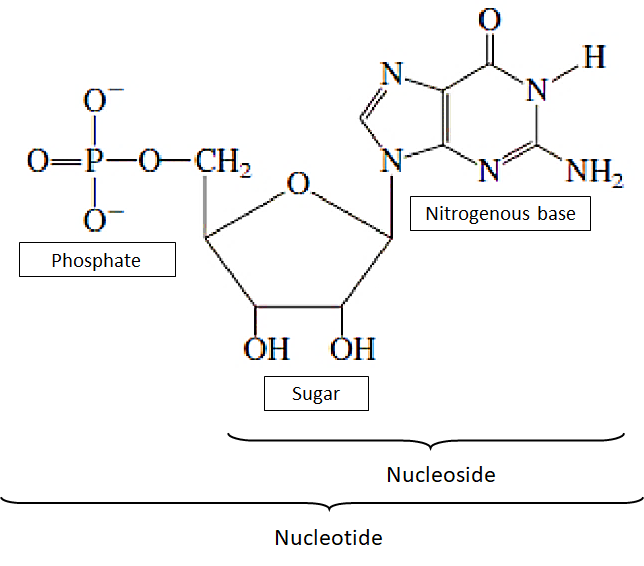
The abbreviation for these nucleotide bases are as follows:
A is for adenine
G is for guanine
C is for cytosine
T is for thymine
U is for uracil
So, the correct answer is, ’Nucleotides’.
Note:
- Adenine and guanine are purines. Purines are the larger of the 2 sorts of bases found in DNA.
- The deoxyribose sugar of the DNA backbone has 5 carbons and three oxygens. The carbon atoms are numbered 1', 2', 3', 4', and 5' to distinguish from the numbering of the atoms of the purine and pyrimidine rings.
- The hydroxyl groups on the 5'- and 3'- carbons link to the phosphate groups to make the DNA backbone. Deoxyribose lacks a hydroxyl at the 2'-position in comparison to ribose, the sugar component of RNA.
- DNA is a normal double- stranded macromolecule. Two polynucleotide chains form a DNA molecule, being held together by weak thermodynamic forces.
Correct step by step answer:
DNA is a polymer of nucleotides. The nucleotides are the elementary unit that forms DNA. Nucleotides are composed of three subunit molecules: a nitrogenous base, a five- carbon sugar (a pentose sugar: ribose or deoxyribose) , and a phosphate group consisting of one to three phosphates DNA is formed through phosphorylation of nucleoside. The chain of nucleotides or the polymer of nucleotides is the DNA. It is acidic in nature. There are four different types of nucleotides found in DNA, the only difference among them is of the nitrogenous base. The four nitrogenous bases in DNA are guanine, adenine, cytosine, and thymine; in RNA, uracil is used in place of thymine.
The abbreviation for these nucleotide bases are as follows:
A is for adenine
G is for guanine
C is for cytosine
T is for thymine
U is for uracil
So, the correct answer is, ’Nucleotides’.
Note:
- Adenine and guanine are purines. Purines are the larger of the 2 sorts of bases found in DNA.
- The deoxyribose sugar of the DNA backbone has 5 carbons and three oxygens. The carbon atoms are numbered 1', 2', 3', 4', and 5' to distinguish from the numbering of the atoms of the purine and pyrimidine rings.
- The hydroxyl groups on the 5'- and 3'- carbons link to the phosphate groups to make the DNA backbone. Deoxyribose lacks a hydroxyl at the 2'-position in comparison to ribose, the sugar component of RNA.
- DNA is a normal double- stranded macromolecule. Two polynucleotide chains form a DNA molecule, being held together by weak thermodynamic forces.
Recently Updated Pages
Basicity of sulphurous acid and sulphuric acid are

Master Class 12 Economics: Engaging Questions & Answers for Success
Master Class 12 Biology: Engaging Questions & Answers for Success
Master Class 11 English: Engaging Questions & Answers for Success
Master Class 11 Physics: Engaging Questions & Answers for Success
Master Class 11 Computer Science: Engaging Questions & Answers for Success
Trending doubts
Draw a labelled sketch of the human eye class 12 physics CBSE
The chemical formula of tear gas is A CO Cl 2 B C 10 class 12 chemistry CBSE
Draw ray diagrams each showing i myopic eye and ii class 12 physics CBSE
Which are the Top 10 Largest Countries of the World?
Differentiate between homogeneous and heterogeneous class 12 chemistry CBSE
Which is the correct genotypic ratio of mendel dihybrid class 12 biology CBSE