




What is DNA fingerprinting? Why is it called fingerprinting?
Answer
 Verified
615.6k+ views
Hint: In DNA fingerprinting, chemicals are used for isolating DNA strands in order to identify the uniqueness of a person’s genome. The samples are in the form of a sequence of stripes that are further compared with other samples.
Complete answer:
DNA (deoxyribonucleic acid) is like the blueprint of human genetic makeup. A DNA fingerprint, therefore, is a DNA pattern that has a unique sequence that can be distinguished from the DNA patterns of other individuals. It relies on short tandem repeats (STRs). These are unique to individuals. The satellite DNA sections can be compared between the two samples. The Satellite DNA is repetitive DNA that does not code for any specific protein. These non-coding sequences form a major part of the DNA of humans. This helps to study the whole sequence by looking at specific sites for the presence or absence of common markers that can be quickly and easily identified.
Steps of DNA fingerprinting involves:
Isolate the DNA.
↓
Digest the DNA with the help of restriction endonuclease enzymes.
↓
Separate the digested fragments as per the fragment size by the process of electrophoresis.
↓
Blot the separated fragments onto synthetic membranes like nylon.
↓
Hybridise the fragments using labelled VNTR probes.
↓
Analyse the hybrid fragments.
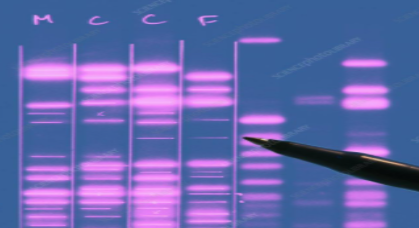
Note: DNA fingerprinting can also be used to determine how closely species are related to one another. Further, it helps to track their spread over time. This ability to look directly at an organism’s gene markers has made it very easy to understand zoology, botany, agriculture and even human history.
Complete answer:
DNA (deoxyribonucleic acid) is like the blueprint of human genetic makeup. A DNA fingerprint, therefore, is a DNA pattern that has a unique sequence that can be distinguished from the DNA patterns of other individuals. It relies on short tandem repeats (STRs). These are unique to individuals. The satellite DNA sections can be compared between the two samples. The Satellite DNA is repetitive DNA that does not code for any specific protein. These non-coding sequences form a major part of the DNA of humans. This helps to study the whole sequence by looking at specific sites for the presence or absence of common markers that can be quickly and easily identified.
Steps of DNA fingerprinting involves:
Isolate the DNA.
↓
Digest the DNA with the help of restriction endonuclease enzymes.
↓
Separate the digested fragments as per the fragment size by the process of electrophoresis.
↓
Blot the separated fragments onto synthetic membranes like nylon.
↓
Hybridise the fragments using labelled VNTR probes.
↓
Analyse the hybrid fragments.
Note: DNA fingerprinting can also be used to determine how closely species are related to one another. Further, it helps to track their spread over time. This ability to look directly at an organism’s gene markers has made it very easy to understand zoology, botany, agriculture and even human history.
Recently Updated Pages
Master Class 12 Business Studies: Engaging Questions & Answers for Success

Master Class 12 Chemistry: Engaging Questions & Answers for Success
Master Class 12 Biology: Engaging Questions & Answers for Success
Class 12 Question and Answer - Your Ultimate Solutions Guide
Master Class 11 English: Engaging Questions & Answers for Success
Master Class 11 Social Science: Engaging Questions & Answers for Success
Trending doubts
Which are the Top 10 Largest Countries of the World?
Draw a labelled sketch of the human eye class 12 physics CBSE
The end of compass needle which points towards north class 12 physics CBSE
Differentiate between homogeneous and heterogeneous class 12 chemistry CBSE
In order to find out the different types of gametes class 12 biology NEET_UG
Why is the cell called the structural and functional class 12 biology CBSE