




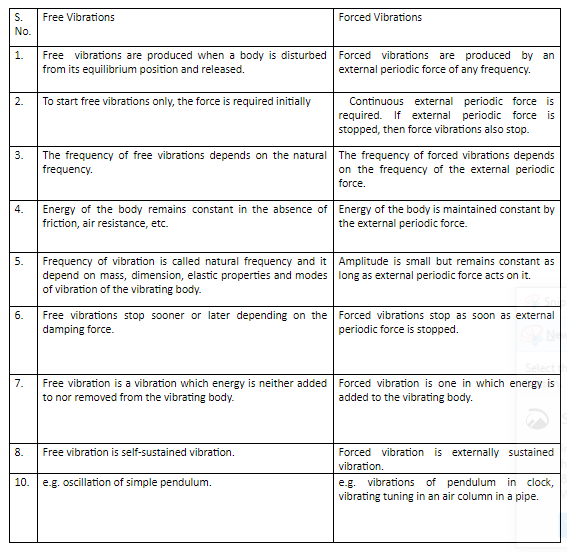
Distinguish between the free (or natural) and forced vibrations.
Answer
 Verified
638.1k+ views
Hint: Here we will proceed by defining the free and forced vibrations, the by differentiating with respect to their properties we will get our answer.
Step By Step Answer:
Free vibrations: Vibrations that occur in the absence of friction and external forces after initial release of the body.
Forced vibrations: When repeated force continuously acts on the system the vibrations are said to be forced vibrations.
Note: Whenever we come up with this type of question, one must know that vibration is a periodic motion of the particles of an elastic body or medium in alternately opposite directions from the position of equilibrium when that equilibrium has been disturbed. By using the basics of vibration we can differentiate different types of vibrations.
Step By Step Answer:
Free vibrations: Vibrations that occur in the absence of friction and external forces after initial release of the body.
Forced vibrations: When repeated force continuously acts on the system the vibrations are said to be forced vibrations.
Note: Whenever we come up with this type of question, one must know that vibration is a periodic motion of the particles of an elastic body or medium in alternately opposite directions from the position of equilibrium when that equilibrium has been disturbed. By using the basics of vibration we can differentiate different types of vibrations.
Recently Updated Pages
Master Class 11 English: Engaging Questions & Answers for Success

Master Class 11 Social Science: Engaging Questions & Answers for Success
Master Class 11 Maths: Engaging Questions & Answers for Success
Master Class 11 Biology: Engaging Questions & Answers for Success
Master Class 11 Physics: Engaging Questions & Answers for Success
Master Class 11 Chemistry: Engaging Questions & Answers for Success
Trending doubts
One Metric ton is equal to kg A 10000 B 1000 C 100 class 11 physics CBSE
Difference Between Prokaryotic Cells and Eukaryotic Cells
1 ton equals to A 100 kg B 1000 kg C 10 kg D 10000 class 11 physics CBSE
Find the value of the expression given below sin 30circ class 11 maths CBSE
Two of the body parts which do not appear in MRI are class 11 biology CBSE
Draw a diagram of a plant cell and label at least eight class 11 biology CBSE