




Distinguish between p-type and n-type semiconductors.
Answer
 Verified
634.5k+ views
Hint: n-type and p-type semiconductors are made by doping a semiconductor with pentavalent and tetravalent impurity atom respectively. In the case of a p-type semiconductor, the conduction occurs due to the creation of a hole created with the addition of a tetravalent impurity.
Complete step by step answer:
A semiconductor is a type of material that normally behaves as an insulator but when a certain condition is like temperature is increased they start behaving as a conductor. To increase a semiconductor’s conductivity, they are doped with certain impurities. The element to which impurity is added is known as a dopant.
Based on the impurity added to the dopant, the semiconductor is of p-type and n-type:
- When a tetravalent semiconductor $Si$ (or $Ge$) is doped with a trivalent impurity such as $B$, $Al$, $Ga$, etc. the type of semiconductor formed is a p-type semiconductor. Since the addition of a trivalent impurity creates a hole that can accept an electron from the neighboring bond hence a trivalent impurity atom is known as an acceptor.
- Similarly, when a tetravalent semiconductor is doped with a pentavalent impurity, the type of semiconductor formed is an n-type semiconductor. Since, In the case of a pentavalent impurity, the atom gives an extra electron for conduction therefore in this case the pentavalent impurity is a donor.
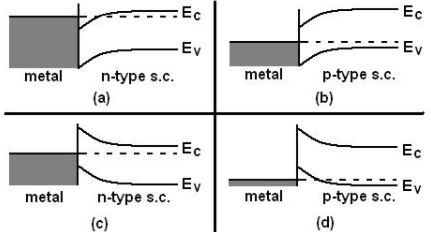
Note:
- The phenomenon of adding a small amount of impurity to a substance to increase its conductivity is known as doping.
- In a p-type semiconductor, holes are the majority charge carrier, and electrons are the minority charge carrier.
- In an n-type semiconductor, the majority charge carriers are electrons whereas the holes are only a minority charge carrier.
- In the case of an n-type semiconductor, the current starts flowing due to the presence of an extra electron due to the addition of a pentavalent impurity.
Complete step by step answer:
A semiconductor is a type of material that normally behaves as an insulator but when a certain condition is like temperature is increased they start behaving as a conductor. To increase a semiconductor’s conductivity, they are doped with certain impurities. The element to which impurity is added is known as a dopant.
Based on the impurity added to the dopant, the semiconductor is of p-type and n-type:
- When a tetravalent semiconductor $Si$ (or $Ge$) is doped with a trivalent impurity such as $B$, $Al$, $Ga$, etc. the type of semiconductor formed is a p-type semiconductor. Since the addition of a trivalent impurity creates a hole that can accept an electron from the neighboring bond hence a trivalent impurity atom is known as an acceptor.
- Similarly, when a tetravalent semiconductor is doped with a pentavalent impurity, the type of semiconductor formed is an n-type semiconductor. Since, In the case of a pentavalent impurity, the atom gives an extra electron for conduction therefore in this case the pentavalent impurity is a donor.
Note:
- The phenomenon of adding a small amount of impurity to a substance to increase its conductivity is known as doping.
- In a p-type semiconductor, holes are the majority charge carrier, and electrons are the minority charge carrier.
- In an n-type semiconductor, the majority charge carriers are electrons whereas the holes are only a minority charge carrier.
- In the case of an n-type semiconductor, the current starts flowing due to the presence of an extra electron due to the addition of a pentavalent impurity.
Recently Updated Pages
Basicity of sulphurous acid and sulphuric acid are

Master Class 12 Economics: Engaging Questions & Answers for Success
Master Class 12 Biology: Engaging Questions & Answers for Success
Master Class 11 English: Engaging Questions & Answers for Success
Master Class 11 Physics: Engaging Questions & Answers for Success
Master Class 11 Computer Science: Engaging Questions & Answers for Success
Trending doubts
Draw a labelled sketch of the human eye class 12 physics CBSE
The chemical formula of tear gas is A CO Cl 2 B C 10 class 12 chemistry CBSE
Draw ray diagrams each showing i myopic eye and ii class 12 physics CBSE
Which are the Top 10 Largest Countries of the World?
Differentiate between homogeneous and heterogeneous class 12 chemistry CBSE
Which is the correct genotypic ratio of mendel dihybrid class 12 biology CBSE