




Distinguish between light and dark reactions
Answer
 Verified
640.5k+ views
Hint: Light reaction dark reactions are a part of photosynthesis. Photosynthesis is the most essential process in the plant for the production of oxygen. It requires a constant source of light for the initiation of the process.
Complete answer:
Photosynthesis is the process where the light energy is converted into chemical energy. It is carried out in stages.
It has two phases:
- The first phase is a light dependent process. It is a photochemical phase of the process. It is known as light reaction.
- The second phase is a light independent process. It is known as a dark reaction.
The whole process takes place inside the chloroplast.
Light reaction - In this reaction light is essential. It involves absorption of light, hydrolysis, oxygen release and formation of ATP and NADPH. It has two types of photosystems— I and II
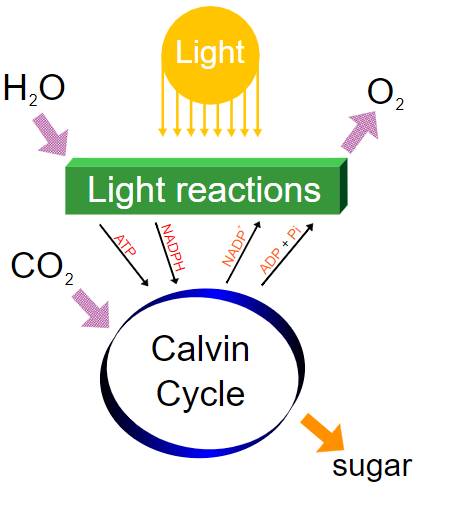
I absorb light at 700 nm and II absorb at 680 nm wavelength. This reaction takes place in thylakoids. When light hits on the light energy molecules it gets converted to ATP and NADPH. It releases oxygen.
Dark reaction— It is known as carbon fixing reaction. Light is not required. Sugar formation takes place here with the help of carbon dioxide and water. It takes inside the stroma. Glucose formation is seen in this process.
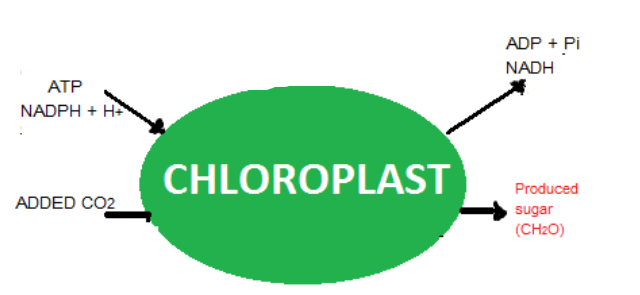
Note: Photosynthesis is the process where the light energy is converted into chemical energy. It has two stages i.e. light and dark reactions. This process takes place in the chloroplast. Oxygen is released in light reaction and Carbon dioxide is utilised in dark reactions.
Complete answer:
Photosynthesis is the process where the light energy is converted into chemical energy. It is carried out in stages.
It has two phases:
- The first phase is a light dependent process. It is a photochemical phase of the process. It is known as light reaction.
- The second phase is a light independent process. It is known as a dark reaction.
The whole process takes place inside the chloroplast.
Light reaction - In this reaction light is essential. It involves absorption of light, hydrolysis, oxygen release and formation of ATP and NADPH. It has two types of photosystems— I and II
I absorb light at 700 nm and II absorb at 680 nm wavelength. This reaction takes place in thylakoids. When light hits on the light energy molecules it gets converted to ATP and NADPH. It releases oxygen.
Dark reaction— It is known as carbon fixing reaction. Light is not required. Sugar formation takes place here with the help of carbon dioxide and water. It takes inside the stroma. Glucose formation is seen in this process.
| Light reaction | Dark reaction |
| Light dependent | Light independent |
| Photochemical reaction | Biochemical reaction |
| It takes place in the thylakoids | It takes place in stroma |
| ATP and NAPDh are formed | Glucose is formed |
| Oxygen is released | Carbon dioxide is utilised |
Note: Photosynthesis is the process where the light energy is converted into chemical energy. It has two stages i.e. light and dark reactions. This process takes place in the chloroplast. Oxygen is released in light reaction and Carbon dioxide is utilised in dark reactions.
Recently Updated Pages
Basicity of sulphurous acid and sulphuric acid are

Master Class 12 Economics: Engaging Questions & Answers for Success
Master Class 12 Biology: Engaging Questions & Answers for Success
Master Class 11 English: Engaging Questions & Answers for Success
Master Class 11 Physics: Engaging Questions & Answers for Success
Master Class 11 Computer Science: Engaging Questions & Answers for Success
Trending doubts
Draw a labelled sketch of the human eye class 12 physics CBSE
Why is the cell called the structural and functional class 12 biology CBSE
Draw ray diagrams each showing i myopic eye and ii class 12 physics CBSE
Which are the Top 10 Largest Countries of the World?
Differentiate between homogeneous and heterogeneous class 12 chemistry CBSE
Which is the correct genotypic ratio of mendel dihybrid class 12 biology CBSE