




Distinguish between Ammeter and Voltmeter.
Answer
 Verified
631.8k+ views
Hint: Ammeter and voltmeter, both the devices are connected in a circuit in order to measure the different aspects of electricity. Ammeter is used to measure the value of electric current, while voltmeter is used to measure the voltage or the potential difference between two points in a circuit.
Complete step by step answer:
There are two ways how we can measure electricity in a circuit. The first one is by measuring electric current where ammeter is being used and another one is by measuring the voltage or the voltage difference where voltmeter is being used. Both of these devices find their use in electric circuits but the major difference between the voltmeter and the ammeter is that; ammeter comes in handy for measuring the flow of electric current whereas the voltmeter comes in handy for measuring the voltage or the electromotive force across two points in an electric circuit.
Representation of Ammeter and Voltmeter in a circuit:
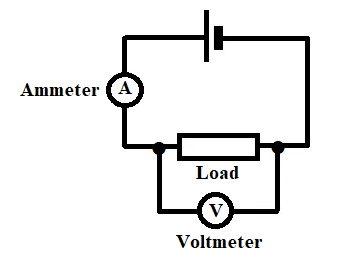
Table of differences between Ammeter and Voltmeter:
Note: The ammeter is used for measuring the value of electric current in a circuit and the result is displayed in amperes (or miliamperes, or microamperes, as per the chosen scale), when it is connected in series with the circuit so that the entire current in the circuit is passing through the ammeter. The voltmeter is connected in parallel with the electric circuit in order to measure the voltage or potential difference between two points.
The devices, ammeter and voltmeter, have the same connection polarity in a circuit, that is, the negative potential of the device is connected to the negative polarity and positive terminal is joined with the positive polarity of the supply.
Complete step by step answer:
There are two ways how we can measure electricity in a circuit. The first one is by measuring electric current where ammeter is being used and another one is by measuring the voltage or the voltage difference where voltmeter is being used. Both of these devices find their use in electric circuits but the major difference between the voltmeter and the ammeter is that; ammeter comes in handy for measuring the flow of electric current whereas the voltmeter comes in handy for measuring the voltage or the electromotive force across two points in an electric circuit.
Representation of Ammeter and Voltmeter in a circuit:
Table of differences between Ammeter and Voltmeter:
| Ammeter | Voltmeter | |
| Use | It is used to measure the flow of electric current in a circuit. | It is used to measure the voltage or potential difference in a circuit. |
| Connection | It is always connected in series with the electrical circuit element. | It is always connected in parallel with the electrical circuit element. |
| Resistance | The resistance of ammeter is low so that it does not affect the flow of current in the circuit. | The resistance of voltmeter is high in order to measure the potential difference between two points in the circuit. |
| Range | The range of an ammeter can be changed. | The range of voltmeter cannot be changed. |
| Accuracy | It measures the value of electric current accurately. | It is less accurate with the measurement of potential difference. |
| Ideal case | An ideal ammeter is supposed to have zero resistance; however, it is not practically possible. | An ideal voltmeter is supposed to have infinite resistance. |
| Representation | ‘A’ is used to denote an ammeter. | ‘V’ is used to denote a voltmeter. |
Note: The ammeter is used for measuring the value of electric current in a circuit and the result is displayed in amperes (or miliamperes, or microamperes, as per the chosen scale), when it is connected in series with the circuit so that the entire current in the circuit is passing through the ammeter. The voltmeter is connected in parallel with the electric circuit in order to measure the voltage or potential difference between two points.
The devices, ammeter and voltmeter, have the same connection polarity in a circuit, that is, the negative potential of the device is connected to the negative polarity and positive terminal is joined with the positive polarity of the supply.
Recently Updated Pages
Master Class 12 Business Studies: Engaging Questions & Answers for Success

Master Class 12 Chemistry: Engaging Questions & Answers for Success
Master Class 12 Biology: Engaging Questions & Answers for Success
Class 12 Question and Answer - Your Ultimate Solutions Guide
Master Class 11 English: Engaging Questions & Answers for Success
Master Class 11 Social Science: Engaging Questions & Answers for Success
Trending doubts
Which are the Top 10 Largest Countries of the World?
Draw a labelled sketch of the human eye class 12 physics CBSE
Differentiate between homogeneous and heterogeneous class 12 chemistry CBSE
Differentiate between Pyramid of energy and pyramid class 12 biology CBSE
Why is the cell called the structural and functional class 12 biology CBSE
Draw the diagram of the pyramid of energy Explain In class 12 biology CBSE