




What is the distance between a crest and a trough in a wave?
A. $\lambda $
B. $\lambda /2$
C. $\lambda /4$
D. $2\lambda $
Answer
 Verified
611.1k+ views
Hint: Waves originate from a disturbance and the energy of such disturbances propagate in the form of waves. The main characteristic of a wave is its repetitive motion. Waves have moving alternate crests and troughs. A crest of the wave refers to the highest part of that wave and the trough refers to the lowest part of the wave. A crest is a point of the wave at which displacement of the medium will be maximum and on the other hand, at trough there is a least displacement of medium.
Complete step by step answer:
If we consider a wave cycle, a wave originates from its starting point and goes up to form a crest then goes down to form a trough and then return back to its starting point. Any type of wave, whether it is sound wave, electromagnetic wave or sea wave, the distance between a crest and trough is known as wavelength of that wave. The given below figure shows the crest, trough and wavelength of a wave.
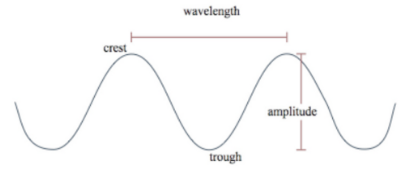
For mathematical purposes, a wavelength is denoted by the Greek letter lambda or $\lambda $. The units used for measuring wavelength of the waves are meter, centimeter or nanometer and it depends upon the type of wave. The distance between a crest and a trough in a wave is wavelength and is denoted by $\lambda $.
Hence, the correct option is option A.
Note: The wavelength is related to the horizontal distance between a crest and a trough. Similarly, wave height is the vertical distance between the crest and trough of a wave. The amplitude of a wave and wave height are not the same. Amplitude of the wave is half the wave height. The amplitude is considered as the measure of intensity of the wave.
Complete step by step answer:
If we consider a wave cycle, a wave originates from its starting point and goes up to form a crest then goes down to form a trough and then return back to its starting point. Any type of wave, whether it is sound wave, electromagnetic wave or sea wave, the distance between a crest and trough is known as wavelength of that wave. The given below figure shows the crest, trough and wavelength of a wave.
For mathematical purposes, a wavelength is denoted by the Greek letter lambda or $\lambda $. The units used for measuring wavelength of the waves are meter, centimeter or nanometer and it depends upon the type of wave. The distance between a crest and a trough in a wave is wavelength and is denoted by $\lambda $.
Hence, the correct option is option A.
Note: The wavelength is related to the horizontal distance between a crest and a trough. Similarly, wave height is the vertical distance between the crest and trough of a wave. The amplitude of a wave and wave height are not the same. Amplitude of the wave is half the wave height. The amplitude is considered as the measure of intensity of the wave.
Recently Updated Pages
Master Class 11 English: Engaging Questions & Answers for Success

Master Class 11 Social Science: Engaging Questions & Answers for Success
Master Class 11 Maths: Engaging Questions & Answers for Success
Master Class 11 Biology: Engaging Questions & Answers for Success
Master Class 11 Physics: Engaging Questions & Answers for Success
Master Class 11 Chemistry: Engaging Questions & Answers for Success
Trending doubts
Difference Between Plant Cell and Animal Cell
Fill the blanks with the suitable prepositions 1 The class 9 english CBSE
What is pollution? How many types of pollution? Define it
Name 10 Living and Non living things class 9 biology CBSE
What is the full form of pH?
On an outline map of India show its neighbouring c class 9 social science CBSE