




Who discovered that mosquito served as a carrier of malaria?
a) Jonas Salk
b) Ronald Ross
c) Louis Pasteur
d) Robert Koch
Answer
 Verified
594.6k+ views
Hint: Malaria is a ubiquitous disease that afflicts humans throughout our evolutionary history. The parasite of malaria is a sporozoan that belongs to the genus Plasmodium.
Complete answer:
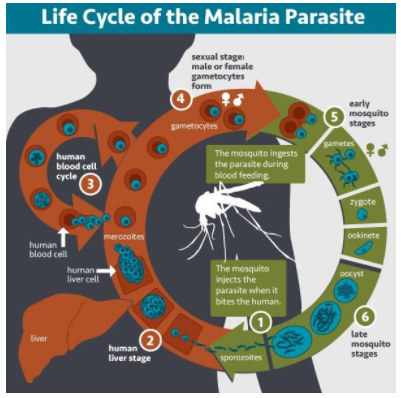
Sir Ronald Ross made the first breakthrough in the study of malaria while working in Secunderabad (then in the Nizam of Hyderabad). He raised 20 mosquitoes in 1897 and let them feed on a malaria patient’s blood. On August 20th now (World Mosquito Day) Sir Ross discovered the malarial parasite in the stomach of one of his raised mosquitoes. The next day, he confirmed that the parasite was growing in the body of the mosquito. In the next year in 1898 in Kolkata (then Calcutta), at the Presidency General Hospital (now the SSKM Hospital), Sir Ross confirmed the mechanism of spread of the parasite. Sir Ross's description of the life cycle of the malarial parasite (Plasmodium) won him the Nobel Prize for Medicine in 1902. The term "malaria" is derived from the Italian word for "bad air" so the malaria is associated with marshes and swamps.
Sign and symptoms of malaria infection are:
> fever and flu-like symptoms
> Headaches and muscle or joint pain.
Symptoms usually appear after an incubation period of 10 to 14 days post infective bite. Upon entering the bloodstream of the host, Plasmodium first inhabits the liver and quietly multiplies in the blood. Fever is intermittent, recurring after fixed intervals. This phase marks the erythrocytic cycle.
So, the correct answer is an option (B), Ronald Ross.
Note: The malarial parasite is a sporozoan that belongs to the genus Plasmodium of Kingdom Protista. Its four species threaten humans and they are:
P. falciparum
P. malariae
P. vivax
P. ovale.
Out of four, P. falciparum and P. vivax are the most common malarial parasites, while P. falciparum by far the most dangerous.
Complete answer:
Sir Ronald Ross made the first breakthrough in the study of malaria while working in Secunderabad (then in the Nizam of Hyderabad). He raised 20 mosquitoes in 1897 and let them feed on a malaria patient’s blood. On August 20th now (World Mosquito Day) Sir Ross discovered the malarial parasite in the stomach of one of his raised mosquitoes. The next day, he confirmed that the parasite was growing in the body of the mosquito. In the next year in 1898 in Kolkata (then Calcutta), at the Presidency General Hospital (now the SSKM Hospital), Sir Ross confirmed the mechanism of spread of the parasite. Sir Ross's description of the life cycle of the malarial parasite (Plasmodium) won him the Nobel Prize for Medicine in 1902. The term "malaria" is derived from the Italian word for "bad air" so the malaria is associated with marshes and swamps.
Sign and symptoms of malaria infection are:
> fever and flu-like symptoms
> Headaches and muscle or joint pain.
Symptoms usually appear after an incubation period of 10 to 14 days post infective bite. Upon entering the bloodstream of the host, Plasmodium first inhabits the liver and quietly multiplies in the blood. Fever is intermittent, recurring after fixed intervals. This phase marks the erythrocytic cycle.
So, the correct answer is an option (B), Ronald Ross.
Note: The malarial parasite is a sporozoan that belongs to the genus Plasmodium of Kingdom Protista. Its four species threaten humans and they are:
P. falciparum
P. malariae
P. vivax
P. ovale.
Out of four, P. falciparum and P. vivax are the most common malarial parasites, while P. falciparum by far the most dangerous.
Recently Updated Pages
Master Class 12 Economics: Engaging Questions & Answers for Success

Master Class 12 Physics: Engaging Questions & Answers for Success
Master Class 12 English: Engaging Questions & Answers for Success
Master Class 12 Social Science: Engaging Questions & Answers for Success
Master Class 12 Maths: Engaging Questions & Answers for Success
Master Class 12 Business Studies: Engaging Questions & Answers for Success
Trending doubts
Which are the Top 10 Largest Countries of the World?
What are the major means of transport Explain each class 12 social science CBSE
Draw a labelled sketch of the human eye class 12 physics CBSE
Why cannot DNA pass through cell membranes class 12 biology CBSE
Differentiate between insitu conservation and exsitu class 12 biology CBSE
Draw a neat and well labeled diagram of TS of ovary class 12 biology CBSE