




Who discovered a C.T scan?
A. Withem Konrad Röntgen
B. Bloch and Purcell
C. Hounsfield
D. Gopal Samudram
Answer
 Verified
623.4k+ views
Hint: Computed Tomography (CT) imaging is also known as "CAT scanning" (Computed Axial Tomography).
Tomography is from the Greek word "tomos" meaning "slice" or "section" and "graphia" meaning "describing.
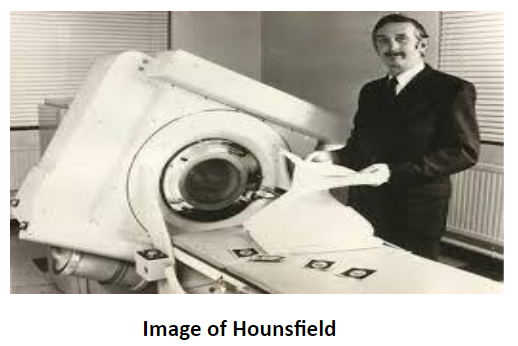
Complete answer: CT was invented in 1972 by British engineer Godfrey Hounsfield of EMI Laboratories, England and by South Africa-born physicist Allan Cormack of Tufts University, Massachusetts.
Hounsfield and Cormack were later awarded the Nobel Peace Prize for their contributions to medicine and science.
CT scans can detect bone and joint diseases, like complex bone fractures and tumors.
If you have a condition like cancer, heart disease, emphysema, or liver masses, CT scans can find it or help doctors see any changes.
They show internal injuries and bleeding, such as those caused by a car accident and other infections.
Additional information: The original systems were dedicated to head imaging only, but "whole body" systems with larger patient openings became available in 1976.
CT scans became widely available by about 1980.
The first CT scanner developed by Hounsfield in his lab at EMI took several hours to acquire the raw data for a single scan or "slice" and took days to reconstruct a single image from this raw data. Whereas the recent CT scans can acquire data quite easily.
So, the answer is C. Hounsfield
Note: CT scan replaced the more invasive pneumoencephalography for imaging of the brain, as well as most applications of focal plane tomography.
Tomography is from the Greek word "tomos" meaning "slice" or "section" and "graphia" meaning "describing.
Complete answer: CT was invented in 1972 by British engineer Godfrey Hounsfield of EMI Laboratories, England and by South Africa-born physicist Allan Cormack of Tufts University, Massachusetts.
Hounsfield and Cormack were later awarded the Nobel Peace Prize for their contributions to medicine and science.
CT scans can detect bone and joint diseases, like complex bone fractures and tumors.
If you have a condition like cancer, heart disease, emphysema, or liver masses, CT scans can find it or help doctors see any changes.
They show internal injuries and bleeding, such as those caused by a car accident and other infections.
Additional information: The original systems were dedicated to head imaging only, but "whole body" systems with larger patient openings became available in 1976.
CT scans became widely available by about 1980.
The first CT scanner developed by Hounsfield in his lab at EMI took several hours to acquire the raw data for a single scan or "slice" and took days to reconstruct a single image from this raw data. Whereas the recent CT scans can acquire data quite easily.
So, the answer is C. Hounsfield
Note: CT scan replaced the more invasive pneumoencephalography for imaging of the brain, as well as most applications of focal plane tomography.
Recently Updated Pages
Master Class 12 Economics: Engaging Questions & Answers for Success

Master Class 12 English: Engaging Questions & Answers for Success
Master Class 12 Social Science: Engaging Questions & Answers for Success
Master Class 12 Maths: Engaging Questions & Answers for Success
Master Class 12 Physics: Engaging Questions & Answers for Success
Master Class 9 General Knowledge: Engaging Questions & Answers for Success
Trending doubts
Which are the Top 10 Largest Countries of the World?
Draw a labelled sketch of the human eye class 12 physics CBSE
Differentiate between homogeneous and heterogeneous class 12 chemistry CBSE
Why is the cell called the structural and functional class 12 biology CBSE
Draw ray diagrams each showing i myopic eye and ii class 12 physics CBSE
Which is the correct genotypic ratio of mendel dihybrid class 12 biology CBSE