




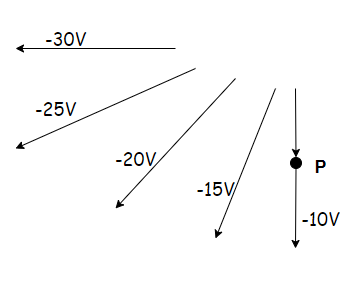
What is the direction of electric field E at point P in the following diagram:
Answer
 Verified
623.7k+ views
Hint: Use the fact that: Electric field always moves from higher to the lower potential and perpendicular to the equipotential surface.
Complete step by step answer:
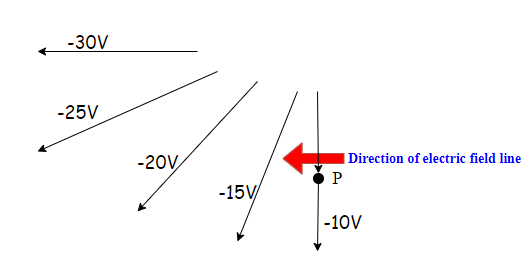
Here, in the given diagram all the lines shown are equipotential surfaces.
Equipotential surface: An equipotential surface is a surface over which the potential is constant everywhere in its plane. Or we can also say that the potential difference between any two points on an equipotential surface is equal to zero.
Below are some important points related to equipotential surfaces:
1. The work done in moving a charge over an equipotential surface is always zero.
2. The direction of the electric field is always perpendicular to an equipotential surface.
3. Any two equipotential surfaces can never intersect, if they could intersect, then at their point of intersection there would have been two values of electric potential which is not possible in real.
So, as we know electric fields move from higher potential to the lower potential and perpendicular to the equipotential surface.
Therefore, at point P, the electric field moves towards left direction and perpendicular to the −10 V surface.
Note:
The potential difference between any two points can be expressed in terms of electric field as:
\[{V_a} - {V_b} = \int {E.dl} \]
Therefore, Electric field (E) as a function of potential can be expressed as:
\[{\vec E_r} = - \dfrac{{dV}}{{dr}}\]
where \[{\vec E_r}\] is the component of electric field along the direction of \[\dfrac{{dV}}{{dr}}\] which is known as the potential gradient and the negative sign here, infers that electric field acts in a direction of decrease of potential.
The expression above also signifies that E is not certainly zero if V is zero it will be constant.
Complete step by step answer:
Here, in the given diagram all the lines shown are equipotential surfaces.
Equipotential surface: An equipotential surface is a surface over which the potential is constant everywhere in its plane. Or we can also say that the potential difference between any two points on an equipotential surface is equal to zero.
Below are some important points related to equipotential surfaces:
1. The work done in moving a charge over an equipotential surface is always zero.
2. The direction of the electric field is always perpendicular to an equipotential surface.
3. Any two equipotential surfaces can never intersect, if they could intersect, then at their point of intersection there would have been two values of electric potential which is not possible in real.
So, as we know electric fields move from higher potential to the lower potential and perpendicular to the equipotential surface.
Therefore, at point P, the electric field moves towards left direction and perpendicular to the −10 V surface.
Note:
The potential difference between any two points can be expressed in terms of electric field as:
\[{V_a} - {V_b} = \int {E.dl} \]
Therefore, Electric field (E) as a function of potential can be expressed as:
\[{\vec E_r} = - \dfrac{{dV}}{{dr}}\]
where \[{\vec E_r}\] is the component of electric field along the direction of \[\dfrac{{dV}}{{dr}}\] which is known as the potential gradient and the negative sign here, infers that electric field acts in a direction of decrease of potential.
The expression above also signifies that E is not certainly zero if V is zero it will be constant.
Recently Updated Pages
Master Class 12 Business Studies: Engaging Questions & Answers for Success

Master Class 12 Chemistry: Engaging Questions & Answers for Success
Master Class 12 Biology: Engaging Questions & Answers for Success
Class 12 Question and Answer - Your Ultimate Solutions Guide
Master Class 11 English: Engaging Questions & Answers for Success
Master Class 11 Social Science: Engaging Questions & Answers for Success
Trending doubts
Which are the Top 10 Largest Countries of the World?
Draw a labelled sketch of the human eye class 12 physics CBSE
Differentiate between homogeneous and heterogeneous class 12 chemistry CBSE
In order to find out the different types of gametes class 12 biology NEET_UG
Why is the cell called the structural and functional class 12 biology CBSE
Draw ray diagrams each showing i myopic eye and ii class 12 physics CBSE