




What is the differential equation of all parabolas whose axis is along the y-axis?
$\left( a \right)x\dfrac{{{d^2}y}}{{d{x^2}}} - \dfrac{{dy}}{{dx}} = 0$
$\left( b \right)x\dfrac{{{d^2}y}}{{d{x^2}}} + \dfrac{{dy}}{{dx}} = 0$
$\left( c \right)\dfrac{{{d^2}y}}{{d{x^2}}} - y = 0$
$\left( d \right)\dfrac{{{d^2}y}}{{d{x^2}}} - \dfrac{{dy}}{{dx}} = 0$
Answer
 Verified
594.3k+ views
Hint: In this particular question consider the standard equation of parabola whose axis is along the y-axis which is given as, ${x^2} = 4ay$, then differentiate this equation w.r.t x, until the constant is eliminated so use these concepts to reach the solution of the question.
Complete step-by-step solution:
Now,
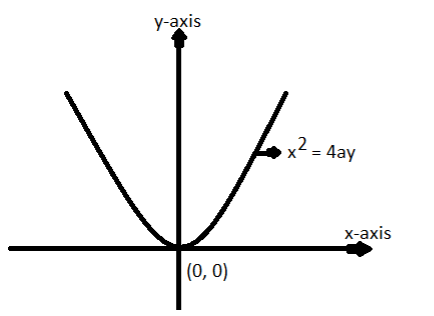
Consider a standard equation of parabola whose axis is along the y-axis which is given as, ${x^2} = 4ay$ as shown in the above figure.
Now differentiate this equation w.r.t x using the property that $\dfrac{d}{{dx}}{x^n} = n{x^{n - 1}},\dfrac{d}{{dx}}y = \dfrac{{dy}}{{dx}}$ so we have,
$ \Rightarrow \dfrac{d}{{dx}}{x^2} = \dfrac{d}{{dx}}\left( {4ay} \right)$
As 4a is constant so it can be written outside the differential operator so we have,
$ \Rightarrow \dfrac{d}{{dx}}{x^2} = 4a\dfrac{d}{{dx}}\left( y \right)$
Now differentiate it we have,
$ \Rightarrow 2{x^{2 - 1}} = 4a\dfrac{{dy}}{{dx}}$
$ \Rightarrow x = 2a\dfrac{{dy}}{{dx}}$................. (1)
Now as we know that in differential equation constant parameters are not present so we have to eliminate them so again differentiate equation (1) w.r.t x until the constant parameter is eliminated so we have,
$ \Rightarrow \dfrac{d}{{dx}}x = \dfrac{d}{{dx}}\left( {2a\dfrac{{dy}}{{dx}}} \right)$
Now differentiate it we have,
$ \Rightarrow 1 = 2a\dfrac{{{d^2}y}}{{d{x^2}}}$......................... (2)
Now from equation (1) the value of 2a is
$ \Rightarrow 2a = \dfrac{x}{{\dfrac{{dy}}{{dx}}}}$
Substitute this value I equation (2) we have,
$ \Rightarrow 1 = \dfrac{x}{{\dfrac{{dy}}{{dx}}}}\left( {\dfrac{{{d^2}y}}{{d{x^2}}}} \right)$
Now simplify this we have,
$ \Rightarrow \dfrac{{dy}}{{dx}} = x\left( {\dfrac{{{d^2}y}}{{d{x^2}}}} \right)$
$ \Rightarrow x\dfrac{{{d^2}y}}{{d{x^2}}} - \dfrac{{dy}}{{dx}} = 0$
So this is the required differential equation.
Hence option (a) is the correct answer.
Note: For such types of questions just keep in mind that the differentiation allows us to find the rate of change of a variable w.r.t another variable. Always recall the basic property of differentiation which is given as $\dfrac{d}{{dx}}{x^n} = n{x^{n - 1}},\dfrac{d}{{dx}}y = \dfrac{{dy}}{{dx}}$. Moreover, a differential equation is an equation that relates one or more functions and their derivatives.
Complete step-by-step solution:
Now,
Consider a standard equation of parabola whose axis is along the y-axis which is given as, ${x^2} = 4ay$ as shown in the above figure.
Now differentiate this equation w.r.t x using the property that $\dfrac{d}{{dx}}{x^n} = n{x^{n - 1}},\dfrac{d}{{dx}}y = \dfrac{{dy}}{{dx}}$ so we have,
$ \Rightarrow \dfrac{d}{{dx}}{x^2} = \dfrac{d}{{dx}}\left( {4ay} \right)$
As 4a is constant so it can be written outside the differential operator so we have,
$ \Rightarrow \dfrac{d}{{dx}}{x^2} = 4a\dfrac{d}{{dx}}\left( y \right)$
Now differentiate it we have,
$ \Rightarrow 2{x^{2 - 1}} = 4a\dfrac{{dy}}{{dx}}$
$ \Rightarrow x = 2a\dfrac{{dy}}{{dx}}$................. (1)
Now as we know that in differential equation constant parameters are not present so we have to eliminate them so again differentiate equation (1) w.r.t x until the constant parameter is eliminated so we have,
$ \Rightarrow \dfrac{d}{{dx}}x = \dfrac{d}{{dx}}\left( {2a\dfrac{{dy}}{{dx}}} \right)$
Now differentiate it we have,
$ \Rightarrow 1 = 2a\dfrac{{{d^2}y}}{{d{x^2}}}$......................... (2)
Now from equation (1) the value of 2a is
$ \Rightarrow 2a = \dfrac{x}{{\dfrac{{dy}}{{dx}}}}$
Substitute this value I equation (2) we have,
$ \Rightarrow 1 = \dfrac{x}{{\dfrac{{dy}}{{dx}}}}\left( {\dfrac{{{d^2}y}}{{d{x^2}}}} \right)$
Now simplify this we have,
$ \Rightarrow \dfrac{{dy}}{{dx}} = x\left( {\dfrac{{{d^2}y}}{{d{x^2}}}} \right)$
$ \Rightarrow x\dfrac{{{d^2}y}}{{d{x^2}}} - \dfrac{{dy}}{{dx}} = 0$
So this is the required differential equation.
Hence option (a) is the correct answer.
Note: For such types of questions just keep in mind that the differentiation allows us to find the rate of change of a variable w.r.t another variable. Always recall the basic property of differentiation which is given as $\dfrac{d}{{dx}}{x^n} = n{x^{n - 1}},\dfrac{d}{{dx}}y = \dfrac{{dy}}{{dx}}$. Moreover, a differential equation is an equation that relates one or more functions and their derivatives.
Recently Updated Pages
Master Class 12 Economics: Engaging Questions & Answers for Success

Master Class 12 Physics: Engaging Questions & Answers for Success
Master Class 12 English: Engaging Questions & Answers for Success
Master Class 12 Social Science: Engaging Questions & Answers for Success
Master Class 12 Maths: Engaging Questions & Answers for Success
Master Class 12 Business Studies: Engaging Questions & Answers for Success
Trending doubts
Which are the Top 10 Largest Countries of the World?
What are the major means of transport Explain each class 12 social science CBSE
Draw a labelled sketch of the human eye class 12 physics CBSE
Why cannot DNA pass through cell membranes class 12 biology CBSE
Differentiate between insitu conservation and exsitu class 12 biology CBSE
Draw a neat and well labeled diagram of TS of ovary class 12 biology CBSE