




How did the process of RNA interference help to control the nematode from infecting the root of the tobacco plants. Explain.
Answer
 Verified
647.7k+ views
Hint: RNA interference is a technique in which the working of RNA to produce a certain molecule is inhibited. In this gene expression silencing is done. They are widely used to study a particular expression of genes. It was discovered by Andrew and Craig.
Complete answer:
RNA present in the cell helps in the translation of proteins molecules to be formed from them. Some of the products formed may lead to destruction of the organism. These RNA are harmful and hence they need to be eliminated. As elimination is not possible because whenever DNA would replicate it would lead to production of new RNA so it’s impossible to eliminate all the RNA that would be produced by the organism in each cell. This requires a technique in which the RNA sequence is silenced and production of undesirable protein is inhibited. This process is known as RNA interference. In this single stranded RNA is made to bind to complementary strands of the target site making it double stranded RNA.
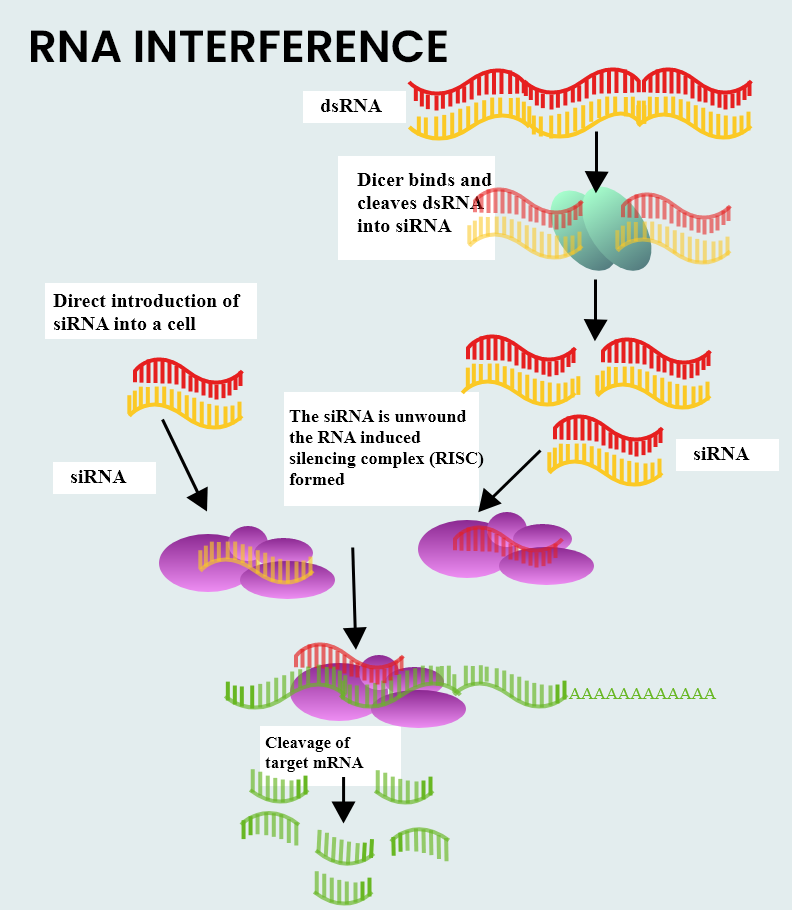
This dsRNA is then unable to get translated hence inhibiting the production of the certain protein molecule. This process was successfully used in the nematode Meloidogyne incognita which caused disease in the tobacco plant. In this RNA responsible for the disease was silenced using vectors of Agrobacterium. Specific genes were introduced into the host plants which produced both sense and antisense RNA in the host cells. As they are complementary to each other they joined together to form dsRNA thus inhibiting the translation of mRNA and leading to the silencing of the gene. Thus, making it difficult for the parasite to stay on the host.
Note: RNAi technique can be used in various medical fields as it can silence certain disease-causing genes present in the human body. In future it may be used to cure cancer related diseases providing a revolution in the medical field. It may also be used in pesticides and insecticides to yield better crops.
Complete answer:
RNA present in the cell helps in the translation of proteins molecules to be formed from them. Some of the products formed may lead to destruction of the organism. These RNA are harmful and hence they need to be eliminated. As elimination is not possible because whenever DNA would replicate it would lead to production of new RNA so it’s impossible to eliminate all the RNA that would be produced by the organism in each cell. This requires a technique in which the RNA sequence is silenced and production of undesirable protein is inhibited. This process is known as RNA interference. In this single stranded RNA is made to bind to complementary strands of the target site making it double stranded RNA.
This dsRNA is then unable to get translated hence inhibiting the production of the certain protein molecule. This process was successfully used in the nematode Meloidogyne incognita which caused disease in the tobacco plant. In this RNA responsible for the disease was silenced using vectors of Agrobacterium. Specific genes were introduced into the host plants which produced both sense and antisense RNA in the host cells. As they are complementary to each other they joined together to form dsRNA thus inhibiting the translation of mRNA and leading to the silencing of the gene. Thus, making it difficult for the parasite to stay on the host.
Note: RNAi technique can be used in various medical fields as it can silence certain disease-causing genes present in the human body. In future it may be used to cure cancer related diseases providing a revolution in the medical field. It may also be used in pesticides and insecticides to yield better crops.
Recently Updated Pages
Explain the structure of megasporangium class 12 biology CBSE

Why is chloroform kept in dark coloured bottles class 12 chemistry CBSE
Derive the balancing condition of a Wheatstone bri class 12 physics CBSE
Draw VI characteristics of a pn junction diode Explain class 12 physics CBSE
Is it possible to carry pride in ones language too class 12 english CBSE
In a population at Hardy Weinberg equilibrium the allele class 12 biology CBSE
Trending doubts
Draw a labelled sketch of the human eye class 12 physics CBSE
Which are the Top 10 Largest Countries of the World?
Draw ray diagrams each showing i myopic eye and ii class 12 physics CBSE
One megawatt is equal to how many units of electri class 12 physics CBSE
Which is the correct genotypic ratio of mendel dihybrid class 12 biology CBSE
Give 10 examples of unisexual and bisexual flowers