




How did Harshey and Chase establish that the DNA is transferred from virus to Bacteria?
Answer
 Verified
597.9k+ views
Hint: Harshey and Chase demonstrated that the genetic material in the bacteriophage is the DNA and not proteins through their experiments. It was widely accepted among all scientists.
Complete Answer:
Harshey and Chase chose Bacteriophage as the experimental organism. Bacteriophage is the virus that infects bacteria. Bacteriophage consists of the DNA and the protein coat called the capsid. They chose bacteriophage because it contains only protein and DNA. So the separation of the two was quite easy.
Harshey and Chase experiment:
- The radioactive labelling of the phage DNA and protein was done using radioactive sulphur and phosphorus.
- These radioactive labelled phages were used to infect E.coli.
- Centrifugation and blending of E.coli was done to remove virus particles.
- The bacteria that were infected with radioactive DNA became radioactive and the ones with radioactive proteins lost radioactivity.
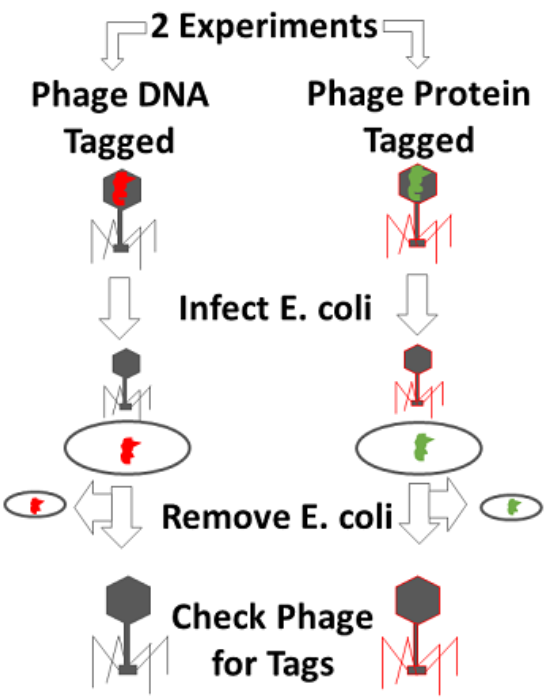
Result: This shows that when the Bacteriophage infects the E.coli, the DNA enters the bacteria and not the proteins.
Additional Information: Radioactive phosphorus-32 was used to label DNA as phosphorus is present in DNA and sulphur-35 was used to label protein as sulphur is present in proteins.
Note: This experiment proved that the DNA is the genetic material not the protein. The DNA of the phage enters the bacterium through a tiny hole and the protein coat remains outside. The DNA as a genetic material opened doors for further applications like DNA fingerprinting, DNA forensics etc.
Complete Answer:
Harshey and Chase chose Bacteriophage as the experimental organism. Bacteriophage is the virus that infects bacteria. Bacteriophage consists of the DNA and the protein coat called the capsid. They chose bacteriophage because it contains only protein and DNA. So the separation of the two was quite easy.
Harshey and Chase experiment:
- The radioactive labelling of the phage DNA and protein was done using radioactive sulphur and phosphorus.
- These radioactive labelled phages were used to infect E.coli.
- Centrifugation and blending of E.coli was done to remove virus particles.
- The bacteria that were infected with radioactive DNA became radioactive and the ones with radioactive proteins lost radioactivity.
Result: This shows that when the Bacteriophage infects the E.coli, the DNA enters the bacteria and not the proteins.
Additional Information: Radioactive phosphorus-32 was used to label DNA as phosphorus is present in DNA and sulphur-35 was used to label protein as sulphur is present in proteins.
Note: This experiment proved that the DNA is the genetic material not the protein. The DNA of the phage enters the bacterium through a tiny hole and the protein coat remains outside. The DNA as a genetic material opened doors for further applications like DNA fingerprinting, DNA forensics etc.
Recently Updated Pages
Three beakers labelled as A B and C each containing 25 mL of water were taken A small amount of NaOH anhydrous CuSO4 and NaCl were added to the beakers A B and C respectively It was observed that there was an increase in the temperature of the solutions contained in beakers A and B whereas in case of beaker C the temperature of the solution falls Which one of the following statements isarecorrect i In beakers A and B exothermic process has occurred ii In beakers A and B endothermic process has occurred iii In beaker C exothermic process has occurred iv In beaker C endothermic process has occurred

Master Class 12 Social Science: Engaging Questions & Answers for Success
Master Class 12 Physics: Engaging Questions & Answers for Success
Master Class 12 Maths: Engaging Questions & Answers for Success
Master Class 12 Economics: Engaging Questions & Answers for Success
Master Class 12 Chemistry: Engaging Questions & Answers for Success
Three beakers labelled as A B and C each containing 25 mL of water were taken A small amount of NaOH anhydrous CuSO4 and NaCl were added to the beakers A B and C respectively It was observed that there was an increase in the temperature of the solutions contained in beakers A and B whereas in case of beaker C the temperature of the solution falls Which one of the following statements isarecorrect i In beakers A and B exothermic process has occurred ii In beakers A and B endothermic process has occurred iii In beaker C exothermic process has occurred iv In beaker C endothermic process has occurred
Master Class 12 Social Science: Engaging Questions & Answers for Success
Master Class 12 Physics: Engaging Questions & Answers for Success
Trending doubts
Which are the Top 10 Largest Countries of the World?
Draw a labelled sketch of the human eye class 12 physics CBSE
Differentiate between homogeneous and heterogeneous class 12 chemistry CBSE
What are the major means of transport Explain each class 12 social science CBSE
Sulphuric acid is known as the king of acids State class 12 chemistry CBSE
Why should a magnesium ribbon be cleaned before burning class 12 chemistry CBSE