




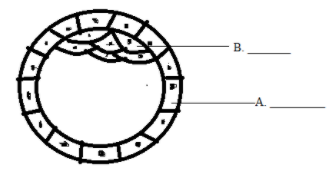
Diagram of a Human blastocyst is given below. Identify A & B
Answer
 Verified
612k+ views
Hint:The morula cells start to initiate cell differentiation during human embryonic development, about 5-6 days after fertilisation, and the morula shifts into the blastocyst.
Complete answer:
First we should know about the blastocyst to answer this question. A complex developed in the early growth of mammals is the blastocyst. It has an inner cell mass that the embryo eventually shapes. The blastocyst's outer layer comprises cells commonly termed trophoblasts.
The internal cell mass and a fluid-filled space identified as the blastocoel are surrounded by this membrane. The placenta is given rise by the trophoblasts Blastocyst development in humans occurs around 5 days after fertilisation if a cavity filled with fluid opens in the morula, the early embryo stage of a 16-cell ball. After rapid cleavage (cell division), the blastocyst has a diameter of approximately 0.1–0.2 mm and contains 200–300 cells. The blastocyst is inserted approximately seven days after fertilization and embedded in the endometrium of the uterine lining. There, it will undergo additional processes of growth, like gastrulation.
The human blastocyst is depicted by the illustration. The name A refers to the trophoblasts that shape the blastocyst’s outer layer of cells. The B name corresponds to the mass of the inner cell. In the development of the embryonic framework, the inner cell mass is included. The placenta shapes the trophoblast.
Note:Blastocyst's inner cell mass are the origins of embryonic stem cells, which are commonly used in stem cell treatments, including reconstruction, substitution and regeneration of cells. The internal cell mass, also recognized as the embryoblast, creates the primitive endoderm and the proper embryo.
Complete answer:
First we should know about the blastocyst to answer this question. A complex developed in the early growth of mammals is the blastocyst. It has an inner cell mass that the embryo eventually shapes. The blastocyst's outer layer comprises cells commonly termed trophoblasts.
The internal cell mass and a fluid-filled space identified as the blastocoel are surrounded by this membrane. The placenta is given rise by the trophoblasts Blastocyst development in humans occurs around 5 days after fertilisation if a cavity filled with fluid opens in the morula, the early embryo stage of a 16-cell ball. After rapid cleavage (cell division), the blastocyst has a diameter of approximately 0.1–0.2 mm and contains 200–300 cells. The blastocyst is inserted approximately seven days after fertilization and embedded in the endometrium of the uterine lining. There, it will undergo additional processes of growth, like gastrulation.
The human blastocyst is depicted by the illustration. The name A refers to the trophoblasts that shape the blastocyst’s outer layer of cells. The B name corresponds to the mass of the inner cell. In the development of the embryonic framework, the inner cell mass is included. The placenta shapes the trophoblast.
Note:Blastocyst's inner cell mass are the origins of embryonic stem cells, which are commonly used in stem cell treatments, including reconstruction, substitution and regeneration of cells. The internal cell mass, also recognized as the embryoblast, creates the primitive endoderm and the proper embryo.
Recently Updated Pages
Master Class 12 Business Studies: Engaging Questions & Answers for Success

Master Class 12 Biology: Engaging Questions & Answers for Success
Master Class 12 Chemistry: Engaging Questions & Answers for Success
Class 12 Question and Answer - Your Ultimate Solutions Guide
Master Class 11 Social Science: Engaging Questions & Answers for Success
Master Class 11 English: Engaging Questions & Answers for Success
Trending doubts
Which is more stable and why class 12 chemistry CBSE
Which are the Top 10 Largest Countries of the World?
Draw a labelled sketch of the human eye class 12 physics CBSE
Differentiate between homogeneous and heterogeneous class 12 chemistry CBSE
What are the major means of transport Explain each class 12 social science CBSE
Sulphuric acid is known as the king of acids State class 12 chemistry CBSE