




What device other than a plane mirror can be used to turn a ray of light through \[180^\circ \] ? Draw a diagram in support of your answer. Name an instrument in which this device is used.
Answer
 Verified
521.7k+ views
Hint: Before we go into the details, let's get a sense of what a fully reflecting prism is. When a light ray falls in a precise way on a specific side of this unusual form of prism, it can deviate a light ray by \[{180^ \circ }\] . The name "total reflecting prism" comes from the fact that any light beam striking on one of its faces causes total internal reflection inside the prism.
Complete step by step answer:
To turn a ray of light \[{180^ \circ }\] , a complete reflecting prism is employed. The diagram below clarifies things much more. The prism effect is employed in binoculars.
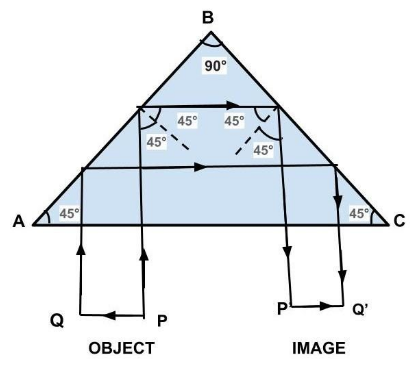
Explanation:- Conditions are as follows to get deviation of \[{180^ \circ }\],
1. The use of a Total Reflecting Prism is required (right-angled isosceles prism with a \[{90^ \circ }\] angle between two equal sides, and \[2\] more angles with \[{45^ \circ }\] each)
2. Light should be incident normally on the side of the Total reflecting prism (right-angled isosceles prism) that forms a \[{45^ \circ }\] angle with the other two sides.
Take a light ray \[PQ\] that is generally incident on \[AC\] in the diagram above (making a \[{90^ \circ }\] angle with \[AC\] ). It enters the prism with no deviation and strikes the \[AB\] at a \[{45^ \circ }\] angle of incidence, which is greater than the critical angle for the air-glass pair \[\left( {{{42}^ \circ }} \right)\] .As a result, the light ray is subjected to total internal reflection at the surface \[AB\].
As a result, it is completely internally reflected and strikes the side \[BC\] inside the prism with a \[{45^ \circ }\] angle of incidence once more. Obviously, thorough internal reflection takes place here as well.It's clear that the ray of light deviates twice, once by \[{90^ \circ }\] after reaching the \[AB\] side, and then by another \[{90^ \circ }\] after hitting the \[BC\] side.With a prism, we may achieve a total \[{180^ \circ }\] deviation of the light ray.
Note: The angle of incident must be greater than the critical angle of the prism for total internal reflection to occur, and the value of the critical angle of glass, \[42^\circ \] , should be kept in mind when solving prism and its applications issues.
Complete step by step answer:
To turn a ray of light \[{180^ \circ }\] , a complete reflecting prism is employed. The diagram below clarifies things much more. The prism effect is employed in binoculars.
Explanation:- Conditions are as follows to get deviation of \[{180^ \circ }\],
1. The use of a Total Reflecting Prism is required (right-angled isosceles prism with a \[{90^ \circ }\] angle between two equal sides, and \[2\] more angles with \[{45^ \circ }\] each)
2. Light should be incident normally on the side of the Total reflecting prism (right-angled isosceles prism) that forms a \[{45^ \circ }\] angle with the other two sides.
Take a light ray \[PQ\] that is generally incident on \[AC\] in the diagram above (making a \[{90^ \circ }\] angle with \[AC\] ). It enters the prism with no deviation and strikes the \[AB\] at a \[{45^ \circ }\] angle of incidence, which is greater than the critical angle for the air-glass pair \[\left( {{{42}^ \circ }} \right)\] .As a result, the light ray is subjected to total internal reflection at the surface \[AB\].
As a result, it is completely internally reflected and strikes the side \[BC\] inside the prism with a \[{45^ \circ }\] angle of incidence once more. Obviously, thorough internal reflection takes place here as well.It's clear that the ray of light deviates twice, once by \[{90^ \circ }\] after reaching the \[AB\] side, and then by another \[{90^ \circ }\] after hitting the \[BC\] side.With a prism, we may achieve a total \[{180^ \circ }\] deviation of the light ray.
Note: The angle of incident must be greater than the critical angle of the prism for total internal reflection to occur, and the value of the critical angle of glass, \[42^\circ \] , should be kept in mind when solving prism and its applications issues.
Recently Updated Pages
Three beakers labelled as A B and C each containing 25 mL of water were taken A small amount of NaOH anhydrous CuSO4 and NaCl were added to the beakers A B and C respectively It was observed that there was an increase in the temperature of the solutions contained in beakers A and B whereas in case of beaker C the temperature of the solution falls Which one of the following statements isarecorrect i In beakers A and B exothermic process has occurred ii In beakers A and B endothermic process has occurred iii In beaker C exothermic process has occurred iv In beaker C endothermic process has occurred

Master Class 12 Social Science: Engaging Questions & Answers for Success
Master Class 12 Physics: Engaging Questions & Answers for Success
Master Class 12 Maths: Engaging Questions & Answers for Success
Master Class 12 Economics: Engaging Questions & Answers for Success
Master Class 12 Chemistry: Engaging Questions & Answers for Success
Three beakers labelled as A B and C each containing 25 mL of water were taken A small amount of NaOH anhydrous CuSO4 and NaCl were added to the beakers A B and C respectively It was observed that there was an increase in the temperature of the solutions contained in beakers A and B whereas in case of beaker C the temperature of the solution falls Which one of the following statements isarecorrect i In beakers A and B exothermic process has occurred ii In beakers A and B endothermic process has occurred iii In beaker C exothermic process has occurred iv In beaker C endothermic process has occurred
Master Class 12 Social Science: Engaging Questions & Answers for Success
Master Class 12 Physics: Engaging Questions & Answers for Success
Trending doubts
Which are the Top 10 Largest Countries of the World?
Draw a labelled sketch of the human eye class 12 physics CBSE
Explain the structure of megasporangium class 12 biology CBSE
What are the major means of transport Explain each class 12 social science CBSE
Differentiate between homogeneous and heterogeneous class 12 chemistry CBSE
Sulphuric acid is known as the king of acids State class 12 chemistry CBSE