




Develop reactions route to convert:
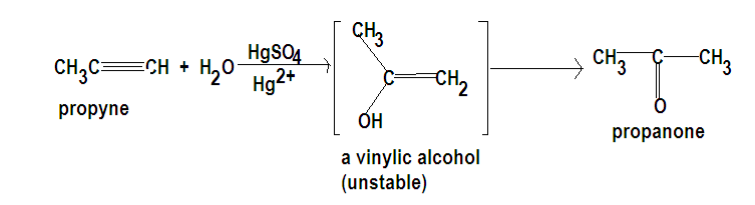
a. Propyne to Propanone
b. Methane to Ethane
Answer
 Verified
534.5k+ views
Hint:The above reaction includes chlorination, dimerization of free radical and synthesization of ketones from alkynes. Ketones can be synthesized from alkenes, arenes and secondary alcohol.
Complete step by step solution:
a. Let us therefore understand the reaction route for the conversion of the first reaction which includes conversion of an alkyne into a ketone .
Alkynes add water readily when the reaction is catalyzed by strong acids and mercuric ions. Aqueous solution of sulphuric acids and mercuric sulfate are often used for this purpose. The vinylic alcohol that is initially produced is usually unstable, and it rearranges rapidly to ketone (or in this case of Propyne, to Propanol). The rearrangement involves the loss of proton from the hydroxyl group, the addition of proton to the vicinal carbon atom, and the relocation of the double bond.
b. In the second reaction methane undergoes chlorination and we know that chlorination of methane can easily be controlled by judicious control of heat and light. It takes place by the attack of the chlorine free radical on methane and abstraction of its hydrogen to from HCl and methyl free radical which further reacts with di-chloride to form methyl chloride.
$
C{l_2} \to 2Cl ^{\cdot} \\
Cl ^{\cdot} + C{H_4} \to HCl + C{H_3} ^{\cdot} \\
C{H_3} + C{l_2} \to C{H_3}Cl + Cl ^{\cdot}
$
Now, we observe the formation of higher alkane i.e ethane as an end product, Therefore the formation of higher alkanes from alkyl halides in the presence of dry ether is named Wurtz reaction it goes on like:
$C{H_3}Cl\xrightarrow[{dryether(E{t_2}O)}]{{2Na}}C{H_3} - C{H_3} + 2NaCl$
In higher alkanes traces of alkenes and alkanes are forms due to dimerization and disproportionation. The whole reaction proceeds like:
$C{H_4} + C{l_2}\xrightarrow{{hv}}C{H_3}Cl + HCl\xrightarrow[{dryether(E{t_2}O)}]{{2Na}}C{H_3} - C{H_3} + 2NaCl$
Note:
Bromine is much less reactive towards methane than chlorine and iodine is so unreactive that for all practical purposes we can say that no reaction can take place. Wurtz reaction cannot prepare methane and gives best yield in case of symmetrical alkanes.
Complete step by step solution:
a. Let us therefore understand the reaction route for the conversion of the first reaction which includes conversion of an alkyne into a ketone .
Alkynes add water readily when the reaction is catalyzed by strong acids and mercuric ions. Aqueous solution of sulphuric acids and mercuric sulfate are often used for this purpose. The vinylic alcohol that is initially produced is usually unstable, and it rearranges rapidly to ketone (or in this case of Propyne, to Propanol). The rearrangement involves the loss of proton from the hydroxyl group, the addition of proton to the vicinal carbon atom, and the relocation of the double bond.
b. In the second reaction methane undergoes chlorination and we know that chlorination of methane can easily be controlled by judicious control of heat and light. It takes place by the attack of the chlorine free radical on methane and abstraction of its hydrogen to from HCl and methyl free radical which further reacts with di-chloride to form methyl chloride.
$
C{l_2} \to 2Cl ^{\cdot} \\
Cl ^{\cdot} + C{H_4} \to HCl + C{H_3} ^{\cdot} \\
C{H_3} + C{l_2} \to C{H_3}Cl + Cl ^{\cdot}
$
Now, we observe the formation of higher alkane i.e ethane as an end product, Therefore the formation of higher alkanes from alkyl halides in the presence of dry ether is named Wurtz reaction it goes on like:
$C{H_3}Cl\xrightarrow[{dryether(E{t_2}O)}]{{2Na}}C{H_3} - C{H_3} + 2NaCl$
In higher alkanes traces of alkenes and alkanes are forms due to dimerization and disproportionation. The whole reaction proceeds like:
$C{H_4} + C{l_2}\xrightarrow{{hv}}C{H_3}Cl + HCl\xrightarrow[{dryether(E{t_2}O)}]{{2Na}}C{H_3} - C{H_3} + 2NaCl$
Note:
Bromine is much less reactive towards methane than chlorine and iodine is so unreactive that for all practical purposes we can say that no reaction can take place. Wurtz reaction cannot prepare methane and gives best yield in case of symmetrical alkanes.
Recently Updated Pages
Basicity of sulphurous acid and sulphuric acid are

Master Class 12 English: Engaging Questions & Answers for Success
Master Class 12 Social Science: Engaging Questions & Answers for Success
Master Class 12 Maths: Engaging Questions & Answers for Success
Master Class 12 Economics: Engaging Questions & Answers for Success
Master Class 12 Physics: Engaging Questions & Answers for Success
Trending doubts
Which are the Top 10 Largest Countries of the World?
Draw a labelled sketch of the human eye class 12 physics CBSE
Which state in the country is at the forefront in controlling class 12 social science CBSE
Mention the role of cyanobacteria as a biofertiliz class 12 biology ICSE
Where is the largest hydroelectric power station located class 12 biology CBSE
Which country did Danny Casey play for class 12 english CBSE