




How do I determine whether a hyperbola opens horizontally or vertically?
Answer
 Verified
607.5k+ views
Hint: First we know it is a horizontal or vertical hyperbola.
If it is a horizontal hyperbola since the $x$ term is positive.
\[\dfrac{{{{(x - h)}^2}}}{{{a^2}}} - \dfrac{{{{(y - k)}^2}}}{{{b^2}}} = 1\]
That means the curves open left and right.
If it is a vertical hyperbola since the $y$ term is positive.
$\dfrac{{{{(y - k)}^2}}}{{{a^2}}} - \dfrac{{{{(x - h)}^2}}}{{{b^2}}} = 1$
That means the curves open up and down.
Complete step by step answer:The graph of a hyperbola creates two smooth curves as pictured here:
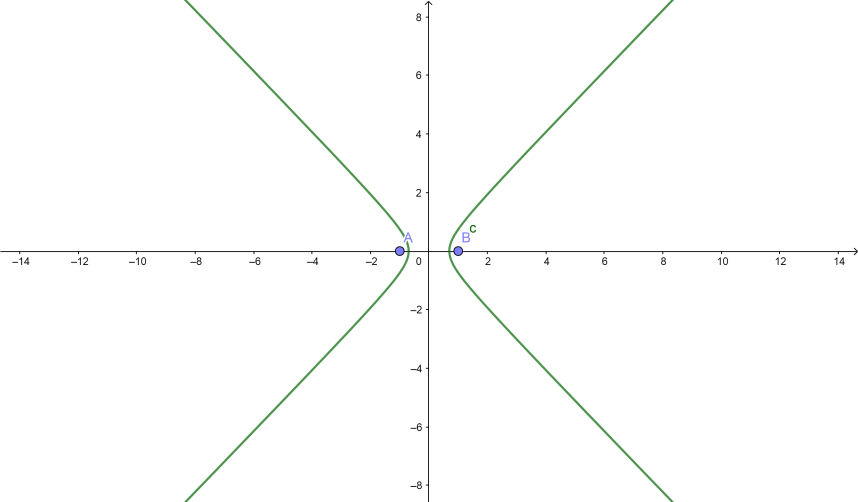
There are two patterns for hyperbolas:
Horizontal:
\[\dfrac{{{{(x - h)}^2}}}{{{a^2}}} - \dfrac{{{{(y - k)}^2}}}{{{b^2}}} = 1\]
Vertical:
$\dfrac{{{{(y - k)}^2}}}{{{a^2}}} - \dfrac{{{{(x - h)}^2}}}{{{b^2}}} = 1$
We can determine the following:
If it is vertical or horizontal:
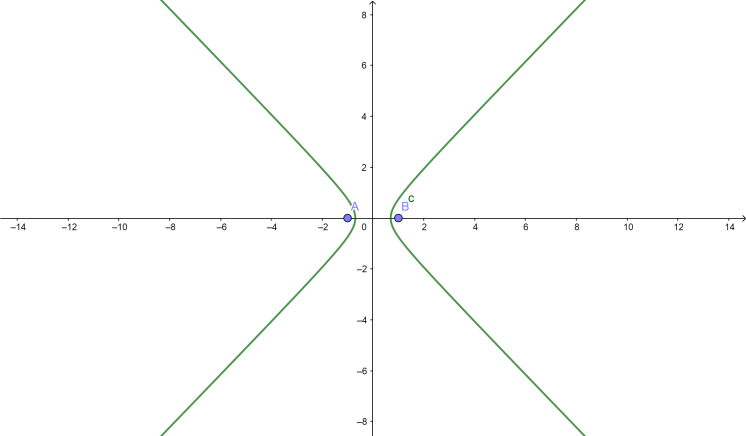
If the $x$ term is positive, the parabola is horizontal (the curves open left and right). The equation is,
\[\dfrac{{{{(x - h)}^2}}}{{{a^2}}} - \dfrac{{{{(y - k)}^2}}}{{{b^2}}} = 1\]
The horizontal parabola graph is
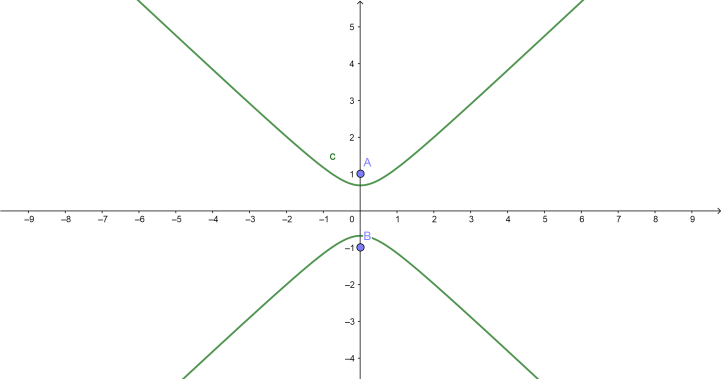
If the $y$ term is positive, the parabola is vertical (the curves open up and down). The equation is
$\dfrac{{{{(y - k)}^2}}}{{{a^2}}} - \dfrac{{{{(x - h)}^2}}}{{{b^2}}} = 1$
The vertical parabola graph is
The center point as with all conic sections, the center points $(h,k)$ . Notice that the $h$ is always with the $x$ and the $k$ is always with the $y$ . There is also a negative in front of each, so you must take the opposite.
The $a$ and $b$ values will be needed to graph the parabola. Notice that $a$ is always under the positive term and $b$ is always under the negative.
Note:
Notice that $(h,k)$ is the center of the entire hyperbola but does not fall on the hyperbola itself. Each hyperbola has a vertex and two asymptotes guide how wide or how narrow the curve.
If $x$ is on the front, the hyperbola opens horizontally.
If $y$ is on the front, the hyperbola opens vertically.
If it is a horizontal hyperbola since the $x$ term is positive.
\[\dfrac{{{{(x - h)}^2}}}{{{a^2}}} - \dfrac{{{{(y - k)}^2}}}{{{b^2}}} = 1\]
That means the curves open left and right.
If it is a vertical hyperbola since the $y$ term is positive.
$\dfrac{{{{(y - k)}^2}}}{{{a^2}}} - \dfrac{{{{(x - h)}^2}}}{{{b^2}}} = 1$
That means the curves open up and down.
Complete step by step answer:The graph of a hyperbola creates two smooth curves as pictured here:
There are two patterns for hyperbolas:
Horizontal:
\[\dfrac{{{{(x - h)}^2}}}{{{a^2}}} - \dfrac{{{{(y - k)}^2}}}{{{b^2}}} = 1\]
Vertical:
$\dfrac{{{{(y - k)}^2}}}{{{a^2}}} - \dfrac{{{{(x - h)}^2}}}{{{b^2}}} = 1$
We can determine the following:
If it is vertical or horizontal:
If the $x$ term is positive, the parabola is horizontal (the curves open left and right). The equation is,
\[\dfrac{{{{(x - h)}^2}}}{{{a^2}}} - \dfrac{{{{(y - k)}^2}}}{{{b^2}}} = 1\]
The horizontal parabola graph is
If the $y$ term is positive, the parabola is vertical (the curves open up and down). The equation is
$\dfrac{{{{(y - k)}^2}}}{{{a^2}}} - \dfrac{{{{(x - h)}^2}}}{{{b^2}}} = 1$
The vertical parabola graph is
The center point as with all conic sections, the center points $(h,k)$ . Notice that the $h$ is always with the $x$ and the $k$ is always with the $y$ . There is also a negative in front of each, so you must take the opposite.
The $a$ and $b$ values will be needed to graph the parabola. Notice that $a$ is always under the positive term and $b$ is always under the negative.
Note:
Notice that $(h,k)$ is the center of the entire hyperbola but does not fall on the hyperbola itself. Each hyperbola has a vertex and two asymptotes guide how wide or how narrow the curve.
If $x$ is on the front, the hyperbola opens horizontally.
If $y$ is on the front, the hyperbola opens vertically.
Recently Updated Pages
Basicity of sulphurous acid and sulphuric acid are

Master Class 11 English: Engaging Questions & Answers for Success
Master Class 11 Physics: Engaging Questions & Answers for Success
Master Class 11 Computer Science: Engaging Questions & Answers for Success
Master Class 11 Chemistry: Engaging Questions & Answers for Success
Master Class 11 Social Science: Engaging Questions & Answers for Success
Trending doubts
Difference Between Prokaryotic Cells and Eukaryotic Cells
Two of the body parts which do not appear in MRI are class 11 biology CBSE
One Metric ton is equal to kg A 10000 B 1000 C 100 class 11 physics CBSE
10 examples of friction in our daily life
Draw a diagram of nephron and explain its structur class 11 biology CBSE
What will happen if the mucus is not secreted by the class 11 biology CBSE