




Determine the electrostatic potential energy of a system consisting of two charges $7\mu C$ and $ - 2\mu C$ separated by a distance of 20 cm.
Answer
 Verified
633.6k+ views
Hint: We will start our solution by understanding what electrostatic potential energy means. Generally, electrostatic potential energy is defined as the amount of energy required to move a charge against the electric field acting on it. Its unit is in Joules (J).
Formula used:
\[ {U_{elect.}} = k\dfrac{{{Q_1} \times {Q_2}}}{{{r_{12}}}}\]
Complete step by step solution:
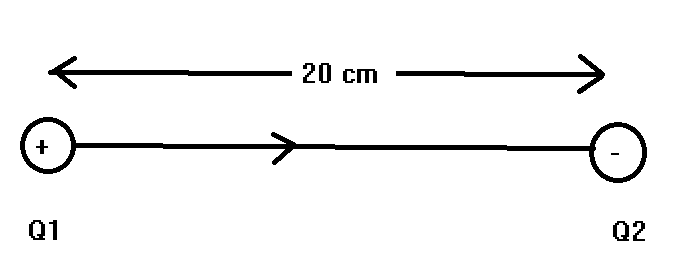
As we are dealing with the system of two charges. Therefore taking ${Q_1}$ and ${Q_2}$be the charges and ${r_{12}}$be the separation between them. As we already know electrostatic potential energy (U) can be defined as the amount of energy required to charge against the electric field. It can be repulsive or attractive based on the nature of the charged particle.
Now the electrostatic potential formula can be given as
\[ \Rightarrow {U_{elect.}} = k\dfrac{{{Q_1} \times {Q_2}}}{{{r_{12}}}}\]
Where$k = \dfrac{1}{{4\pi {\varepsilon _0}}}$hence
\[ \Rightarrow {U_{elect.}} = \dfrac{1}{{4\pi {\varepsilon _0}}}\dfrac{{{Q_1} \times {Q_2}}}{{{r_{12}}}}\] -------- Equation (1)
As the two charges of the system and separation between the charges are provided in the question
So, we can deduce as
$ \Rightarrow {Q_1} = 7\mu C = 7 \times {10^{ - 6}}C$
$ \Rightarrow {Q_2} = - 2\mu C = - 2 \times {10^{ - 6}}C$
$ \Rightarrow {r_{12}} = 20cm = 0.20m$
$ \Rightarrow k = \dfrac{1}{{4\pi {\varepsilon _0}}} = 9 \times {10^9}$
Now substituting the above quantities in equation (1), we get
\[ \Rightarrow {U_{elect.}} = \dfrac{1}{{4\pi {\varepsilon _0}}}\dfrac{{{Q_1} \times {Q_2}}}{{{r_{12}}}}\]
\[ \Rightarrow {U_{elect.}} = 9 \times {10^9} \times \dfrac{{7 \times {{10}^{ - 6}}C \times - 2 \times {{10}^{ - 6}}C}}{{0.20m}}\]
\[ \Rightarrow {U_{elect.}} = - 630 \times {10^{ - 3}}J\]
\[ \Rightarrow {U_{elect.}} = - 0.630J\]
Here, our electrostatic potential is \[ - 0.630J\] and it is negative which indicates that the nature of the interaction between the charges is attractive. That means one of the charges is positive and the other will be negative.
Note: It has to be remembered that for a system of charges it can be seen that if the two charges are of the same sign let say both the charges are positive or negative and then the positive value of electrostatic potential energy will show that the interaction between them will be repulsive and if the value of electrostatic potential energy is negative then the interaction will be attractive.
Formula used:
\[ {U_{elect.}} = k\dfrac{{{Q_1} \times {Q_2}}}{{{r_{12}}}}\]
Complete step by step solution:
As we are dealing with the system of two charges. Therefore taking ${Q_1}$ and ${Q_2}$be the charges and ${r_{12}}$be the separation between them. As we already know electrostatic potential energy (U) can be defined as the amount of energy required to charge against the electric field. It can be repulsive or attractive based on the nature of the charged particle.
Now the electrostatic potential formula can be given as
\[ \Rightarrow {U_{elect.}} = k\dfrac{{{Q_1} \times {Q_2}}}{{{r_{12}}}}\]
Where$k = \dfrac{1}{{4\pi {\varepsilon _0}}}$hence
\[ \Rightarrow {U_{elect.}} = \dfrac{1}{{4\pi {\varepsilon _0}}}\dfrac{{{Q_1} \times {Q_2}}}{{{r_{12}}}}\] -------- Equation (1)
As the two charges of the system and separation between the charges are provided in the question
So, we can deduce as
$ \Rightarrow {Q_1} = 7\mu C = 7 \times {10^{ - 6}}C$
$ \Rightarrow {Q_2} = - 2\mu C = - 2 \times {10^{ - 6}}C$
$ \Rightarrow {r_{12}} = 20cm = 0.20m$
$ \Rightarrow k = \dfrac{1}{{4\pi {\varepsilon _0}}} = 9 \times {10^9}$
Now substituting the above quantities in equation (1), we get
\[ \Rightarrow {U_{elect.}} = \dfrac{1}{{4\pi {\varepsilon _0}}}\dfrac{{{Q_1} \times {Q_2}}}{{{r_{12}}}}\]
\[ \Rightarrow {U_{elect.}} = 9 \times {10^9} \times \dfrac{{7 \times {{10}^{ - 6}}C \times - 2 \times {{10}^{ - 6}}C}}{{0.20m}}\]
\[ \Rightarrow {U_{elect.}} = - 630 \times {10^{ - 3}}J\]
\[ \Rightarrow {U_{elect.}} = - 0.630J\]
Here, our electrostatic potential is \[ - 0.630J\] and it is negative which indicates that the nature of the interaction between the charges is attractive. That means one of the charges is positive and the other will be negative.
Note: It has to be remembered that for a system of charges it can be seen that if the two charges are of the same sign let say both the charges are positive or negative and then the positive value of electrostatic potential energy will show that the interaction between them will be repulsive and if the value of electrostatic potential energy is negative then the interaction will be attractive.
Recently Updated Pages
Master Class 12 Economics: Engaging Questions & Answers for Success

Master Class 12 Social Science: Engaging Questions & Answers for Success
Master Class 12 English: Engaging Questions & Answers for Success
Master Class 12 Maths: Engaging Questions & Answers for Success
Master Class 12 Physics: Engaging Questions & Answers for Success
Master Class 12 Biology: Engaging Questions & Answers for Success
Trending doubts
Draw a labelled sketch of the human eye class 12 physics CBSE
Which are the Top 10 Largest Countries of the World?
Draw ray diagrams each showing i myopic eye and ii class 12 physics CBSE
Which is the correct genotypic ratio of mendel dihybrid class 12 biology CBSE
Differentiate between homogeneous and heterogeneous class 12 chemistry CBSE
Which animal never drinks water in its entire life class 12 biology CBSE