




Determine the electric potential at point P due to two point charges each of charge $+Q$ with one point charge being at a distance $R$ and other being at a distance $2R$.
Answer
 Verified
634.5k+ views
Hint: Due to the electrostatic forces acting between the charges, there is some potential acting on a charge in the field of another charge. The work done to move a charge from one point to the other in a field is called electric potential difference between two points in the field. Potential has a direct relation to the product of charges and inverse relation to the distance between them.
Formulas used:
$P=\dfrac{{{Q}_{1}}{{Q}_{2}}}{4\pi {{\varepsilon }_{0}}r}$
Complete step-by-step solution:
The potential difference due a charged particle is defined as the work done to move another charged particle between two points. Positive potential is due to a positive charge and negative potential is due to a negative charge.
It is given as-
$P=\dfrac{{{Q}_{1}}{{Q}_{2}}}{4\pi {{\varepsilon }_{0}}r}$ - (1)
Here,
$P$ is the potential difference
${{Q}_{1}},\,{{Q}_{2}}$ are charges on the charged particles
$r$ is the distance between the particles
${{\varepsilon }_{0}}$ is the permeability of free space
Given potential at point P is influenced by two charges having charge $+Q$ each, at a distance of $R$ and $2R$ respectively.
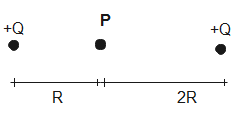
Therefore, potential at point P will be due to both charges.
We substitute given values in eq (1) to get,
$\begin{align}
& P={{P}_{1}}+{{P}_{2}} \\
& \Rightarrow P=\dfrac{{{Q}_{1}}}{4\pi {{\varepsilon }_{0}}{{R}_{1}}}+\dfrac{{{Q}_{2}}}{4\pi {{\varepsilon }_{0}}{{R}_{2}}} \\
& \Rightarrow P=\dfrac{Q}{4\pi {{\varepsilon }_{0}}R}+\dfrac{Q}{4\pi {{\varepsilon }_{0}}2R} \\
& \therefore P=\dfrac{3Q}{8\pi {{\varepsilon }_{0}}R} \\
\end{align}$
Therefore, the potential at point P due to both charges is$\dfrac{3Q}{8\pi {{\varepsilon }_{0}}R}$.
Note:
A unit charge is assumed to be kept at point P on which potential due to the charges is acting on. When the work is done to bring a unit charge from infinity to a point, then it is called electric field. Positive charge has a tendency to flow from higher electric potential to lower electric potential. According to coulomb’s law, electrostatic force has a direct relation to the product of charges and inverse relation to the square of distance between them.
Formulas used:
$P=\dfrac{{{Q}_{1}}{{Q}_{2}}}{4\pi {{\varepsilon }_{0}}r}$
Complete step-by-step solution:
The potential difference due a charged particle is defined as the work done to move another charged particle between two points. Positive potential is due to a positive charge and negative potential is due to a negative charge.
It is given as-
$P=\dfrac{{{Q}_{1}}{{Q}_{2}}}{4\pi {{\varepsilon }_{0}}r}$ - (1)
Here,
$P$ is the potential difference
${{Q}_{1}},\,{{Q}_{2}}$ are charges on the charged particles
$r$ is the distance between the particles
${{\varepsilon }_{0}}$ is the permeability of free space
Given potential at point P is influenced by two charges having charge $+Q$ each, at a distance of $R$ and $2R$ respectively.
Therefore, potential at point P will be due to both charges.
We substitute given values in eq (1) to get,
$\begin{align}
& P={{P}_{1}}+{{P}_{2}} \\
& \Rightarrow P=\dfrac{{{Q}_{1}}}{4\pi {{\varepsilon }_{0}}{{R}_{1}}}+\dfrac{{{Q}_{2}}}{4\pi {{\varepsilon }_{0}}{{R}_{2}}} \\
& \Rightarrow P=\dfrac{Q}{4\pi {{\varepsilon }_{0}}R}+\dfrac{Q}{4\pi {{\varepsilon }_{0}}2R} \\
& \therefore P=\dfrac{3Q}{8\pi {{\varepsilon }_{0}}R} \\
\end{align}$
Therefore, the potential at point P due to both charges is$\dfrac{3Q}{8\pi {{\varepsilon }_{0}}R}$.
Note:
A unit charge is assumed to be kept at point P on which potential due to the charges is acting on. When the work is done to bring a unit charge from infinity to a point, then it is called electric field. Positive charge has a tendency to flow from higher electric potential to lower electric potential. According to coulomb’s law, electrostatic force has a direct relation to the product of charges and inverse relation to the square of distance between them.
Recently Updated Pages
Which of the following graphs shows the variation of class 12 physics CBSE

Draw a labelled diagram of the human male reproductive class 12 biology CBSE
Describe the experiment to compare the emf of two cells class 12 physics CBSE
What is standard hydrogen electrode
What is conventional current and electric current class 12 physics CBSE
2Bromopentane is treated with an alcoholic KOH solution class 12 chemistry CBSE
Trending doubts
Draw a labelled sketch of the human eye class 12 physics CBSE
Which are the Top 10 Largest Countries of the World?
Differentiate between homogeneous and heterogeneous class 12 chemistry CBSE
Draw ray diagrams each showing i myopic eye and ii class 12 physics CBSE
Which is the correct genotypic ratio of mendel dihybrid class 12 biology CBSE
What is the Full Form of PVC, PET, HDPE, LDPE, PP and PS ?