




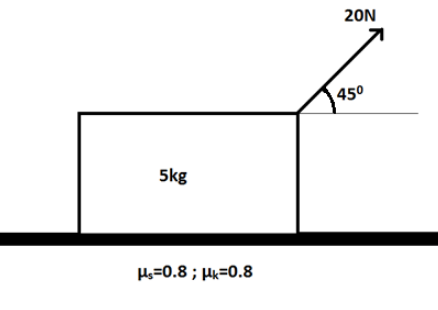
Determine force of limiting friction.
Answer
 Verified
599.7k+ views
Hint:We know that frictional force is dependent on the coefficient of the friction of the surface and the normal force acting on a body, Thus, we have to find the normal force first which can be done by considering the weight of the block as well as the vertical and horizontal components of the force.
Formulas used:
$W = mg$ ,
Where $W$ is the weight of the body, $m$ is the mass of the body and $g$ is the gravitational acceleration.
${F_s} = {\mu _s}N$ ,
Where ${F_s}$ is the force of limiting friction,${\mu _s}$ is the coefficient of the friction of the surface and $N$is the normal force.
Complete step by step answer:
As shown in figure, a block of $5kg$is resting on a surface whose coefficient of friction is $0.8$. A force of $20N$is applied on the upper right corner of the block at an angle of ${45^0}$with the horizontal. ${F_s} = {\mu _s}N = 0.8 \times 35.86 = 28.68N$.Now, let us first consider all the forces acting on the system.
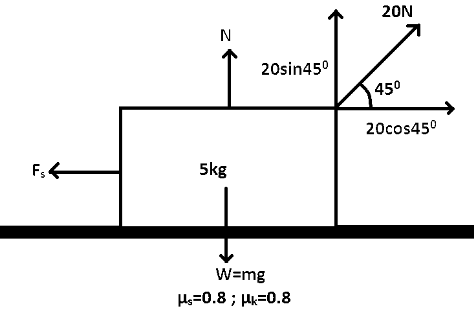
First, we need to find the normal force which can be obtained by considering the vertical forces action on the block in the equilibrium condition.
Normal force and the vertical component of the applied force act in upward direction whereas the weight of the block acts in the downward direction. Therefore,
\[
N = W - 20\cos {45^0} \\
\Rightarrow N = mg - 20\left( {0.7071} \right) \\
\Rightarrow N = 5 \times 10 - 14.14 \\
\Rightarrow N = 35.86N \\
\]
Now. We know that force of limiting friction
${F_s} = {\mu _s}N \\
\Rightarrow{F_s} = 0.8 \times 35.86 \\
\therefore {F_s} = 28.68N$
Thus, the answer is the force of limiting friction for the given system is $28.68N$.
Note:Here, we have determined the limiting force of friction. Limiting force can be defined as the maximum value of static friction that comes into play when the body is just at the point of sliding over the surface of another body. This is because the amount of friction that can be applied between two surfaces is limited and if the forces acting on the body are made sufficiently great, the motion will occur.
Formulas used:
$W = mg$ ,
Where $W$ is the weight of the body, $m$ is the mass of the body and $g$ is the gravitational acceleration.
${F_s} = {\mu _s}N$ ,
Where ${F_s}$ is the force of limiting friction,${\mu _s}$ is the coefficient of the friction of the surface and $N$is the normal force.
Complete step by step answer:
As shown in figure, a block of $5kg$is resting on a surface whose coefficient of friction is $0.8$. A force of $20N$is applied on the upper right corner of the block at an angle of ${45^0}$with the horizontal. ${F_s} = {\mu _s}N = 0.8 \times 35.86 = 28.68N$.Now, let us first consider all the forces acting on the system.
First, we need to find the normal force which can be obtained by considering the vertical forces action on the block in the equilibrium condition.
Normal force and the vertical component of the applied force act in upward direction whereas the weight of the block acts in the downward direction. Therefore,
\[
N = W - 20\cos {45^0} \\
\Rightarrow N = mg - 20\left( {0.7071} \right) \\
\Rightarrow N = 5 \times 10 - 14.14 \\
\Rightarrow N = 35.86N \\
\]
Now. We know that force of limiting friction
${F_s} = {\mu _s}N \\
\Rightarrow{F_s} = 0.8 \times 35.86 \\
\therefore {F_s} = 28.68N$
Thus, the answer is the force of limiting friction for the given system is $28.68N$.
Note:Here, we have determined the limiting force of friction. Limiting force can be defined as the maximum value of static friction that comes into play when the body is just at the point of sliding over the surface of another body. This is because the amount of friction that can be applied between two surfaces is limited and if the forces acting on the body are made sufficiently great, the motion will occur.
Recently Updated Pages
Master Class 11 English: Engaging Questions & Answers for Success

Master Class 11 Social Science: Engaging Questions & Answers for Success
Master Class 11 Maths: Engaging Questions & Answers for Success
Master Class 11 Biology: Engaging Questions & Answers for Success
Master Class 11 Physics: Engaging Questions & Answers for Success
Master Class 11 Chemistry: Engaging Questions & Answers for Success
Trending doubts
One Metric ton is equal to kg A 10000 B 1000 C 100 class 11 physics CBSE
Difference Between Prokaryotic Cells and Eukaryotic Cells
Find the value of the expression given below sin 30circ class 11 maths CBSE
Difference between physical and chemical change class 11 chemistry CBSE
Two of the body parts which do not appear in MRI are class 11 biology CBSE
Draw a diagram of a plant cell and label at least eight class 11 biology CBSE