




Determine equation of the circle whose diameter is the chord x+y=1 of the circle ${{\text{x}}^{\text{2}}}{\text{ + }}{{\text{y}}^{\text{2}}}{\text{ = 4}}$
Answer
 Verified
631.2k+ views
Hint: To solve this question, we use basic theory of circles. In this first we find the two points on the circle by using given chord equation and then after using these two points we easily Determine equation of the circle whose diameter is the chord x+y=1 of the circle ${{\text{x}}^{\text{2}}}{\text{ + }}{{\text{y}}^{\text{2}}}{\text{ = 4}}$.
Complete step-by-step answer:
As given in question,
Circle: ${{\text{x}}^{\text{2}}}{\text{ + }}{{\text{y}}^{\text{2}}}{\text{ = 4}}$ …………….. (1)
Chord: x+y=1
y=1-x ………………(2)
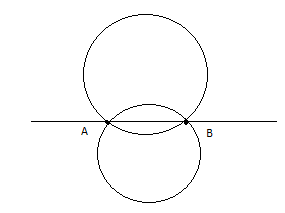
now, put value of y in equation (1), we get
${{\text{x}}^{\text{2}}}{\text{ + (1 - x}}{{\text{)}}^{\text{2}}}{\text{ = 4}}$
${{\text{x}}^{\text{2}}}{\text{ + 1 + }}{{\text{x}}^{\text{2}}}{\text{ - 2x = 4}}$
2${{\text{x}}^{\text{2}}}$-2x-3=0
x= $\dfrac{{{ - b \pm }\sqrt {\text{D}} }}{{{\text{2a}}}}$
by using this we get,
x= $\dfrac{{{1 \pm }\sqrt {\text{7}} }}{{\text{2}}}$ (\[{{\text{x}}_{\text{1}}}{\text{ and }}{{\text{x}}_{\text{2}}}\])
and by putting value of x, we get value of y
y= ${\text{1 - }}\left( {\dfrac{{{1 \pm }\sqrt {\text{7}} }}{{\text{2}}}} \right)$
y= $\dfrac{1}{2} - \dfrac{{\sqrt 7 }}{2}$or $\dfrac{1}{2} + \dfrac{{\sqrt 7 }}{2}$ (\[{{\text{y}}_{\text{1}}}{\text{ and }}{{\text{y}}_{\text{2}}}\])
So, when x= $\dfrac{{{\text{1 + }}\sqrt {\text{7}} }}{{\text{2}}}$ $ \Rightarrow $ y= $\dfrac{1}{2} - \dfrac{{\sqrt 7 }}{2}$
And x= $\dfrac{{{\text{1 - }}\sqrt {\text{7}} }}{{\text{2}}}$$ \Rightarrow $ y= $\dfrac{1}{2} + \dfrac{{\sqrt 7 }}{2}$
Now, equation of new circle passing through points A and B.
$\left( {{\text{x - }}{{\text{x}}_{\text{1}}}} \right){\text{(x - }}{{\text{x}}_{\text{2}}}{\text{) + (y - }}{{\text{y}}_{\text{1}}}{\text{)(y - }}{{\text{y}}_{\text{2}}}{\text{) = }}$0
\[{{\text{x}}^{\text{2}}}{\text{ - x(}}{{\text{x}}_{\text{1}}}{\text{ + }}{{\text{x}}_{\text{2}}}{\text{) + }}{{\text{x}}_{\text{1}}}{{\text{x}}_{\text{2}}}{\text{ + }}{{\text{y}}^{\text{2}}}{\text{ - y(}}{{\text{y}}_{\text{1}}}{\text{ + }}{{\text{y}}_{\text{2}}}{\text{) + }}{{\text{y}}_{\text{1}}}{{\text{y}}_{\text{2}}}{\text{ = 0}}\]
Here put all values of x and y, which we calculated above.
\[{{\text{x}}_{\text{1}}}{\text{ + }}{{\text{x}}_{\text{2}}}\]= 1
\[{{\text{x}}_{\text{1}}}{{\text{x}}_{\text{2}}}\]= \[\dfrac{{ - 3}}{2}\]
\[{{\text{y}}_{\text{1}}}{\text{ + }}{{\text{y}}_{\text{2}}}\]= 1
\[{{\text{y}}_{\text{1}}}{{\text{y}}_{\text{2}}}\]= \[\dfrac{{ - 3}}{2}\]
Now, we get:
\[{{\text{x}}^{\text{2}}}{\text{ - x(1) + }}\left( {\dfrac{{ - 3}}{2}} \right){\text{ + }}{{\text{y}}^{\text{2}}}{\text{ - y(1) + }}\left( {\dfrac{{ - 3}}{2}} \right){\text{ = 0}}\]
\[{\text{2}}{{\text{x}}^{\text{2}}}{\text{ - 2x - 3 + 2}}{{\text{y}}^{\text{2}}}{\text{ - 2y - 3 = 0}}\]
Therefore, equation of the circle whose diameter is the chord x+y=1 of the circle ${{\text{x}}^{\text{2}}}{\text{ + }}{{\text{y}}^{\text{2}}}{\text{ = 4}}$ is \[{\text{2}}{{\text{x}}^{\text{2}}}{\text{ - 2x - 3 + 2}}{{\text{y}}^{\text{2}}}{\text{ - 2y - 3 = 0}}\].
Note- A chord is a line passing from one point to another on the circumference of a circle. Diameter is a chord that passes through the centre. The perimeter of a circle is known as the circumference. Chords equal in length subtend equal angles at centre. Similarly, the chords are equal if the angles subtended by chords are equal at the centre. The perpendicular drawn on a chord from the centre bisects the chord.
Complete step-by-step answer:
As given in question,
Circle: ${{\text{x}}^{\text{2}}}{\text{ + }}{{\text{y}}^{\text{2}}}{\text{ = 4}}$ …………….. (1)
Chord: x+y=1
y=1-x ………………(2)
now, put value of y in equation (1), we get
${{\text{x}}^{\text{2}}}{\text{ + (1 - x}}{{\text{)}}^{\text{2}}}{\text{ = 4}}$
${{\text{x}}^{\text{2}}}{\text{ + 1 + }}{{\text{x}}^{\text{2}}}{\text{ - 2x = 4}}$
2${{\text{x}}^{\text{2}}}$-2x-3=0
x= $\dfrac{{{ - b \pm }\sqrt {\text{D}} }}{{{\text{2a}}}}$
by using this we get,
x= $\dfrac{{{1 \pm }\sqrt {\text{7}} }}{{\text{2}}}$ (\[{{\text{x}}_{\text{1}}}{\text{ and }}{{\text{x}}_{\text{2}}}\])
and by putting value of x, we get value of y
y= ${\text{1 - }}\left( {\dfrac{{{1 \pm }\sqrt {\text{7}} }}{{\text{2}}}} \right)$
y= $\dfrac{1}{2} - \dfrac{{\sqrt 7 }}{2}$or $\dfrac{1}{2} + \dfrac{{\sqrt 7 }}{2}$ (\[{{\text{y}}_{\text{1}}}{\text{ and }}{{\text{y}}_{\text{2}}}\])
So, when x= $\dfrac{{{\text{1 + }}\sqrt {\text{7}} }}{{\text{2}}}$ $ \Rightarrow $ y= $\dfrac{1}{2} - \dfrac{{\sqrt 7 }}{2}$
And x= $\dfrac{{{\text{1 - }}\sqrt {\text{7}} }}{{\text{2}}}$$ \Rightarrow $ y= $\dfrac{1}{2} + \dfrac{{\sqrt 7 }}{2}$
Now, equation of new circle passing through points A and B.
$\left( {{\text{x - }}{{\text{x}}_{\text{1}}}} \right){\text{(x - }}{{\text{x}}_{\text{2}}}{\text{) + (y - }}{{\text{y}}_{\text{1}}}{\text{)(y - }}{{\text{y}}_{\text{2}}}{\text{) = }}$0
\[{{\text{x}}^{\text{2}}}{\text{ - x(}}{{\text{x}}_{\text{1}}}{\text{ + }}{{\text{x}}_{\text{2}}}{\text{) + }}{{\text{x}}_{\text{1}}}{{\text{x}}_{\text{2}}}{\text{ + }}{{\text{y}}^{\text{2}}}{\text{ - y(}}{{\text{y}}_{\text{1}}}{\text{ + }}{{\text{y}}_{\text{2}}}{\text{) + }}{{\text{y}}_{\text{1}}}{{\text{y}}_{\text{2}}}{\text{ = 0}}\]
Here put all values of x and y, which we calculated above.
\[{{\text{x}}_{\text{1}}}{\text{ + }}{{\text{x}}_{\text{2}}}\]= 1
\[{{\text{x}}_{\text{1}}}{{\text{x}}_{\text{2}}}\]= \[\dfrac{{ - 3}}{2}\]
\[{{\text{y}}_{\text{1}}}{\text{ + }}{{\text{y}}_{\text{2}}}\]= 1
\[{{\text{y}}_{\text{1}}}{{\text{y}}_{\text{2}}}\]= \[\dfrac{{ - 3}}{2}\]
Now, we get:
\[{{\text{x}}^{\text{2}}}{\text{ - x(1) + }}\left( {\dfrac{{ - 3}}{2}} \right){\text{ + }}{{\text{y}}^{\text{2}}}{\text{ - y(1) + }}\left( {\dfrac{{ - 3}}{2}} \right){\text{ = 0}}\]
\[{\text{2}}{{\text{x}}^{\text{2}}}{\text{ - 2x - 3 + 2}}{{\text{y}}^{\text{2}}}{\text{ - 2y - 3 = 0}}\]
Therefore, equation of the circle whose diameter is the chord x+y=1 of the circle ${{\text{x}}^{\text{2}}}{\text{ + }}{{\text{y}}^{\text{2}}}{\text{ = 4}}$ is \[{\text{2}}{{\text{x}}^{\text{2}}}{\text{ - 2x - 3 + 2}}{{\text{y}}^{\text{2}}}{\text{ - 2y - 3 = 0}}\].
Note- A chord is a line passing from one point to another on the circumference of a circle. Diameter is a chord that passes through the centre. The perimeter of a circle is known as the circumference. Chords equal in length subtend equal angles at centre. Similarly, the chords are equal if the angles subtended by chords are equal at the centre. The perpendicular drawn on a chord from the centre bisects the chord.
Recently Updated Pages
Master Class 12 Social Science: Engaging Questions & Answers for Success

Master Class 12 Physics: Engaging Questions & Answers for Success
Master Class 12 Maths: Engaging Questions & Answers for Success
Master Class 12 Economics: Engaging Questions & Answers for Success
Master Class 12 Chemistry: Engaging Questions & Answers for Success
Master Class 12 Business Studies: Engaging Questions & Answers for Success
Trending doubts
Which are the Top 10 Largest Countries of the World?
Draw a labelled sketch of the human eye class 12 physics CBSE
Explain the structure of megasporangium class 12 biology CBSE
What are the major means of transport Explain each class 12 social science CBSE
Differentiate between homogeneous and heterogeneous class 12 chemistry CBSE
Sulphuric acid is known as the king of acids State class 12 chemistry CBSE