



Describe the parts of the mouth of a cockroach.
Answer
 Verified
555.9k+ views
Hint: Cockroaches are present for hundreds of thousands of years evolving into some of the most adaptable pests on Earth. The body of the cockroach is segmented and divisible into three different regions:
1. Head
2. Thorax
3. Abdomen
The complete body of the cockroach is covered by way of a challenging chitinous exoskeleton which is typically brown in colour.
Complete answer:
Cockroach: They belong to a type of Insect of Phylum Arthropod. Cockroaches are usually brown or black bodied animals. But in tropical regions, vibrant yellow, red, and green coloured cockroaches are found.
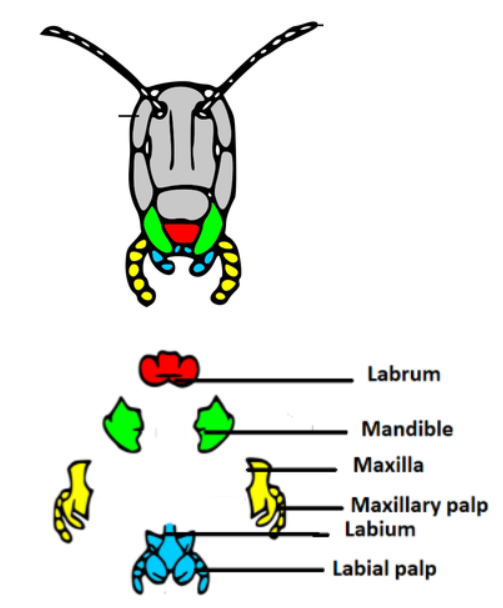
Sizes range from 0.5 inches to 3 inches. Anterior parts of the head endure appendages forming biting and chewing type of mouth parts. The mouthparts of the cockroach include
1. Labarum
2. Mandibles
3. Maxillae
4. Labium.
Labarum or also acknowledged as the upper lip is a huge and roughly rectangular fashioned structure. It hangs from the front aspect of the head on the lower side. A tongue-like shape is current in the floor of the mouth known as the hypopharynx.
Mandibles are a pair of hard, strong, large, dark-coloured constructions located one on either facet with ragged internal sides. They go in a horizontal motion and crush the meals existing in-between them.
Maxillae are a pair of structures that are present outside and in the back of the mandibles. Each consists of three components known as
1. Protopodite
2. Exopodite
3. Endopodite.
The labium is stated to be fashioned by means of the fusion of the 2d pair of maxillae. It varieties the extensive median decrease lip and has a pair of 3-segmented labial palps on either facet which is sensory in nature.
The mouthparts of the cockroach is shown by the figure below
Note: A cockroach's mouth can cross from facet to aspect and is capable of processing odor and taste simultaneously. Cockroaches are also equipped with salivary glands which helps them in the digestion of food.
1. Head
2. Thorax
3. Abdomen
The complete body of the cockroach is covered by way of a challenging chitinous exoskeleton which is typically brown in colour.
Complete answer:
Cockroach: They belong to a type of Insect of Phylum Arthropod. Cockroaches are usually brown or black bodied animals. But in tropical regions, vibrant yellow, red, and green coloured cockroaches are found.
Sizes range from 0.5 inches to 3 inches. Anterior parts of the head endure appendages forming biting and chewing type of mouth parts. The mouthparts of the cockroach include
1. Labarum
2. Mandibles
3. Maxillae
4. Labium.
Labarum or also acknowledged as the upper lip is a huge and roughly rectangular fashioned structure. It hangs from the front aspect of the head on the lower side. A tongue-like shape is current in the floor of the mouth known as the hypopharynx.
Mandibles are a pair of hard, strong, large, dark-coloured constructions located one on either facet with ragged internal sides. They go in a horizontal motion and crush the meals existing in-between them.
Maxillae are a pair of structures that are present outside and in the back of the mandibles. Each consists of three components known as
1. Protopodite
2. Exopodite
3. Endopodite.
The labium is stated to be fashioned by means of the fusion of the 2d pair of maxillae. It varieties the extensive median decrease lip and has a pair of 3-segmented labial palps on either facet which is sensory in nature.
The mouthparts of the cockroach is shown by the figure below
Note: A cockroach's mouth can cross from facet to aspect and is capable of processing odor and taste simultaneously. Cockroaches are also equipped with salivary glands which helps them in the digestion of food.
Recently Updated Pages
Master Class 12 Economics: Engaging Questions & Answers for Success

Master Class 12 English: Engaging Questions & Answers for Success
Master Class 12 Social Science: Engaging Questions & Answers for Success
Master Class 12 Maths: Engaging Questions & Answers for Success
Master Class 12 Physics: Engaging Questions & Answers for Success
Master Class 11 Social Science: Engaging Questions & Answers for Success
Trending doubts
One Metric ton is equal to kg A 10000 B 1000 C 100 class 11 physics CBSE
Difference Between Prokaryotic Cells and Eukaryotic Cells
Two of the body parts which do not appear in MRI are class 11 biology CBSE
1 ton equals to A 100 kg B 1000 kg C 10 kg D 10000 class 11 physics CBSE
Draw a diagram of nephron and explain its structur class 11 biology CBSE
10 examples of friction in our daily life