




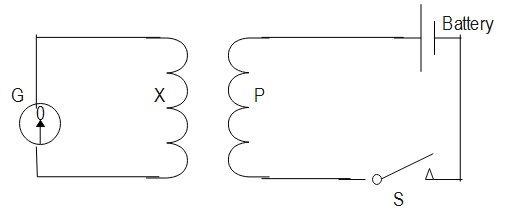
Describe the observation when the switch S is (i) closed suddenly, (ii) then closed, (iii) finally opened.
Answer
 Verified
572.7k+ views
Hint: In this question, we will first study the deflection of the galvanometer in different cases. The basic idea of galvanometer will help to get the answer. Further, we will study about the series circuit, for our better understanding.
Complete step by step solution:
As we know, in the given circuit when the key is pressed it is observed that the galvanometer shows a very small or can be called as momentary deflection and then returns to zero.
Now, when the key is released, the galvanometer again gives a very small momentary deflection, but now this deflection can be seen in the opposite direction and then returns to zero. This phenomenon is due to Electromagnetic induction which is discovered by Faraday.
Now, when we take the different cases:
Closed suddenly: when the switch is closed suddenly, the Galvanometer needle shows a small momentary deflection and then returns to zero.
Then closed: when the switch is closed suddenly and then again closed, the Galvanometer will show no deflection because there is no change in the electric circuit.
Finally opened: at the last case, when the switch is finally opened, the Galvanometer shows a small momentary deflection in the opposite direction and then comes back to zero.
Additional information:
We should know that in a series circuit, the output current of the first resistor flows into the input of the second resistor; so, the current is the same in each resistor whereas In a parallel circuit, all of the resistor are on connected together on one side and all the leads on the other side are connected together.
In a circuit if the resistance is constant over a range of voltage, then I = V/R, can be used to predict the behavior of the material. This involves DC current and voltage, it is the same for the resistors. Further, a material obeys Ohm's law or does not obey; the resistance of the material can be described in terms of its bulk. The resistivity, and the resistance both, is temperature dependent. Over certain ranges of temperature, this temperature dependence can be predicted from resistance.
Note:
We need to know that a transformer works on the principle of Faraday’s law of electromagnetic induction and mutual induction. Also, internal resistance of a circuit refers to the opposition to the flow of current offered by the cells and batteries themselves thereby, resulting in the generation of heat. Internal resistance and resistance both are measured in Ohms.
Complete step by step solution:
As we know, in the given circuit when the key is pressed it is observed that the galvanometer shows a very small or can be called as momentary deflection and then returns to zero.
Now, when the key is released, the galvanometer again gives a very small momentary deflection, but now this deflection can be seen in the opposite direction and then returns to zero. This phenomenon is due to Electromagnetic induction which is discovered by Faraday.
Now, when we take the different cases:
Closed suddenly: when the switch is closed suddenly, the Galvanometer needle shows a small momentary deflection and then returns to zero.
Then closed: when the switch is closed suddenly and then again closed, the Galvanometer will show no deflection because there is no change in the electric circuit.
Finally opened: at the last case, when the switch is finally opened, the Galvanometer shows a small momentary deflection in the opposite direction and then comes back to zero.
Additional information:
We should know that in a series circuit, the output current of the first resistor flows into the input of the second resistor; so, the current is the same in each resistor whereas In a parallel circuit, all of the resistor are on connected together on one side and all the leads on the other side are connected together.
In a circuit if the resistance is constant over a range of voltage, then I = V/R, can be used to predict the behavior of the material. This involves DC current and voltage, it is the same for the resistors. Further, a material obeys Ohm's law or does not obey; the resistance of the material can be described in terms of its bulk. The resistivity, and the resistance both, is temperature dependent. Over certain ranges of temperature, this temperature dependence can be predicted from resistance.
Note:
We need to know that a transformer works on the principle of Faraday’s law of electromagnetic induction and mutual induction. Also, internal resistance of a circuit refers to the opposition to the flow of current offered by the cells and batteries themselves thereby, resulting in the generation of heat. Internal resistance and resistance both are measured in Ohms.
Recently Updated Pages
Master Class 12 Economics: Engaging Questions & Answers for Success

Master Class 12 Physics: Engaging Questions & Answers for Success
Master Class 12 English: Engaging Questions & Answers for Success
Master Class 12 Social Science: Engaging Questions & Answers for Success
Master Class 12 Maths: Engaging Questions & Answers for Success
Master Class 12 Business Studies: Engaging Questions & Answers for Success
Trending doubts
Which are the Top 10 Largest Countries of the World?
What are the major means of transport Explain each class 12 social science CBSE
Draw a labelled sketch of the human eye class 12 physics CBSE
Why cannot DNA pass through cell membranes class 12 biology CBSE
Differentiate between insitu conservation and exsitu class 12 biology CBSE
Draw a neat and well labeled diagram of TS of ovary class 12 biology CBSE