




Describe the initiation process of transcription in bacteria.
Answer
 Verified
615.3k+ views
Hint: Transcription is a vital process that takes place in the cells to make a transcript that is used to make proteins. To make the transcript the DNA needs to get unwind. As the transcription enzymes need to read it by binding to the template strand. This is followed by the elongation and termination steps of transcription.
Complete step by step answer: Transcription refers to the process of formation of the mRNA from the DNA. It can also be termed as the transcript. This process involves complementary base pairing that is catalyzed by an RNA polymerase enzyme. The transcript is produced in a unidirectional manner $5'to3'$.
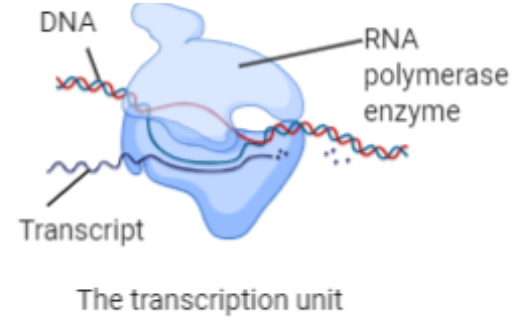
The initiation process is the first step in transcription. As bacteria are prokaryotic organisms the process is simple. The initiation begins with the RNA polymerase enzyme. The $\sigma $ (sigma) factor of RNA polymerase recognizes the promoter sequence in the double helix DNA. RNA polymerase binds to a promoter sequence that covers around $80bp$ from $-55$ to $+20$ position of DNA sequence. This results in the formation of a binary complex because the DNA is in the duplex form that will be converted into an open complex (unwind form) by melting a short region of DNA that is an A-T rich region within the promoter sequence. The structure so formed is called the transcription bubble. Now, for the melting of the A-T rich region, the RNA polymerase needs some transcription factors that are A, B, D, E, F, and H and transcription factors II H-TF II H. TF II H forms the transcription bubble. Some dNTPs are also required that are Uracil, Adenine, Guanine, and Cytosine. After the association of all these factors with the enzyme, the complex of DNA, RNA, and enzyme is called the ternary complex. Transcription is not usually successful in two or three attempts. It gets terminated until and unless the transcript becomes of length $10bp$.
Note: The DNA-RNA hybrid formed in initiation is important for the elongation of the transcript. The dNTPs are added to form the transcript by covalent phosphodiester bonds using DNA-RNA hybrid.
Complete step by step answer: Transcription refers to the process of formation of the mRNA from the DNA. It can also be termed as the transcript. This process involves complementary base pairing that is catalyzed by an RNA polymerase enzyme. The transcript is produced in a unidirectional manner $5'to3'$.
The initiation process is the first step in transcription. As bacteria are prokaryotic organisms the process is simple. The initiation begins with the RNA polymerase enzyme. The $\sigma $ (sigma) factor of RNA polymerase recognizes the promoter sequence in the double helix DNA. RNA polymerase binds to a promoter sequence that covers around $80bp$ from $-55$ to $+20$ position of DNA sequence. This results in the formation of a binary complex because the DNA is in the duplex form that will be converted into an open complex (unwind form) by melting a short region of DNA that is an A-T rich region within the promoter sequence. The structure so formed is called the transcription bubble. Now, for the melting of the A-T rich region, the RNA polymerase needs some transcription factors that are A, B, D, E, F, and H and transcription factors II H-TF II H. TF II H forms the transcription bubble. Some dNTPs are also required that are Uracil, Adenine, Guanine, and Cytosine. After the association of all these factors with the enzyme, the complex of DNA, RNA, and enzyme is called the ternary complex. Transcription is not usually successful in two or three attempts. It gets terminated until and unless the transcript becomes of length $10bp$.
Note: The DNA-RNA hybrid formed in initiation is important for the elongation of the transcript. The dNTPs are added to form the transcript by covalent phosphodiester bonds using DNA-RNA hybrid.
Recently Updated Pages
Master Class 12 Business Studies: Engaging Questions & Answers for Success

Master Class 12 Chemistry: Engaging Questions & Answers for Success
Master Class 12 Biology: Engaging Questions & Answers for Success
Class 12 Question and Answer - Your Ultimate Solutions Guide
Master Class 11 English: Engaging Questions & Answers for Success
Master Class 11 Social Science: Engaging Questions & Answers for Success
Trending doubts
The end of compass needle which points towards north class 12 physics CBSE
In order to find out the different types of gametes class 12 biology NEET_UG
Hormone responsible for the secretion of milk after class 12 biology CBSE
Yeast reproduces by A Spore formation B Multiple fission class 12 biology CBSE
Draw a well labelled diagram of LS of the human ki class 12 biology CBSE
Draw a diagram of a flower and name the parts class 12 biology ICSE