




How do you describe the end behavior for \[f(x)={{x}^{3}}+10{{x}^{2}}+32x+34\]?
Answer
 Verified
563.4k+ views
Hint: The degree of the function is the highest power to which the function is raised. We can state the type of polynomial by checking its degree. For example, polynomials with degree one are linear, with degree two are quadratic, while with degree three are cubic. We also know that all polynomials are continuous and differentiable for all values of x. To check the end behaviour of a polynomial, we have to evaluate their limit at negative infinity and positive infinity.
Complete step by step solution:
We are asked to describe the end behavior of the function \[f(x)={{x}^{3}}+10{{x}^{2}}+32x+34\]. We can see that this is a polynomial of degree three, as it is a polynomial it is continuous for all values of x. To describe the end behaviour, we have to evaluate their limit at negative infinity and positive infinity.
First let’s evaluate \[\displaystyle \lim_{x \to -\infty }f(x)\]. Substituting the function, we get
\[\displaystyle \lim_{x \to -\infty }\left( {{x}^{3}}+10{{x}^{2}}+32x+34 \right)\]
In polynomials, while evaluating limits the highest exponent will dominate. Here, the highest exponent is 3. Thus, we can simplify the limit as.
\[\Rightarrow \displaystyle \lim_{x \to -\infty }{{x}^{3}}\]
\[\Rightarrow -\infty \]
Now, let’s evaluate \[\displaystyle \lim_{x \to \infty }f(x)\]. Substituting the function, we get
\[\displaystyle \lim_{x \to \infty }\left( {{x}^{3}}+10{{x}^{2}}+32x+34 \right)\]
Again, using the same method, we can simplify the limit as \[\displaystyle \lim_{x \to \infty }{{x}^{3}}\]
\[\Rightarrow \infty \]
Note: For these types of questions, you should know the meaning of end behaviour. Here, as the function was polynomial, we were able to evaluate the limit easily. We can also check the end behaviour of a function by plotting the graph of the function, and where the graph goes if x tends to any of the infinity.
As follows:
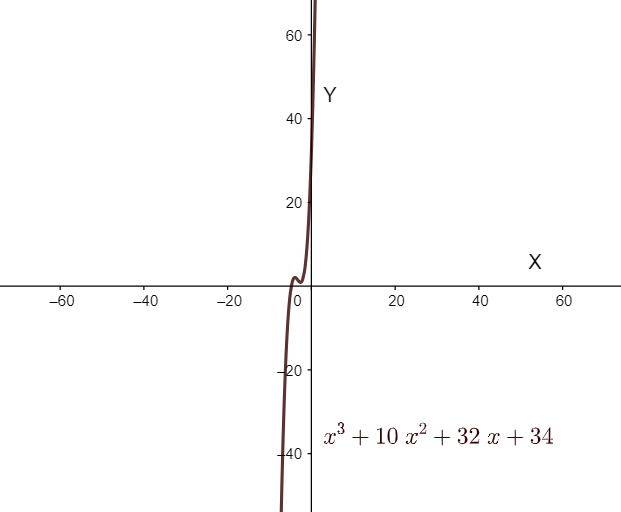
Complete step by step solution:
We are asked to describe the end behavior of the function \[f(x)={{x}^{3}}+10{{x}^{2}}+32x+34\]. We can see that this is a polynomial of degree three, as it is a polynomial it is continuous for all values of x. To describe the end behaviour, we have to evaluate their limit at negative infinity and positive infinity.
First let’s evaluate \[\displaystyle \lim_{x \to -\infty }f(x)\]. Substituting the function, we get
\[\displaystyle \lim_{x \to -\infty }\left( {{x}^{3}}+10{{x}^{2}}+32x+34 \right)\]
In polynomials, while evaluating limits the highest exponent will dominate. Here, the highest exponent is 3. Thus, we can simplify the limit as.
\[\Rightarrow \displaystyle \lim_{x \to -\infty }{{x}^{3}}\]
\[\Rightarrow -\infty \]
Now, let’s evaluate \[\displaystyle \lim_{x \to \infty }f(x)\]. Substituting the function, we get
\[\displaystyle \lim_{x \to \infty }\left( {{x}^{3}}+10{{x}^{2}}+32x+34 \right)\]
Again, using the same method, we can simplify the limit as \[\displaystyle \lim_{x \to \infty }{{x}^{3}}\]
\[\Rightarrow \infty \]
Note: For these types of questions, you should know the meaning of end behaviour. Here, as the function was polynomial, we were able to evaluate the limit easily. We can also check the end behaviour of a function by plotting the graph of the function, and where the graph goes if x tends to any of the infinity.
As follows:
Recently Updated Pages
Master Class 11 English: Engaging Questions & Answers for Success

Master Class 11 Maths: Engaging Questions & Answers for Success
Class 11 Question and Answer - Your Ultimate Solutions Guide
Master Class 11 Biology: Engaging Questions & Answers for Success
Master Class 11 Physics: Engaging Questions & Answers for Success
Master Class 11 Accountancy: Engaging Questions & Answers for Success
Trending doubts
Differentiate between an exothermic and an endothermic class 11 chemistry CBSE
One Metric ton is equal to kg A 10000 B 1000 C 100 class 11 physics CBSE
Difference Between Prokaryotic Cells and Eukaryotic Cells
There are 720 permutations of the digits 1 2 3 4 5 class 11 maths CBSE
Draw a diagram of a plant cell and label at least eight class 11 biology CBSE
1 Quintal is equal to a 110 kg b 10 kg c 100kg d 1000 class 11 physics CBSE