




Describe the cyclic photophosphorylation? What is the purpose of the proton gradient during the process in thylakoids?
Answer
 Verified
549.3k+ views
Hint: The living organisms usually extract energy from oxidisable substances and they usually store this in the form of bond energy. We know that special substances like ATP carry this energy in their chemical bond. In PS I, the flow of electrons takes place in the photosystem only due to the cyclic flow of electrons.
Complete answer:
The process through which ATP is synthesized by the cells in the mitochondria and the chloroplast of the cell is called phosphorylation. Photophosphorylation is the process of synthesis of ATP from ADP and inorganic phosphate and it can take place only in the presence of light. If only PS I is functional only then the electrons are circulated.
The process of phosphorylation can take place only due to the flow of electrons. A possible location where this happens is stroma lamellae. While the membrane or lamellae of the grana have both PS I and PS II the stroma lamellae membranes lack PSII as well as NADP reductase enzyme. The excited electron does not pass on to $NADP^+$ but is cycled back to the PS I complex through the electron transport chain. The process of cyclic photophosphorylation can also take place when light wavelengths beyond 680 nm are available for excitation.
The proton gradient is important because it is the breakdown of this gradient that leads to the release of energy. The gradient is broken down due to the movement of protons across the membrane to the stroma through the transmembrane channel of the F. of the ATPase. The ATPase is an enzyme that consists of two parts one called the F.is embedded in the membrane and forms a transmembrane channel that carries out facilitated diffusion of protons across the membrane.
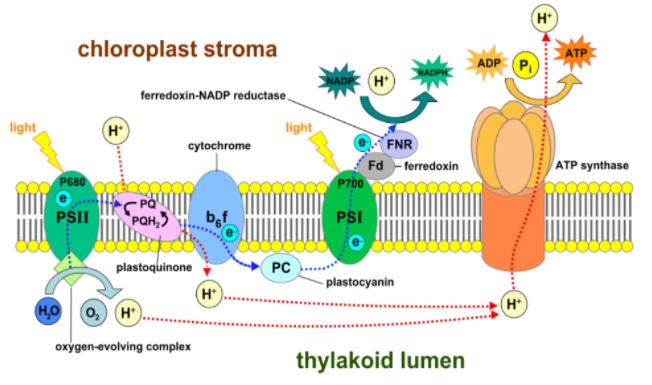
The outer surface of the thylakoid membrane usually on the side that faces the stroma contains another portion which is called F1. These portions usually protrude on the surface. The breakdown of the gradient helps in providing energy for conformational change taking place in The F1 particles of the ATPase. This helps the enzymes synthesize several molecules of energy-packed ATP.
Note: Jan Ingenhousz showed that sunlight is essential to the plants for the process that somehow purifies the air fouled by burning candles or breathing animals. He performed an experiment with aquatic plants that showed bright light, small bubbles were formed around the green plants while dark do not form such bubbles around the plants. For photophosphorylation, sunlight is the main source of the production of ATP.
Complete answer:
The process through which ATP is synthesized by the cells in the mitochondria and the chloroplast of the cell is called phosphorylation. Photophosphorylation is the process of synthesis of ATP from ADP and inorganic phosphate and it can take place only in the presence of light. If only PS I is functional only then the electrons are circulated.
The process of phosphorylation can take place only due to the flow of electrons. A possible location where this happens is stroma lamellae. While the membrane or lamellae of the grana have both PS I and PS II the stroma lamellae membranes lack PSII as well as NADP reductase enzyme. The excited electron does not pass on to $NADP^+$ but is cycled back to the PS I complex through the electron transport chain. The process of cyclic photophosphorylation can also take place when light wavelengths beyond 680 nm are available for excitation.
The proton gradient is important because it is the breakdown of this gradient that leads to the release of energy. The gradient is broken down due to the movement of protons across the membrane to the stroma through the transmembrane channel of the F. of the ATPase. The ATPase is an enzyme that consists of two parts one called the F.is embedded in the membrane and forms a transmembrane channel that carries out facilitated diffusion of protons across the membrane.
The outer surface of the thylakoid membrane usually on the side that faces the stroma contains another portion which is called F1. These portions usually protrude on the surface. The breakdown of the gradient helps in providing energy for conformational change taking place in The F1 particles of the ATPase. This helps the enzymes synthesize several molecules of energy-packed ATP.
Note: Jan Ingenhousz showed that sunlight is essential to the plants for the process that somehow purifies the air fouled by burning candles or breathing animals. He performed an experiment with aquatic plants that showed bright light, small bubbles were formed around the green plants while dark do not form such bubbles around the plants. For photophosphorylation, sunlight is the main source of the production of ATP.
Recently Updated Pages
If x a + bt + ct2 where x is in meters and t is in class 11 physics CBSE

A car covers the first half distance between two places class 11 physics CBSE
The resultant of two vectors overrightarrow P and overrightarrow class 11 physics CBSE
Find the value of cos 135 class 11 maths CBSE
A mass M is held in place by an applied force F and class 11 physics CBSE
A solution of glucose in water is labelled as 10 dfracwv class 11 chemistry CBSE
Trending doubts
One Metric ton is equal to kg A 10000 B 1000 C 100 class 11 physics CBSE
Find the value of the expression given below sin 30circ class 11 maths CBSE
What do you mean by retardation What is its SI uni class 11 physics CBSE
Draw a diagram of nephron and explain its structur class 11 biology CBSE
10 examples of friction in our daily life
Difference between physical and chemical change class 11 chemistry CBSE