




Describe the characteristics of the image formed when the object is placed at $2{F_1}$ of the concave lens.
Answer
 Verified
616.2k+ views
Hint:The object is placed at a distance $2{F_1}$ from the pole of the concave lens. The point corresponding to this distance is the centre of curvature of the lens on its left.
Complete step by step answer.
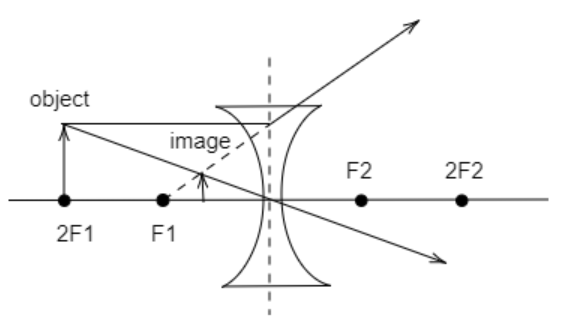
Step 1: Sketch a figure representing the image formation of the object placed at $2{F_1}$ of the concave lens.
Step 2: Describe the image formed.
All images formed by the concave lens are diminished and virtual. From the above figure, we see that the image formed is upright too. It is located just before the first focal point ${F_1}$ of the lens.
Additional information:A concave lens is thinner at its centre and has bulging edges. A concave lens is also known as a diverging lens as the light rays diverge after refraction. Concave lenses find many applications in real-life. A concave lens is usually used to correct short-sightedness of the eye as it can shift the light rays coming from the object back at the retina. The diverging property of the concave lens is also used in binoculars as it makes the objects look smaller in size and farther away.
Note:For the image formation, the rays of light from the object are taken such that a ray passing parallel to the principal axis will diverge upon refraction, a ray passing through the optical centre of the lens passes undeflected upon refraction and a ray of light appearing to meet the principal focus will emerge parallel to the principal focus upon refraction.
Complete step by step answer.
Step 1: Sketch a figure representing the image formation of the object placed at $2{F_1}$ of the concave lens.
Image formation in a concave lens
Step 2: Describe the image formed.
All images formed by the concave lens are diminished and virtual. From the above figure, we see that the image formed is upright too. It is located just before the first focal point ${F_1}$ of the lens.
Additional information:A concave lens is thinner at its centre and has bulging edges. A concave lens is also known as a diverging lens as the light rays diverge after refraction. Concave lenses find many applications in real-life. A concave lens is usually used to correct short-sightedness of the eye as it can shift the light rays coming from the object back at the retina. The diverging property of the concave lens is also used in binoculars as it makes the objects look smaller in size and farther away.
Note:For the image formation, the rays of light from the object are taken such that a ray passing parallel to the principal axis will diverge upon refraction, a ray passing through the optical centre of the lens passes undeflected upon refraction and a ray of light appearing to meet the principal focus will emerge parallel to the principal focus upon refraction.
Recently Updated Pages
Master Class 12 Business Studies: Engaging Questions & Answers for Success

Master Class 12 Chemistry: Engaging Questions & Answers for Success
Master Class 12 Biology: Engaging Questions & Answers for Success
Class 12 Question and Answer - Your Ultimate Solutions Guide
Master Class 11 English: Engaging Questions & Answers for Success
Master Class 11 Social Science: Engaging Questions & Answers for Success
Trending doubts
Which are the Top 10 Largest Countries of the World?
Draw a labelled sketch of the human eye class 12 physics CBSE
Differentiate between homogeneous and heterogeneous class 12 chemistry CBSE
In order to find out the different types of gametes class 12 biology NEET_UG
Why is the cell called the structural and functional class 12 biology CBSE
Draw ray diagrams each showing i myopic eye and ii class 12 physics CBSE