




Describe the asexual and sexual phase of life cycle of Plasmodium that causes malaria in humans.
Answer
 Verified
627.9k+ views
Hint: Malaria is caused by the toxins produced in the human body by the parasite Plasmodium. It is transmitted from an infected person to the healthy person by the action of Anopheles mosquito.
Complete answer:
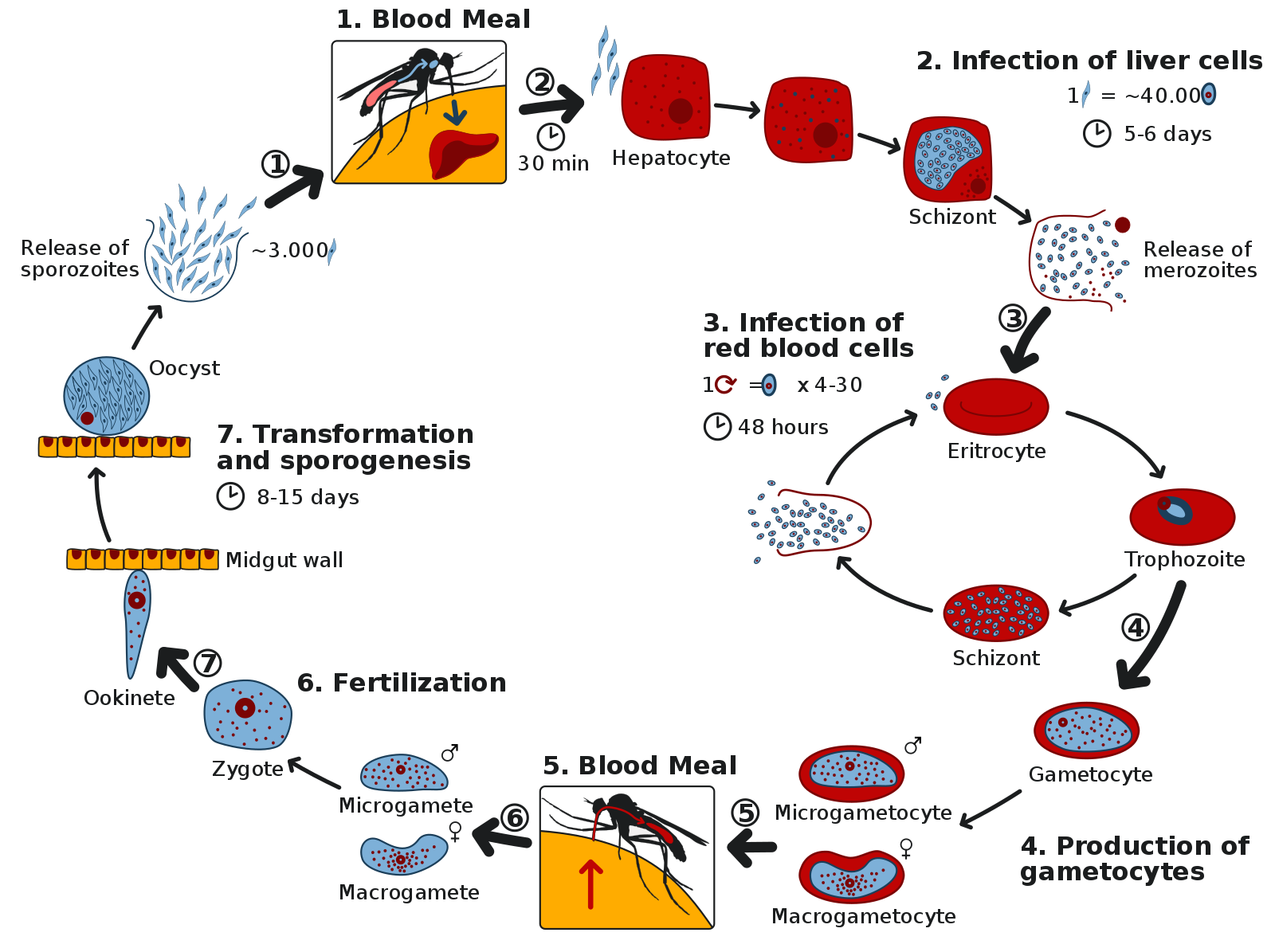
The two phases i.e asexual reproduction occurs in the human host whereas the sexual phase pccurs in the female Anopheles mosquito. The phases are described below-
Asexual phase:- It occurs inside the human body. The toxins released by the parasite is known as sporozite. These sporozite enter the liver cells and start dividing to give rise to merozoites, which are then released into the bloodstream. These merozoites move towards the red blood cells. After invading red blood cells they first form a signet ring stage followed by the amoeboid stage and ultimately leads to the rupture of Red blood cells causing a cycle of fever along with chills. Merozoites released from the ruptured Red blood cells, some of them further target the other red blood corpuscle and form male gametophyte and female gametophyte i.e sexual stages in red blood cells.
Sexual phase:- The female mosquito takes up gametocytes along with the blood meal. Fertilisation occurs followed by the development in the mosquito stomach. Mature sporozoites are the infective stages that escape from the intestine and move towards the mosquito's salivary gland.
Note:
Plasmodium completes its life cycle in two hosts i.e primary host is mosquito itself and secondary host is man. When the infected mosquito bites a healthy human being then the parasites migrate into his blood with the saliva.
Complete answer:
The two phases i.e asexual reproduction occurs in the human host whereas the sexual phase pccurs in the female Anopheles mosquito. The phases are described below-
Asexual phase:- It occurs inside the human body. The toxins released by the parasite is known as sporozite. These sporozite enter the liver cells and start dividing to give rise to merozoites, which are then released into the bloodstream. These merozoites move towards the red blood cells. After invading red blood cells they first form a signet ring stage followed by the amoeboid stage and ultimately leads to the rupture of Red blood cells causing a cycle of fever along with chills. Merozoites released from the ruptured Red blood cells, some of them further target the other red blood corpuscle and form male gametophyte and female gametophyte i.e sexual stages in red blood cells.
Sexual phase:- The female mosquito takes up gametocytes along with the blood meal. Fertilisation occurs followed by the development in the mosquito stomach. Mature sporozoites are the infective stages that escape from the intestine and move towards the mosquito's salivary gland.
Note:
Plasmodium completes its life cycle in two hosts i.e primary host is mosquito itself and secondary host is man. When the infected mosquito bites a healthy human being then the parasites migrate into his blood with the saliva.
Recently Updated Pages
Onehalf of a convex lens is covered with a black paper class 12 physics CBSE

Differentiate between lanthanoids and actinoids class 12 chemistry CBSE
An object 5 cm in length is held 25 cm away from a class 12 physics CBSE
Name the following halides according to the IUPAC system class 12 chemistry CBSE
What is the Full Form of PVC, PET, HDPE, LDPE, PP and PS ?
An infinite ladder network of resistances is constructed class 12 physics CBSE
Trending doubts
Draw a labelled sketch of the human eye class 12 physics CBSE
Which are the Top 10 Largest Countries of the World?
Draw ray diagrams each showing i myopic eye and ii class 12 physics CBSE
Which is the correct genotypic ratio of mendel dihybrid class 12 biology CBSE
Differentiate between homogeneous and heterogeneous class 12 chemistry CBSE
Give 10 examples of unisexual and bisexual flowers