




Describe schematically, the equipotential surfaces corresponding to
(a) A constant electric field in the Z direction.
(b) A field that uniformly increases in magnitude but remains in a constant (say, z) direction.
(c) A single positive charge at the origin.
Answer
 Verified
591.3k+ views
Hint:Equipotential surfaces are those surfaces where the potential is the same at every point on the surface. The electric at a point on an equipotential surface is perpendicular to the surface. We shall use this property to draw the equipotential surfaces for the given situations.
Complete answer:
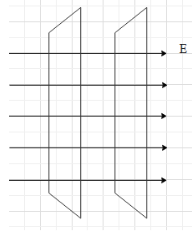
(a) Consider a constant field in the Z direction, as shown. We can represent a constant electric field with parallel field lines. Therefore, the surface perpendicular to these field lines is a plane, as shown in the figure. Hence, the equipotential surfaces for a constant electric field in Z direction are planes parallel to the xy plane.
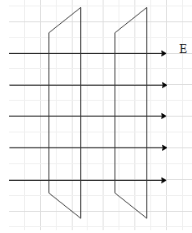
(b) In this case too, we can represent the electric field as parallel field lines but the magnitude of the field is increasing in the z direction. Since the electric field lines are parallel to the z axis, the equipotential surfaces will be planes parallel to the y plane.
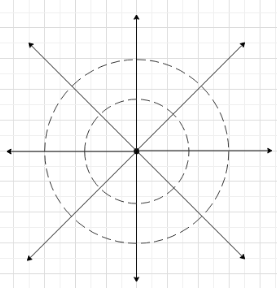
(c) We know that a single positive charge produces electric field lines are move radially outwards, as shown in the figure. If we try to draw a surface that is perpendicular to the field lines, then we will get a sphere. Therefore, equipotential surfaces for a single positive charge are concentric spheres with the charge at their centre.
Note: It is not necessary that any two equipotential surfaces have equal potential.
In (a) all the equipotential surfaces have equal potentials because the electric field is constant. However, in (b) different equipotential surfaces will have different potential on them as the electric field is increasing in the z direction.
Complete answer:
(a) Consider a constant field in the Z direction, as shown. We can represent a constant electric field with parallel field lines. Therefore, the surface perpendicular to these field lines is a plane, as shown in the figure. Hence, the equipotential surfaces for a constant electric field in Z direction are planes parallel to the xy plane.
(b) In this case too, we can represent the electric field as parallel field lines but the magnitude of the field is increasing in the z direction. Since the electric field lines are parallel to the z axis, the equipotential surfaces will be planes parallel to the y plane.
(c) We know that a single positive charge produces electric field lines are move radially outwards, as shown in the figure. If we try to draw a surface that is perpendicular to the field lines, then we will get a sphere. Therefore, equipotential surfaces for a single positive charge are concentric spheres with the charge at their centre.
Note: It is not necessary that any two equipotential surfaces have equal potential.
In (a) all the equipotential surfaces have equal potentials because the electric field is constant. However, in (b) different equipotential surfaces will have different potential on them as the electric field is increasing in the z direction.
Recently Updated Pages
Master Class 12 Economics: Engaging Questions & Answers for Success

Master Class 12 English: Engaging Questions & Answers for Success
Master Class 12 Social Science: Engaging Questions & Answers for Success
Master Class 12 Maths: Engaging Questions & Answers for Success
Master Class 12 Physics: Engaging Questions & Answers for Success
Master Class 12 Business Studies: Engaging Questions & Answers for Success
Trending doubts
Which are the Top 10 Largest Countries of the World?
Draw a labelled sketch of the human eye class 12 physics CBSE
Differentiate between homogeneous and heterogeneous class 12 chemistry CBSE
Why is the cell called the structural and functional class 12 biology CBSE
Draw ray diagrams each showing i myopic eye and ii class 12 physics CBSE
Which is the correct genotypic ratio of mendel dihybrid class 12 biology CBSE