




Describe briefly the underlying principle of a transistor amplifier working as an oscillator. Hence, use the necessary circuit diagram to explain how self sustained oscillations are achieved in the oscillator.
Answer
 Verified
592.2k+ views
Hint:Here we need to follow the principle of self -sustained oscillation, means vibration in which forces outside the system are controlled by the system to maintain the system's periodic vibration at a period or frequency that is almost the natural period of the system.
Complete answer:
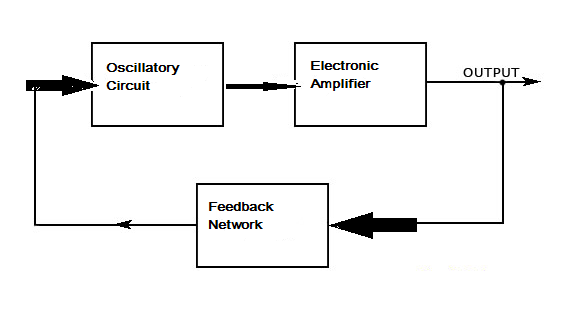
In a transistor an oscillator must have all three elements: oscillatory element or circuit, amplifier, and feedback network. The oscillating circuit or element consists of an inductor coil of inductance L that is connected in parallel with a capacitor of capacitance C. The frequency of oscillation in the circuit depends on the values of L and C.
The actual frequency of oscillation is the resonant or natural frequency and is given by
${\text{f}} = \dfrac{1}{{2\pi \sqrt {LC} }}$
where L is inductance of coil in henrys, and C is the capacitance of capacitor in farads.
The electronic amplifier gets dc power from the battery or dc power flexibly and changes over it into ac power for supply to the tank circuit. The motions happening in the circuit are applied to the input of the electronic amplifier. Due to the amplifying properties of the speaker, we get expanded yield of these oscillations. This amplified yield of oscillations is a direct result of dc power provided from the outer source (a battery or force flexibly). The output of the amplifier can be provided to the tank circuit to meet the losses.
The feedback network supplies a part of output power to the tank or oscillatory circuit in the correct phase to aid the oscillations. In other words the feedback circuit provides positive feedback.
Information: Sustained oscillation is a special type of vibration in which each cycle of vibration is similar to the previous cycle. In control theory, continuous vibration means that the vibration continues due to insufficient damping of the reaction path, the force acting is outside the system, but controlled by the system, maintains the periodic oscillation of the system at a period or frequency that is the natural period of the system. Here is an example of sustained oscillation, showing the behavior of a stock exhibiting sustained oscillation over the course of 12 time units.
Note:Transistors are semiconductor devices used to amplify or switch electronic signals and power. It is usually made of a semiconductor material with at least three terminals for connecting to external circuits.
Amplifiers are used to increase the amplitude of a signal waveform without changing other parameters of the waveform, such as frequency or waveform. These are one of the most commonly used circuits in electronic devices and perform different functions in a large number of electronic systems.
Complete answer:
In a transistor an oscillator must have all three elements: oscillatory element or circuit, amplifier, and feedback network. The oscillating circuit or element consists of an inductor coil of inductance L that is connected in parallel with a capacitor of capacitance C. The frequency of oscillation in the circuit depends on the values of L and C.
The actual frequency of oscillation is the resonant or natural frequency and is given by
${\text{f}} = \dfrac{1}{{2\pi \sqrt {LC} }}$
where L is inductance of coil in henrys, and C is the capacitance of capacitor in farads.
The electronic amplifier gets dc power from the battery or dc power flexibly and changes over it into ac power for supply to the tank circuit. The motions happening in the circuit are applied to the input of the electronic amplifier. Due to the amplifying properties of the speaker, we get expanded yield of these oscillations. This amplified yield of oscillations is a direct result of dc power provided from the outer source (a battery or force flexibly). The output of the amplifier can be provided to the tank circuit to meet the losses.
The feedback network supplies a part of output power to the tank or oscillatory circuit in the correct phase to aid the oscillations. In other words the feedback circuit provides positive feedback.
Information: Sustained oscillation is a special type of vibration in which each cycle of vibration is similar to the previous cycle. In control theory, continuous vibration means that the vibration continues due to insufficient damping of the reaction path, the force acting is outside the system, but controlled by the system, maintains the periodic oscillation of the system at a period or frequency that is the natural period of the system. Here is an example of sustained oscillation, showing the behavior of a stock exhibiting sustained oscillation over the course of 12 time units.
Note:Transistors are semiconductor devices used to amplify or switch electronic signals and power. It is usually made of a semiconductor material with at least three terminals for connecting to external circuits.
Amplifiers are used to increase the amplitude of a signal waveform without changing other parameters of the waveform, such as frequency or waveform. These are one of the most commonly used circuits in electronic devices and perform different functions in a large number of electronic systems.
Recently Updated Pages
Three beakers labelled as A B and C each containing 25 mL of water were taken A small amount of NaOH anhydrous CuSO4 and NaCl were added to the beakers A B and C respectively It was observed that there was an increase in the temperature of the solutions contained in beakers A and B whereas in case of beaker C the temperature of the solution falls Which one of the following statements isarecorrect i In beakers A and B exothermic process has occurred ii In beakers A and B endothermic process has occurred iii In beaker C exothermic process has occurred iv In beaker C endothermic process has occurred

Master Class 12 Social Science: Engaging Questions & Answers for Success
Master Class 12 Physics: Engaging Questions & Answers for Success
Master Class 12 Maths: Engaging Questions & Answers for Success
Master Class 12 Economics: Engaging Questions & Answers for Success
Master Class 12 Chemistry: Engaging Questions & Answers for Success
Three beakers labelled as A B and C each containing 25 mL of water were taken A small amount of NaOH anhydrous CuSO4 and NaCl were added to the beakers A B and C respectively It was observed that there was an increase in the temperature of the solutions contained in beakers A and B whereas in case of beaker C the temperature of the solution falls Which one of the following statements isarecorrect i In beakers A and B exothermic process has occurred ii In beakers A and B endothermic process has occurred iii In beaker C exothermic process has occurred iv In beaker C endothermic process has occurred
Master Class 12 Social Science: Engaging Questions & Answers for Success
Master Class 12 Physics: Engaging Questions & Answers for Success
Trending doubts
Which are the Top 10 Largest Countries of the World?
Draw a labelled sketch of the human eye class 12 physics CBSE
Differentiate between homogeneous and heterogeneous class 12 chemistry CBSE
What are the major means of transport Explain each class 12 social science CBSE
Sulphuric acid is known as the king of acids State class 12 chemistry CBSE
Why should a magnesium ribbon be cleaned before burning class 12 chemistry CBSE