




Derive the expression for the potential energy of a system of two charges in the absence of the external electric field.
Answer
 Verified
635.4k+ views
Hint: The potential energy of this system of charge is equal to total work done ,i.e., To move charge q$_{1}$ from infinity to A and charge q$_{2}$ from infinity to B. when we bring charge q$_{2}$ from infinity to point B, q$_{1}$ is also taken into account, whereas in case of q$_{1}$, the charge q$_{2}$ is not taken because there is no initial electric field.
Complete step-by-step answer:
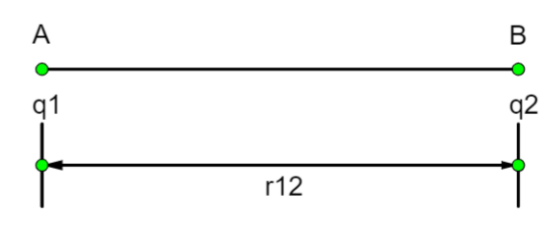
The work done to move q from infinity to A is, $W_1$
($\therefore $ There is no initial electric field hence work done to bring charge q$_{1}$ from infinity to A is zero)
The work done to move q$_{2}$ from infinity to B is, \[{W_1} = {V_1}{q_1}\]
Here,${V_1}$ is the electric potential at B due to ${q_1}$ , it is given by:
${V_1} = \dfrac{1}{{4\pi {\xi _ \circ }}}\left( {\dfrac{{{q_1}}}{{{r_{12}}}}} \right)$
$ \Rightarrow {W_2} = {V_1}{q_2} = {V_1} = \dfrac{1}{{4\pi {\xi _ \circ }}}\left( {\dfrac{{{q_1}}}{{{r_{12}}}}} \right){q_2}$
${W_2} = \dfrac{1}{{4\pi {\xi _ \circ }}}\left( {\dfrac{{{q_1}{q_2}}}{{{r_{12}}}}} \right)$
The potential energy of this system of charge is equal to total work done to bring the charges from infinity to A or B.
\[U = {W_1} + {W_2} = 0 + \dfrac{1}{{4\pi {\xi _ \circ }}}\left( {\dfrac{{{q_1}{q_2}}}{{{r_{12}}}}} \right)\]
$U = \left( {\dfrac{1}{{4\pi {\xi _ \circ }}}} \right)\left( {\dfrac{{{q_1}{q_2}}}{{r{}_{12}}}} \right)$
$U = K\left( {\dfrac{{{q_1}{q_2}}}{{{r_{12}}}}} \right)$. (Where,$K = \left( {\dfrac{1}{{4\pi {\xi _ \circ }}}} \right)$ )
Note: Generally students can go wrong in considering the work done to move charge q$_{1}$ from infinity to A where there is no external electric field working, the same goes for charge q$_{2}$ where actually the charge q$_{1}$ affects the work done. We can also consider q$_{2}$ as the first charge which comes into the system from infinity in that case q$_{1}$ will not affect the work done to bring the charge from infinity to B, but q$_{2}$ will affect work done to bring charge $q_{1}$ to A.
Complete step-by-step answer:
The work done to move q from infinity to A is, $W_1$
($\therefore $ There is no initial electric field hence work done to bring charge q$_{1}$ from infinity to A is zero)
The work done to move q$_{2}$ from infinity to B is, \[{W_1} = {V_1}{q_1}\]
Here,${V_1}$ is the electric potential at B due to ${q_1}$ , it is given by:
${V_1} = \dfrac{1}{{4\pi {\xi _ \circ }}}\left( {\dfrac{{{q_1}}}{{{r_{12}}}}} \right)$
$ \Rightarrow {W_2} = {V_1}{q_2} = {V_1} = \dfrac{1}{{4\pi {\xi _ \circ }}}\left( {\dfrac{{{q_1}}}{{{r_{12}}}}} \right){q_2}$
${W_2} = \dfrac{1}{{4\pi {\xi _ \circ }}}\left( {\dfrac{{{q_1}{q_2}}}{{{r_{12}}}}} \right)$
The potential energy of this system of charge is equal to total work done to bring the charges from infinity to A or B.
\[U = {W_1} + {W_2} = 0 + \dfrac{1}{{4\pi {\xi _ \circ }}}\left( {\dfrac{{{q_1}{q_2}}}{{{r_{12}}}}} \right)\]
$U = \left( {\dfrac{1}{{4\pi {\xi _ \circ }}}} \right)\left( {\dfrac{{{q_1}{q_2}}}{{r{}_{12}}}} \right)$
$U = K\left( {\dfrac{{{q_1}{q_2}}}{{{r_{12}}}}} \right)$. (Where,$K = \left( {\dfrac{1}{{4\pi {\xi _ \circ }}}} \right)$ )
Note: Generally students can go wrong in considering the work done to move charge q$_{1}$ from infinity to A where there is no external electric field working, the same goes for charge q$_{2}$ where actually the charge q$_{1}$ affects the work done. We can also consider q$_{2}$ as the first charge which comes into the system from infinity in that case q$_{1}$ will not affect the work done to bring the charge from infinity to B, but q$_{2}$ will affect work done to bring charge $q_{1}$ to A.
Recently Updated Pages
Master Class 12 Business Studies: Engaging Questions & Answers for Success

Master Class 12 Chemistry: Engaging Questions & Answers for Success
Master Class 12 Biology: Engaging Questions & Answers for Success
Class 12 Question and Answer - Your Ultimate Solutions Guide
Master Class 11 English: Engaging Questions & Answers for Success
Master Class 11 Social Science: Engaging Questions & Answers for Success
Trending doubts
Which are the Top 10 Largest Countries of the World?
Draw a labelled sketch of the human eye class 12 physics CBSE
Differentiate between homogeneous and heterogeneous class 12 chemistry CBSE
Differentiate between Pyramid of energy and pyramid class 12 biology CBSE
Why is the cell called the structural and functional class 12 biology CBSE
Draw the diagram of the pyramid of energy Explain In class 12 biology CBSE