




Derive the expression for the electric potential at any point along the axial line of an electric dipole?
Answer
 Verified
608.1k+ views
Hint: An electric potential is defined as the amount of work required to move a unit of electric charge from a reference to a specific point in an electric field without producing acceleration. The electric potential at a given point for a group of charges will be equal to the algebraic sum of the potentials due to individual charges. An electric dipole is an arrangement of two equal and opposite charges that are separated by a finite distance. Its units are coulomb-meter.
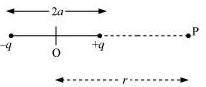
Let P be the axial point at a distance r from the center of the dipole. The Electric potential at point P is given as
$V$ = $V_1 + V_2$
Let $V_1$ and $V_2$ are the potentials at point P due to the charges $+q$ and $-q$ respectively.
$\therefore $ Then the Electric Potential, V $ = $ \[\dfrac{1}{{4\pi \varepsilon o}}\left( {(\dfrac{q}{{r - 2a}}) + (\dfrac{{ - q}}{{r + 2a}})} \right)\] $(\because V = \dfrac{1}{{4\pi \varepsilon o}}\dfrac{q}{r})$
Here $\varepsilon _0$ is the permittivity of the vacuum, q is the charge and r is the distance
$ \Rightarrow $V $ = $ $\dfrac{1}{{4\pi \varepsilon o}}\left( {\dfrac{{4aq}}{{({r^2} - 4{a^2})}}} \right)$
$ \Rightarrow $V $ = $ \[\dfrac{1}{{4\pi \varepsilon o}}\left( {\dfrac{{2P}}{{({r^2} - 4{a^2})}}} \right)\] $(\because qa = P/2)$
$\therefore $ The expression for the electric potential is V $ = $ $\dfrac{1}{{4\pi \varepsilon o}}\left( {\dfrac{{2P}}{{{r^2} - 4{a^2}}}} \right)$
Note: 1) The electric potential for a system of point charges will be equal to the sum of the point charges of the individual potentials.
2) The electric potential is a scalar quantity and has no direction. It is also called the electric field potential or electrostatic potential or potential drop.
3) Electric potential can also be defined as potential energy per unit charge.
4) The potential at an infinite distance is often taken to be zero.
5) Dipoles are mostly found in the molecular structures which are caused by the non-uniform charge distribution of protons and electrons.
Let P be the axial point at a distance r from the center of the dipole. The Electric potential at point P is given as
$V$ = $V_1 + V_2$
Let $V_1$ and $V_2$ are the potentials at point P due to the charges $+q$ and $-q$ respectively.
$\therefore $ Then the Electric Potential, V $ = $ \[\dfrac{1}{{4\pi \varepsilon o}}\left( {(\dfrac{q}{{r - 2a}}) + (\dfrac{{ - q}}{{r + 2a}})} \right)\] $(\because V = \dfrac{1}{{4\pi \varepsilon o}}\dfrac{q}{r})$
Here $\varepsilon _0$ is the permittivity of the vacuum, q is the charge and r is the distance
$ \Rightarrow $V $ = $ $\dfrac{1}{{4\pi \varepsilon o}}\left( {\dfrac{{4aq}}{{({r^2} - 4{a^2})}}} \right)$
$ \Rightarrow $V $ = $ \[\dfrac{1}{{4\pi \varepsilon o}}\left( {\dfrac{{2P}}{{({r^2} - 4{a^2})}}} \right)\] $(\because qa = P/2)$
$\therefore $ The expression for the electric potential is V $ = $ $\dfrac{1}{{4\pi \varepsilon o}}\left( {\dfrac{{2P}}{{{r^2} - 4{a^2}}}} \right)$
Note: 1) The electric potential for a system of point charges will be equal to the sum of the point charges of the individual potentials.
2) The electric potential is a scalar quantity and has no direction. It is also called the electric field potential or electrostatic potential or potential drop.
3) Electric potential can also be defined as potential energy per unit charge.
4) The potential at an infinite distance is often taken to be zero.
5) Dipoles are mostly found in the molecular structures which are caused by the non-uniform charge distribution of protons and electrons.
Recently Updated Pages
Master Class 12 Business Studies: Engaging Questions & Answers for Success

Master Class 12 Chemistry: Engaging Questions & Answers for Success
Master Class 12 Biology: Engaging Questions & Answers for Success
Class 12 Question and Answer - Your Ultimate Solutions Guide
Master Class 11 English: Engaging Questions & Answers for Success
Master Class 11 Social Science: Engaging Questions & Answers for Success
Trending doubts
When was the first election held in India a 194748 class 12 sst CBSE
The first microscope was invented by A Leeuwenhoek class 12 biology CBSE
The first general election of Lok Sabha was held in class 12 social science CBSE
The first general election of Lok Sabha was held in class 12 social science CBSE
In an ecosystem which of the following shows oneway class 12 biology CBSE
Who is the father of zoology A Aristotle B Theophrastus class 12 biology CBSE