




Derive the expression for capacitance of parallel plate capacitor.
Answer
 Verified
613.8k+ views
Hint: For a parallel plate capacitor charge density is opposite for both the plates. And the electric field between the plates is directed from positive to negatively charged plate. This electric field will give the value of potential difference between the plates. Use that to find the capacitance.
Formula Used:
Electric field at a point in front of an infinite charged sheet is:
$E = \dfrac{\sigma }{{2{\varepsilon _0}}}$ (1)
Where,
E is the value of electric field,
$\sigma $ is charge density of the plate,
${\varepsilon _0}$ is the permittivity of vacuum.
Potential difference between two plates is given as:
$V = Ed$ (2)
Where,
V is the potential difference between the plates,
E is the electric field between the plates,
d is distance between the plates.
Charge stored in a capacitor is given by:
$Q = CV$ (3)
Where,
Q is total charge stored,
C is the capacitance of the capacitor.
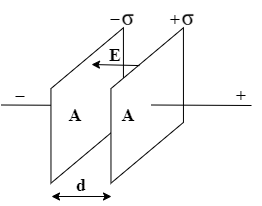
Complete step by step answer:
Assumption: Area of each plate is A. So we get $\sigma = \dfrac{Q}{A}$.
To find: Capacitance C of the parallel plate capacitor.
Step 1
To find the total electric field between the plates first you need to find the field direction for each plate’s field. At any point within the plates direction of electric field due to each plate must be opposite as they are in opposite directions from the point. But here, the charge densities of each plate is different. Hence, using eq.(1) get the total field E within the plates as:
\[E = \dfrac{\sigma }{{2{\varepsilon _0}}} - \dfrac{{( - \sigma )}}{{2{\varepsilon _0}}} = \dfrac{\sigma }{{{\varepsilon _0}}}\] (4)
Step 2
Now, substitute the value of E and $\sigma $from eq.(4) into eq.(2) to get the potential difference as:
$
V = Ed = \dfrac{{\sigma d}}{{{\varepsilon _0}}} \\
\therefore V = \dfrac{{\tfrac{Q}{A}d}}{{{\varepsilon _0}}} = \dfrac{{Qd}}{{{\varepsilon _0}A}} \\
$ (5)
Step 3
Use the value of V obtained in eq.(5) in eq.(3) to get the value of C as:
$
Q = C \times \dfrac{{Qd}}{{{\varepsilon _0}A}} \\
\Rightarrow 1 = C \times \dfrac{d}{{{\varepsilon _0}A}} \\
\therefore C = \dfrac{{{\varepsilon _0}A}}{d} \\
$
Final answer:
The expression for the capacitance for parallel plate capacitor is $C = \dfrac{{{\varepsilon _0}A}}{d}$.
Note: While doing the derivation we have used the formula for infinite charged sheet but these capacitor plates have finite dimension. Here, the electric field remains uniform straight line perpendicular to the plates but at the edges they take rounded shape and show non-uniform nature. This effect is known as the fringing effect. But practically this doesn’t affect much at the value of the capacitance.
Formula Used:
Electric field at a point in front of an infinite charged sheet is:
$E = \dfrac{\sigma }{{2{\varepsilon _0}}}$ (1)
Where,
E is the value of electric field,
$\sigma $ is charge density of the plate,
${\varepsilon _0}$ is the permittivity of vacuum.
Potential difference between two plates is given as:
$V = Ed$ (2)
Where,
V is the potential difference between the plates,
E is the electric field between the plates,
d is distance between the plates.
Charge stored in a capacitor is given by:
$Q = CV$ (3)
Where,
Q is total charge stored,
C is the capacitance of the capacitor.
Complete step by step answer:
Assumption: Area of each plate is A. So we get $\sigma = \dfrac{Q}{A}$.
To find: Capacitance C of the parallel plate capacitor.
Step 1
To find the total electric field between the plates first you need to find the field direction for each plate’s field. At any point within the plates direction of electric field due to each plate must be opposite as they are in opposite directions from the point. But here, the charge densities of each plate is different. Hence, using eq.(1) get the total field E within the plates as:
\[E = \dfrac{\sigma }{{2{\varepsilon _0}}} - \dfrac{{( - \sigma )}}{{2{\varepsilon _0}}} = \dfrac{\sigma }{{{\varepsilon _0}}}\] (4)
Step 2
Now, substitute the value of E and $\sigma $from eq.(4) into eq.(2) to get the potential difference as:
$
V = Ed = \dfrac{{\sigma d}}{{{\varepsilon _0}}} \\
\therefore V = \dfrac{{\tfrac{Q}{A}d}}{{{\varepsilon _0}}} = \dfrac{{Qd}}{{{\varepsilon _0}A}} \\
$ (5)
Step 3
Use the value of V obtained in eq.(5) in eq.(3) to get the value of C as:
$
Q = C \times \dfrac{{Qd}}{{{\varepsilon _0}A}} \\
\Rightarrow 1 = C \times \dfrac{d}{{{\varepsilon _0}A}} \\
\therefore C = \dfrac{{{\varepsilon _0}A}}{d} \\
$
Final answer:
The expression for the capacitance for parallel plate capacitor is $C = \dfrac{{{\varepsilon _0}A}}{d}$.
Note: While doing the derivation we have used the formula for infinite charged sheet but these capacitor plates have finite dimension. Here, the electric field remains uniform straight line perpendicular to the plates but at the edges they take rounded shape and show non-uniform nature. This effect is known as the fringing effect. But practically this doesn’t affect much at the value of the capacitance.
Recently Updated Pages
Master Class 12 Business Studies: Engaging Questions & Answers for Success

Master Class 12 Biology: Engaging Questions & Answers for Success
Master Class 12 Chemistry: Engaging Questions & Answers for Success
Class 12 Question and Answer - Your Ultimate Solutions Guide
Master Class 11 Social Science: Engaging Questions & Answers for Success
Master Class 11 English: Engaging Questions & Answers for Success
Trending doubts
Which are the Top 10 Largest Countries of the World?
Draw a labelled sketch of the human eye class 12 physics CBSE
Name the crygenes that control cotton bollworm and class 12 biology CBSE
Differentiate between homogeneous and heterogeneous class 12 chemistry CBSE
Ribosomal RNA is actively synthesised in A Nucleoplasm class 12 biology CBSE
How many molecules of ATP and NADPH are required information class 12 biology CBSE